



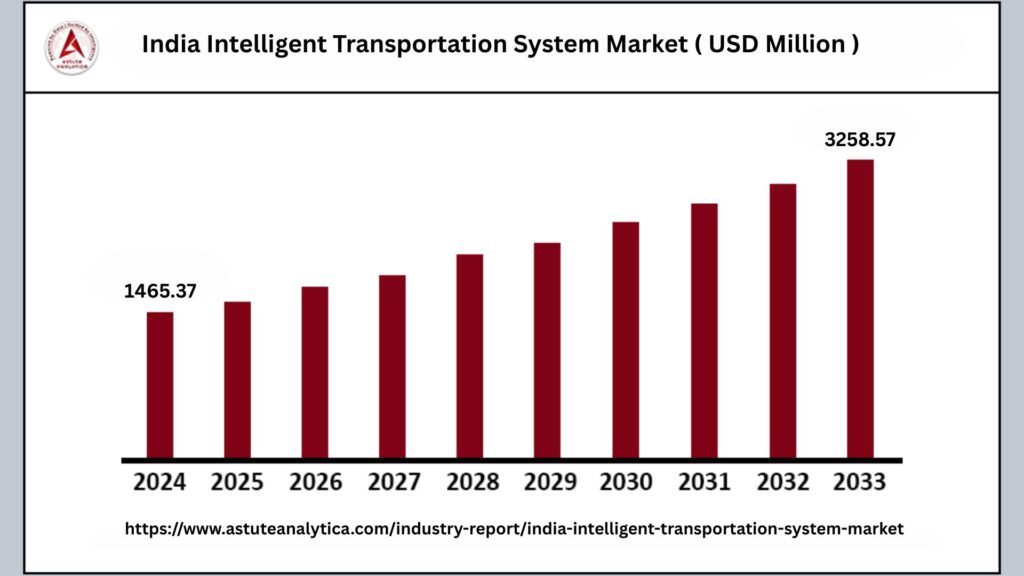
The India intelligent transportation system market was valued at US$ 11,465.37 million in 2024 and is projected to reach US$ 3,258.57 million by 2033, reflecting a Compound Annual Growth Rate (CAGR) of 9.87% during the forecast period from 2025 to 2033.
An Intelligent Transportation System (ITS) is a sophisticated blend of technology and automation designed to enhance the safety, efficiency, and sustainability of transportation networks. By integrating advanced components such as sensors, communication networks, and data processing units, ITS enables the seamless management of traffic flows, provides real-time travel information to commuters, and optimizes overall transportation operations.
In India, the intelligent transportation system market is poised for significant expansion, driven by several key factors. The rapid development of digital infrastructure across the country has laid the foundation for widespread ITS adoption, enabling more effective deployment of connected technologies. Additionally, government policy incentives aimed at modernizing transportation networks and addressing urban mobility challenges provide strong support for ITS initiatives. The increasing pressures of urbanization, characterized by growing populations and expanding cities, further intensify the demand for efficient traffic management and sustainable transit solutions.
India Intelligent Transportation System Market Key Takeaways
- By component, the India Intelligent Transportation System market is predominantly driven by the hardware segment, which holds a commanding 63.31% share.
- In terms of system type, the Advanced Traffic Management System (ATMS) emerges as the leading solution within the India ITS market, capturing over 35.86% of the market share.
- When considering end users, the public sector is the major contributor, accounting for more than 42.52% of the total market revenue.
- Regarding applications, roadways dominate the India Intelligent Transportation System market with a substantial share of 43.90%.
Top Trends Escalating the India Intelligent Transportation System Market
Expansion of AI-Driven Traffic Management Systems in Metropolitan Cities: Metropolitan cities in India are witnessing a rapid expansion of AI-driven traffic management systems designed to tackle the growing challenges of urban congestion and road safety. These systems leverage artificial intelligence algorithms to analyze real-time traffic data, predict congestion patterns, and optimize signal timings. By automating decision-making processes, AI-powered traffic management enhances traffic flow, reduces delays, and minimizes accidents.
Adoption of IoT-Based Real-Time Vehicle Tracking and Monitoring Solutions: The adoption of Internet of Things (IoT) technology plays a crucial role in advancing intelligent transportation systems across India. Real-time vehicle tracking and monitoring solutions enabled by IoT devices allow authorities and fleet operators to gather accurate data on vehicle locations, speeds, and operational status. This continuous flow of information enhances traffic management, improves fleet efficiency, and facilitates rapid incident response.
Integration of ITS with EV Charging Stations and Renewable Energy Sources: The integration of intelligent transportation systems with electric vehicle (EV) charging infrastructure and renewable energy sources is an emerging trend shaping the future of sustainable transportation in India. ITS technologies are increasingly being deployed to monitor and manage EV charging stations, optimizing energy usage and reducing wait times for users. By combining ITS with renewable energy, such as solar or wind power, cities aim to minimize the carbon footprint associated with transportation.
Accelerated Government Funding under Smart Cities Mission for ITS Projects: Government initiatives, particularly the Smart Cities Mission, are accelerating funding and support for ITS projects nationwide. These programs allocate substantial budgets to develop cutting-edge transportation infrastructure that incorporates intelligent systems for traffic management, safety enhancement, and commuter convenience. The infusion of government capital facilitates the deployment of advanced technologies and encourages collaboration between public agencies and private sector players.
Growing Urban Population Demanding Efficient and Sustainable Transportation Solutions: India’s expanding urban population is exerting significant pressure on existing transportation networks, creating an urgent demand for efficient and sustainable mobility solutions. As more people migrate to cities for economic opportunities, traffic congestion, pollution, and infrastructure strain have intensified. Intelligent transportation systems offer critical tools to manage this growth by optimizing traffic flow, promoting multimodal transport options, and reducing environmental impact.
Increasing Private Sector Investments in ITS Technologies and Infrastructure: Private sector investments in intelligent transportation systems are rising steadily, reflecting growing confidence in the market’s potential and the strategic importance of modernizing India’s transport infrastructure. Companies across technology, automotive, and infrastructure domains are channeling funds into developing innovative ITS solutions, such as smart sensors, data analytics platforms, and connected vehicle technologies. These investments facilitate research and development, pilot projects, and large-scale deployments, accelerating the commercialization and adoption of ITS.
India Intelligent Transportation System Market Segmentation
By Component
The India Intelligent Transportation System (ITS) market is predominantly driven by the hardware segment, which holds a commanding market share of approximately 63.31%. This dominance underscores the fundamental importance of hardware components in establishing and maintaining the infrastructure required for effective ITS deployment. Hardware elements serve as the foundational backbone of ITS, enabling critical functions such as data collection, real-time processing, and seamless communication across both urban and rural transportation networks.
In 2024, the demand for ITS hardware has witnessed a significant surge, largely fueled by extensive government-led infrastructure projects aimed at modernizing India’s transportation landscape. These initiatives often involve the installation of a wide array of hardware devices, including traffic cameras, sensors, communication modules, and control systems, all of which are essential for monitoring and managing traffic flow efficiently.
By System Type
In the India intelligent transportation system market, the Advanced Traffic Management System (ATMS) has emerged as the leading system type, commanding a significant market share of over 35.86%. This dominant position can be attributed to ATMS’s exceptional capability to optimize traffic flow, reduce congestion, and enhance overall road safety. As urban populations continue to swell and vehicular density increases on both city streets and highway networks, the need for sophisticated traffic management solutions becomes increasingly critical.
The demand for ATMS is especially pronounced in densely populated urban centers such as Delhi, Mumbai, and Bengaluru, where traffic congestion often leads to significant delays, increased pollution, and a higher risk of accidents. These metropolitan areas experience heavy vehicle volumes during peak hours, requiring dynamic traffic signal controls, incident detection, and efficient incident response mechanisms that ATMS systems can deliver.
By End User
The India intelligent transportation system (ITS) market is currently dominated by the public sector, which serves as a fundamental driver behind the widespread adoption and implementation of ITS technologies across the country. Government agencies and public institutions have taken the lead in integrating intelligent transportation solutions as part of their efforts to modernize and enhance the nation’s transportation infrastructure. Through the initiation of large-scale infrastructure projects such as smart highways, urban traffic management systems, and integrated public transit networks, the public sector is actively shaping the future of transportation in India.
This leadership role is further reinforced by strong policy support and regulatory frameworks that encourage the deployment of ITS technologies. Government initiatives aimed at improving road safety, reducing traffic congestion, and promoting sustainable urban mobility have created a favorable environment for ITS growth. These policies often come with dedicated funding and strategic roadmaps that prioritize intelligent transportation as a key component of national development plans.
By Application
The India Intelligent Transportation System (ITS) market is heavily influenced by the dominance of roadways, which constitute a significant 43.90% share of the overall transport sector. This prominence is largely attributed to India’s vast and intricate road network, which serves as the backbone for the country’s transportation infrastructure. The extensive reach of roadways connects urban centers, rural areas, and industrial hubs, making it the primary mode of transport for passengers and freight.
Recent Developments in the India Intelligent Transportation System Market
- IKIO Technologies and Bitsensing Collaborate on AI-Powered Traffic Monitoring in India: In July 2025, Indian smart infrastructure solutions provider IKIO Technologies announced a strategic partnership with South Korean startup Bitsensing to introduce advanced AI-powered traffic monitoring technology across India. This collaboration targets expressways, highways, and urban areas as part of the government’s Smart City Initiative. The joint deployment will begin with a pilot project on the Delhi–Mumbai Expressway, utilizing BitSensing’s TIMOS (Traffic Insight Monitoring Sensor) combined with an AI-based analytics server and a local edge server.
- Nagpur’s Pilot of a Unified Contactless Token for Urban Mobility: Earlier, in January 2024, the city of Nagpur successfully completed a pilot test involving a single contactless token priced at just US$6. This token was designed to offer seamless access across multiple modes of urban transportation, including metro rail services, feeder e-autos, and municipal parking facilities. The pilot engaged 240 commuters over the course of the month, demonstrating the token’s ability to simplify fare payments and improve the commuter experience by integrating several transport modes into one convenient solution.
Key Players in the India Intelligent Transportation System Market
- Denso Corporation
- CISCO
- Indra Sistemas
- Garmin International Inc
- Hitachi, Ltd.
- IBM Corporation
- Bosch
- Siemens AG
- Thales Group
- TomTom N.V.
- Schneider Electric
- Other prominent players
Market Segmentation Overview
By Component
- Hardware
- Monitoring & Detection
- Number Plate Recognition System
- Signal Control Systems
- Inductive Loop Detectors
- Magnetic Detectors
- Acoustic Detectors
- Others
- Surveillance
- Thermal Camera
- AID Cameras
- Video Imaging
- Sensors
- Speed Sensor
- Temperature Sensor
- Motion Sensor
- Weather Condition Sensor
- Other Sensors
- Telecommunication
- Fiber Optics
- Copper Lines
- Wireless Communication
- Others
- Software
- Cloud-Based
- On-Premises
- Services
- Managed Services
- Professional Services
By System Type
- Advanced Traveler Information System (ATIS)
- Advanced Traffic Management System (ATMS)
- Advanced Transportation Pricing System (ATPS)
- Advanced Public Transportation System (APTS)
- Emergency Medical System (EMS)
By Application
- Roadways
- Intelligent Traffic Control
- Traffic Monitoring
- Traffic Signal Control
- Traffic Enforcement Cameras
- Variable Traffic Message Signboards
- Emergency Vehicle Notification
- Automotive Telematics
- Collision Avoidance
- Parking Management
- Fleet Management & Asset Monitoring
- Passenger Information Management
- Ticketing Management
- Others
- Railways
- Rail Running Operation
- Collision Avoidance
- Security & Surveillance
- Passenger Information Management
- Smart Ticketing
- Emergency Notification
- Others
- Airways
- Security & Surveillance
- Passenger Information Management
- Smart Ticketing
- Shuttle Bus Tracking
- Aircraft Management
- Emergency Notification
- Others
- Waterways
- Real Time Weather Information Tracking
- Container Movement Scheduling
- Freight Arrival & Transit
- Emergency Notification
- Others
By End Users
- Public Sector
- Commercial Sector
- Private Vehicle User
- Emergency Service
- Infrastructure Operators