


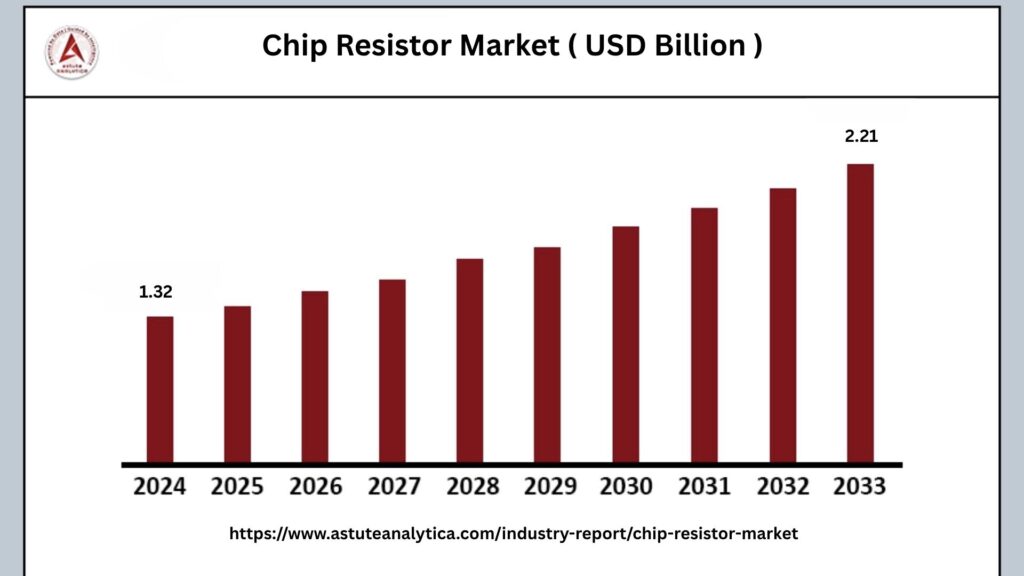
The global chip resistor market was valued at US$ 1.32 billion in 2024 and is projected to reach US$ 2.21 billion by 2033, reflecting a Compound Annual Growth Rate (CAGR) of 5.9% during the forecast period from 2025 to 2033.
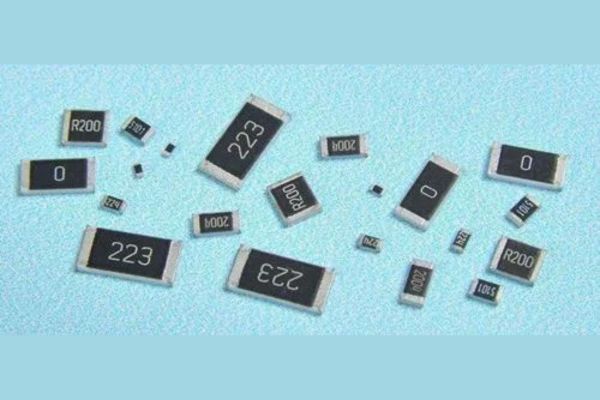
Chip resistors, also referred to as surface-mount device (SMD) resistors, are small rectangular components essential to modern electronic circuits. Their primary function is to regulate current and voltage, ensuring that electronic devices operate safely and efficiently. These miniature components are designed to be mounted directly onto printed circuit boards (PCBs), making them ideal for compact and densely packed electronic systems.
The chip resistor market has been experiencing significant growth, fueled by several influential factors. A major driver is the rising demand for consumer electronics, including smartphones, tablets, laptops, and wearable devices. As these products become increasingly sophisticated, they require more advanced and miniaturized components to maintain performance while reducing size and power consumption.
Chip Resistor Market Key Takeaways
- In 2023, the consumer electronics sector generated a substantial $6.4 billion in chip resistor revenue, significantly outpacing other industries such as automotive and industrial applications.
- By type, thick-film chip resistors dominate the market, commanding an 87% share of units sold and accounting for 46% of the revenue within the chip resistor segment.
Regional Analysis
Asia-Pacific Dominance in the Chip Resistor Market
The Asia-Pacific region holds a commanding position in the global chip resistor market, accounting for over 41% of the total market share and shipping an impressive 2.16 trillion chip resistors in 2024 alone. This dominant output far surpasses the combined production of other regions, highlighting the region’s critical role in the electronics supply chain.
- Growing Demand from Consumer Electronics: The surge in demand for consumer electronics, including smartphones, laptops, and wearable technology, is a major driver of the chip resistor market in Asia-Pacific. As consumers in these countries and beyond seek more advanced, compact, and energy-efficient devices, manufacturers require a steady supply of high-performance chip resistors to meet these specifications.
- Expansion Fueled by IoT and Smart Technologies: The increasing adoption of the Internet of Things (IoT) and the proliferation of smart homes and buildings are further accelerating the chip resistor market in Asia-Pacific. IoT devices, which connect everyday objects to the internet for enhanced functionality and automation, depend heavily on reliable, miniaturized electronic components such as chip resistors.
- Robust Electronics Manufacturing Ecosystem: Countries like Japan, China, and South Korea boast strong and rapidly developing electronics manufacturing sectors, supported by extensive supply chains and advanced production facilities. These nations serve as the backbone of the chip resistor market, hosting numerous manufacturers that benefit from economies of scale and technological expertise.
Europe’s Prominent Role in the Chip Resistor Market
Europe represents a vital market for chip resistors, supported by a well-established electronics industry and a strong consumer base for electronic devices. The region hosts numerous electronics manufacturers and technology firms that contribute to steady demand for advanced components like chip resistors.
- Rising Demand Fueled by Mobile Devices: The increasing usage of smartphones, laptops, and other mobile devices across Europe is a significant factor boosting demand for chip resistors. As consumers seek more powerful, compact, and energy-efficient gadgets, the need for high-quality resistors that can meet stringent power and thermal management requirements grows accordingly.
- Growing Popularity of IoT Applications: The Internet of Things (IoT) is gaining considerable traction in Europe, further stimulating demand for chip resistors. IoT applications span across smart cities, industrial automation, healthcare, and home automation, all of which rely on connected devices embedded with compact and reliable electronic components. Chip resistors play a crucial role in managing power and signal integrity within these IoT devices, supporting their functionality in diverse environments.
North America as a Key Market for Chip Resistors
North America stands out as a significant market for chip resistors, driven by the region’s strong presence of electronics manufacturers and a robust demand for advanced electronic devices. It is mainly U.S. and Canadian companies that make technology products.
- Growing Adoption of Smart Homes and Wearable Technology: The increasing adoption of smart homes and smart buildings in North America is playing a pivotal role in expanding the chip resistor market. Connected devices that manage lighting, security, climate, and energy efficiency rely heavily on chip resistors to ensure precise power management and stable operation. Likewise, wearable technology such as fitness trackers, smartwatches, and health monitoring devices is becoming more popular among consumers.
- Industrial Demand from Automotive and Aerospace Sectors: Beyond consumer electronics, industrial sectors such as automotive and aerospace contribute substantially to the chip resistor market in North America. The automotive industry is rapidly evolving with the integration of electric vehicles, advanced driver-assistance systems (ADAS), and autonomous driving technologies, all of which depend on high-performance chip resistors for sensors, control units, and power management.
Top Trends Escalating Chip Resistor Market
Miniaturization of Chip Resistors: The trend toward miniaturization in electronic components is accelerating, driven by the demand for smaller, more powerful devices across various industries. Chip resistors are no exception, with manufacturers focusing on reducing their size while enhancing performance to meet the needs of advanced applications. Miniaturized resistors enable the design of compact electronic devices such as smartphones, wearables, and medical implants, where space is at a premium.
Increasing Adoption of Thick-Film Resistors: Thick-film resistors are gaining significant traction in the automotive and industrial sectors due to their robustness and reliability under harsh operating conditions. These resistors are well-suited for applications where high power dissipation, temperature tolerance, and durability are essential. In automotive systems, thick-film resistors are widely used in sensors, engine controls, and safety devices, ensuring consistent performance despite the demanding environment.
Integration of AI and 5G Technologies: The rapid advancement of AI and 5G technologies is driving innovation in resistor design and functionality. These technologies require highly reliable, precise, and fast-responding electronic components to support complex signal processing and high-frequency communication. Chip resistor manufacturers are responding by developing specialized resistors that can handle increased power loads and operate efficiently at higher frequencies.
Escalating Demand for Compact Devices in Consumer Electronics and IoT: Consumer electronics and Internet of Things (IoT) devices are driving a surge in demand for compact, energy-efficient components. Chip resistors play a pivotal role in these devices by managing power and ensuring thermal stability within limited space constraints. As consumers seek smaller gadgets with enhanced capabilities—ranging from smartwatches to home automation sensors—the need for resistors that combine miniaturization with high performance grows.
Rising Adoption of Chip Resistors in EVs and Autonomous Vehicles: The electric vehicle (EV) and autonomous vehicle markets are expanding rapidly, creating new opportunities for chip resistor applications. These vehicles rely heavily on sophisticated electronics for battery management, sensor systems, powertrain control, and autonomous navigation. Chip resistors used in these systems must endure wide temperature ranges, vibration, and high electrical loads, all while maintaining precision and reliability.
Expansion of Data Centers: The ongoing expansion of data centers worldwide is fueling a growing demand for high-performance chip resistors. Data centers require components capable of handling substantial power levels and maintaining stable operation under continuous heavy workloads. High-performance resistors contribute to effective power management, thermal regulation, and signal integrity within servers and networking equipment.
Chip Resistor Market Segmentation
By Application
In 2023, the consumer electronics sector generated an impressive $6.4 billion in chip resistor revenue, significantly outpacing the automotive and industrial sectors, according to IDC. This substantial revenue lead is primarily driven by the sheer volume of devices produced and sold worldwide. The rapid development and widespread adoption of personal electronics—including computers, tablets, smartphones, and wearables—have positioned consumer electronics as the dominant force in the chip resistor market.
The growth of this sector is fueled by the increasing complexity and functionality of consumer devices. As gadgets become more compact and packed with advanced features, the demand for chip resistors that can meet stringent power management and thermal requirements has surged. These resistors play a critical role in ensuring that devices operate efficiently without overheating, which is essential for maintaining battery life and overall device reliability.
By Type
Thick-film chip resistors hold a dominant position in the chip resistor market, commanding an impressive 87% share of units sold and accounting for 46% of the total revenue. This strong market presence is largely driven by their production scalability, enabling manufacturers to meet high-volume demands efficiently and cost-effectively. The wide range of applications for thick-film resistors further strengthens their market position, as they are integral components in popular consumer electronics such as smartphones and notebooks, as well as in LED drivers and various white goods.
Beyond their versatility, thick-film chip resistors are highly valued for their reliability and durability, especially in harsh operating environments. This resilience makes them particularly well-suited for critical automotive applications, where components must consistently perform under extreme temperature fluctuations, vibrations, and other challenging conditions. Within the automotive sector, thick-film resistors are extensively used in a variety of essential functions.
Recent Developments in the Chip Resistor Market
- Vishay Expands CHA Series with Compact 0402: In July 2025, Vishay Intertechnology, Inc. expanded its CHA series of AEC-Q200 qualified thin film chip resistors by introducing new devices in the compact 0402 case size. These CHA0402 resistors offer a wide range of resistance values from 10 Ω to 500 Ω and deliver high-frequency performance up to 50 GHz. Designed for demanding applications, they are suitable for automotive, telecom, medical, space, avionics, and military sectors.
- Bourns Introduces High Heat Tolerance Thick Film Resistors: In July 2025, Bourns, Inc. announced the launch of a new thick film resistor series that provides exceptional heat tolerance within a compact TO-227 package. The Riedon PF2270 Series Power Film Resistors leverage thick film technology to achieve superior power dissipation and excellent pulse handling. These resistors can handle up to 300 W of power dissipation when used with a heatsink, making them ideal for high-power applications.
- TT Electronics Launches New MELF Wirewound Resistor Series: In June 2025, UK-based TT Electronics unveiled two new product series: FMW fusible MELF wirewound resistors and HSMW high surge MELF wirewound resistors. Both series come in the 0309 size and are rated for 1W with UL1412 fusing capability up to 240V. The FMW series is engineered for fast fusing performance, while the HSMW series is designed to withstand large inrush currents or power line surges, addressing critical protection needs.
- ROHM Semiconductor Expands General-Purpose Chip Resistor Portfolio: In February 2025, ROHM Semiconductor announced an expanded portfolio of general-purpose chip resistors under its MCRx family. This new lineup focuses on greater miniaturization and enhanced performance across diverse applications. Among the additions are the high-power MCRS series and the low-resistance, high-power MCRL series, offering designers more options for efficient and compact resistor solutions.
Top Companies in the Chip Resistor Market
- Bourns Inc.
- International Manufacturing Services, Inc.
- KOA Speer Electronics Inc.
- Littelfuse, Inc.
- Panasonic Industry Co., Ltd.
- ROHM Co., Ltd
- Samsung Electro-Mechanics
- Susumu Co., Ltd.
- TE Connectivity
- Tzai Yuan Enterprise Co. Ltd.
- Viking Tech Corporation
- Vishay Intertechnology, Inc.
- YAGEO Group
- Other Prominent Players
Market Segmentation Overview
By Type
- Thick Film
- Thin Film
- Others
By Application
- Consumer Electronics
- Automotive
- Industrial
- Aerospace & Defense
- Healthcare
- Others
By Geography
- North America
- Europe
- Asia-Pacific
- Latin America
- Middle East and Africa