

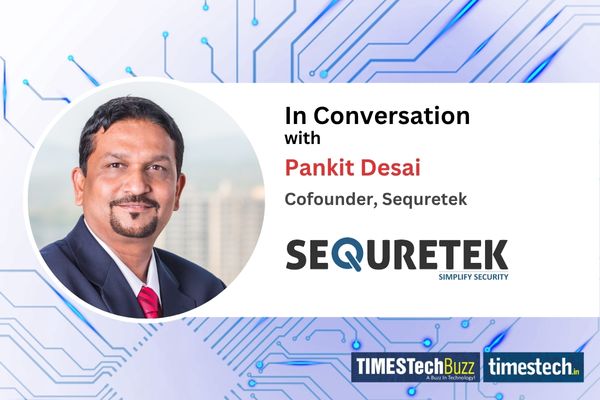
In an interview with TimesTech, Pankit Desai, Co-founder of Sequretek, reflects on the evolving cyber threat landscape and how Sequretek is tackling it through its AI-driven Percept platform. He shares insights into their latest offering, Percept CTEM, the role of AI in cyber defense, and how proactive cybersecurity is essential in an era of rising digital complexity, AI-powered threats, and industry-specific vulnerabilities.
Read the full interview here:
TimesTech: Sequretek has now been in operation for over a decade. How have you seen the behavior of cyber threat actors evolve over the past 12 years? What are some of the key upgrades in the threat landscape?
Pankit: Every wave of digital transformation has brought new cybersecurity challenges, expanding the threat landscape and demanding smarter defenses. Over the past 12 years, cyberthreats have evolved from opportunistic intrusions to sophisticated, persistent campaigns. What was once the domain of isolated hackers is now an organized, monetized industry fueled by geopolitical agendas and underground economies.
The Internet wave introduced global connectivity, but also removed geographical barriers for attackers, making every connected device a potential target. The Mobile wave empowered users with on-the-go access through smartphones and tablets. However, these devices often bypassed traditional security perimeters, increasing exposure and risk. With the Cloud wave, data centers moved to the cloud, delivering agility and decentralization. Misconfigured services and exposed interfaces gave attackers easier access to enterprise environments. The IT/OT convergence wave connected operational technology to IT networks. Systems that were once isolated like industrial controls became susceptible to attacks that could disrupt critical operations. Then came the Big Data wave, where vast volumes of sensitive information were collected and processed. This created a rich target environment for attackers seeking to steal or manipulate high-value data. And now, we’re in the age of AI with both promises and pitfalls.
The biggest pitfall we’ve observed is the weaponization of AI, where attackers use generative models to craft believable phishing emails, deepfake identities, and polymorphic malware that constantly changes its signature to evade detection. Ransomware-as-a-Service has commoditized extortion, and supply chain attacks have blurred the perimeter altogether. The rise of zero-day exploits, fileless malware, and insider threats has further complicated an already dynamic landscape.
TimesTech: As a global cybersecurity service provider today, what are the new solutions or offerings that Sequretek is bringing to the market?
Pankit: Sequretek’s latest innovation, Percept CTEM, redefines how organizations identify, assess, and respond to cyber risks in real time. At its core, Percept CTEM is designed to eliminate blind spots. It offers complete visibility into every digital asset, be it critical infrastructure or an overlooked asset, by continuously monitoring the organization’s entire attack surface. Guided by the principle that every asset matters, it recognizes that even the smallest, seemingly insignificant asset could be the launchpad for a devastating breach.
In parallel, Sequretek addresses another critical challenge: Compliance Management. Today’s enterprises grapple with an overwhelming regulatory landscape and disparate tools, some focused on assessments, others on managing policies leaving companies struggling to achieve a unified view. To bridge this gap, we introduced the Percept Compliance Manager, delivering a single, integrated dashboard for streamlined oversight and control.
Adding another layer of proactive defense, Percept Deception Services is an advanced security solution designed to detect, mislead, and neutralize attackers before they compromise critical assets. By deploying decoys and traps across the network, it creates a deceptive environment that diverts adversaries away from real systems. Every interaction with these decoys provides high-fidelity alerts, offering security teams actionable intelligence on attacker behavior, tactics, and techniques without impacting business operations. Seamlessly integrating with Sequretek’s Percept security suite, this service enhances threat detection, reduces dwell time, and strengthens your overall defense strategy against sophisticated attacks.
TimesTech: Could you elaborate on the unique features of your flagship platform, Percept CTEM, and how its 24/7 surveillance capabilities set it apart from other solutions?
Pankit: Percept CTEM stands at the forefront of next-generation cybersecurity with a bold, proactive philosophy: every asset matters. Unlike traditional tools that operate reactively or in silos, Percept CTEM delivers continuous threat exposure management across the entire digital landscape, working around the clock to keep organizations ahead of adversaries.
What makes Percept CTEM truly unique is its 24/7 surveillance capability, which doesn’t just monitor, but validates your security posture in real time. It constantly scans the environment to uncover hidden vulnerabilities, shadow assets, misconfigurations, and risky user behaviors elements often missed by periodic assessments. This continuous loop of detection and validation ensures that no lapse in visibility becomes an entry point for attack.
But Percept CTEM goes beyond detection. It leverages AI-powered analytics and business-contextual intelligence to prioritize threats that matter most. Instead of flooding security teams with alerts, it ranks exposures based on potential business impact, guiding faster and smarter decisions. For example, it will flag a vulnerability in a public-facing application handling customer data as a higher priority than one in a non-critical test environment.
Another standout feature is its integration-first design. Percept CTEM doesn’t operate in a vacuum; it’s purpose-built to work seamlessly with third-party tools and the broader Sequretek Percept Suite, including XDR & NG SIEM, EDR, Identity, and Compliance Manager. This creates an intelligent, centralized layer of cyber awareness that fortifies your defense posture without increasing operational complexity.
TimesTech: With the rise of Generative AI and broader AI technologies, how has their integration transformed the cybersecurity landscape? How is Sequretek leveraging this shift?
Pankit: The advent of Generative AI has marked a turning point in cybersecurity both in how attacks are launched and how defenses are built. On one hand, adversaries are weaponizing AI to automate phishing campaigns, create deepfakes, and orchestrate sophisticated social engineering attacks. On the other hand, AI, when applied thoughtfully, can be a force multiplier for cyber defense. Sequretek stands at the forefront of this transformation.
At the heart of Sequretek’s offering is the Percept platform that deeply integrates AI and Gen AI technologies to automate, accelerate, and elevate every aspect of cybersecurity. From threat detection to incident response, the Percept suite uses AI to turn vast amounts of raw data into real-time insights, helping security teams act with speed and precision.
AI’s impact is most visible in features like natural language and voice-based search, eliminating the need for complex query languages when navigating log data. It also powers adaptive response playbooks that automatically map threats to pre-built mitigation strategies. In case management, AI-driven chat interfaces help streamline workflows, while autonomous parsing eliminates the burden of creating device-specific log parsers, allowing faster onboarding and more accurate threat correlation.
For instance, through analytical AI models, Percept XDR & NG SIEM enables proactive threat hunting, attack path simulations, and vulnerability-based exposure management. These capabilities are woven into an intelligent SOAR (Security Orchestration, Automation, and Response) layer that responds autonomously to known threats, reducing human fatigue and response time.
In a world where threat actors are leveraging AI, Sequretek is ensuring defenders aren’t left behind. By embedding AI deeply in detection, decision-making, and response, the Percept suite transforms cybersecurity from reactive protection to real-time, predictive resilience ready for the challenges of today and tomorrow.
TimesTech: In recent years, we’ve witnessed major data breaches across industries from crypto and hospitality to aviation, and most recently, the M&S breach. Why do you think these companies failed to detect or act on early cyber alerts? Can Percept CTEM help prevent such lapses?
Pankit: The common thread across many high-profile breaches from cryptocurrency exchanges to global retail and aviation giants isn’t just a lack of tools. It is a lack of visibility, context, and timely action. Most organizations today operate with fragmented security stacks, generating thousands of alerts daily. In this noise, early warning signs often go unnoticed or are deprioritized due to alert fatigue, lack of context, or resource constraints.
Large organizations manage an enormous number of digital assets, and it’s humanly impossible to monitor every single one at every point in time. The sheer complexity of modern technology environments creates blind spots—areas where visibility drops and risk escalates. These gaps become fertile ground for attackers, who exploit overlooked, low-priority assets and misconfigurations to gain an initial foothold. Once inside, they often move laterally, staying undetected for months.
In the case of breaches like the one at M&S, it’s likely that indicators of compromise existed well before the event but were buried under routine logs, siloed tools, or outdated threat prioritization mechanisms. Traditional security models focus on asset criticality or perimeter-based defenses. But attackers think differently they exploit overlooked, low-priority assets and misconfigurations to gain a foothold, often going undetected for months.
This is precisely where Sequretek’s Percept CTEM platform delivers transformative value. Rather than reacting to alerts, Percept CTEM offers a proactive, continuous approach to risk validation. It identifies vulnerabilities not just by severity, but by how exploitable they are within your real-world environment. Using AI-driven simulations and attack path analysis, it shows how even a minor misconfiguration in a seemingly insignificant asset could lead to a major breach.
Percept CTEM cuts through the noise, integrates with existing tools, and provides clear, actionable insights. By doing so, it bridges the gap between detection and response, ensuring that early cyber alerts don’t become tomorrow’s headline breach.
TimesTech: In your view, which sectors are the most vulnerable and how can they better protect themselves?
Pankit: In today’s hyperconnected world, sectors with vast digital footprints and sensitive data like Government, BFSI, Healthcare, Retail, and Manufacturing are increasingly in the crosshairs of cybercriminals. These industries, due to their reliance on legacy systems, disparate applications, and regulatory scrutiny, often face the dual challenge of complexity and visibility. At Sequretek, we believe the path to resilience begins with a clear understanding of what you have, who has access to it, and how it behaves.
Government entities, in particular, become prime targets during times of geopolitical tension or when borders are unstable moments when critical public systems and infrastructure are most vulnerable to disruption.
Consider the BFSI sector, for instance fraud, insider threats, and compliance risks are everyday battles. Similarly, Healthcare and Pharmaceuticals must safeguard patient data, research IP, and supply chains, all while remaining compliant with evolving global standards. In Manufacturing, the convergence of IT and OT environments opens new attack vectors, while retail brands face a deluge of credential stuffing and digital skimming attempts.
Sequretek addresses these pain points through a sector-specific lens. Our industry-aligned cybersecurity solutions offer contextualized protection. Our latest product, Percept CTEM, empowers organizations to preemptively identify, assess, and mitigate cyber exposures before they are exploited. Percept CTEM bridges the gap between risk visibility and remediation by continuously validating an organization’s security posture through attack simulations and prioritized threat intelligence.
What makes this transformative is that Percept CTEM is not just another dashboard; it is a proactive engine, seamlessly integrating with industry-specific environments. Whether you’re a retail chain protecting POS systems or a bank navigating zero-trust journeys, Percept CTEM ensures that your crown jewels are continuously safeguarded.
TimesTech: What are Sequretek’s current expansion plans? Are you considering further fundraising to support your global growth or product development?
Pankit: Sequretek is actively pursuing global expansion with a focused vision to create a meaningful impact across international markets. Having already seen success in the US, the company is now scaling its operations to build both capacity and capability that serve the needs of global economies. As part of this strategic growth, Sequretek is strengthening its partner ecosystem to extend its reach and deliver value across geographies.
A significant milestone in this journey has been the partnership with Aryaka, which marks the beginning of several such collaborations aimed at accelerating global presence. These alliances are central to Sequretek’s plan to seamlessly access and operate in diverse regions worldwide. By leveraging these partnerships and combining them with its proven cybersecurity expertise, Sequretek is well-positioned to establish a strong international footprint and deliver cutting-edge solutions to enterprises globally.
TimesTech: What are some of the key cybersecurity trends you foresee over the next five years? How are Sequretek’s products positioned to address these future challenges?
Pankit: As we peer into the cybersecurity landscape of the next five years, one trend stands out with transformative potential and threat: quantum computing. This emerging technology promises immense computational power, but it also threatens to upend traditional encryption standards that form the foundation of today’s cybersecurity.
Quantum computing’s ability to break widely used cryptographic algorithms in a fraction of the time will render current security protocols obsolete. This post-quantum reality demands not only new encryption models but also agile, adaptive security platforms that can evolve with the threat.
Sequretek has anticipated these evolving threats with innovative products like Percept CTEM. At its core, Percept CTEM is designed to eliminate blind spots. It offers complete visibility into every digital asset, be it critical infrastructure or an overlooked asset, by continuously monitoring the organization’s entire attack surface. Its AI-driven, business-contextual intelligence not only identifies exposures but also assesses their impacts on operations, allowing organizations to prioritize responses effectively.
Percept CTEM integrates seamlessly with third-party tools and Sequretek’s broader Percept Security Suite. This cohesive integration helps ensure robust protection for all digital assets, positioning Sequretek to effectively tackle the evolving challenges posed by cybersecurity threats.
TimesTech: There’s often confusion in the market between cyber insurance and cybersecurity services. What’s the key difference, and what do you think most companies still misunderstand about this distinction?
Pankit: It is critical for businesses to understand that cyber insurance and cybersecurity services can’t replace one another. Cyber insurance is a financial safety net designed to help organizations recover after a breach, covering costs like legal fees, regulatory fines, reputational damage, and business interruption. It’s reactive by nature.
On the other hand, cybersecurity services, like those provided by Sequretek, are proactive. They aim to prevent breaches in the first place by continuously monitoring, detecting, and neutralizing threats before they can escalate. Cybersecurity isn’t just about installing firewalls or anti-virus software; it’s about building a robust, adaptive ecosystem that understands your business context and defends it accordingly.
The misconception arises when companies assume that having cyber insurance is a substitute for investing in real-time threat management. But insurance doesn’t reduce your risk exposure; it simply pays out after the damage is done. And increasingly, insurers are tightening coverage or even denying claims when due diligence or adequate controls are found to be lacking.
This is where Sequretek’s Percept CTEM plays a pivotal role. It provides real-time visibility into all assets and helps organizations prioritize vulnerabilities based on business impact, not just technical severity. With Percept CTEM, companies build a kind of defensible security posture that not only prevents breaches but also strengthens their insurability.
In essence, cyber insurance may help you recover from an incident, but cybersecurity services ensure you don’t become a headline in the first place. Companies that grasp this difference are better positioned to survive and thrive in today’s volatile digital landscape.
TimesTech: Can you share some insight into Sequretek’s financial performance in 2025? What profit ratios has the company achieved, and who are some of your major clients? Which sectors or regions do they represent?
Pankit: Sequretek has continued to grow steadily through 2025, maintaining a strong compound annual growth rate (CAGR) in the range of 40–50% over the past few years. This growth reflects both our strategic expansion across key markets and the increasing demand for integrated, AI-driven cybersecurity solutions. We have remained profitable while reinvesting significantly in innovation, talent, and global expansion ensuring that performance is not just sustained, but scalable.
Our recent most notable partnership is with Aryaka, a leading unified SASE as a Service provider using Sequretek’s white labeled Percept XDR & NG SIEM to power its AI-powered network security monitoring, threat detection, prevention, and analytics product. This engagement reflects the maturity, scalability, and enterprise-grade readiness of our solutions.
In India, we continue to serve the government as well as a diverse clientele that includes several of the country’s leading financial services, insurance, and healthcare organizations, among others. These clients operate in highly regulated sectors where compliance, visibility, and rapid threat response are mission-critical, and Sequretek is proud to be their cybersecurity backbone.