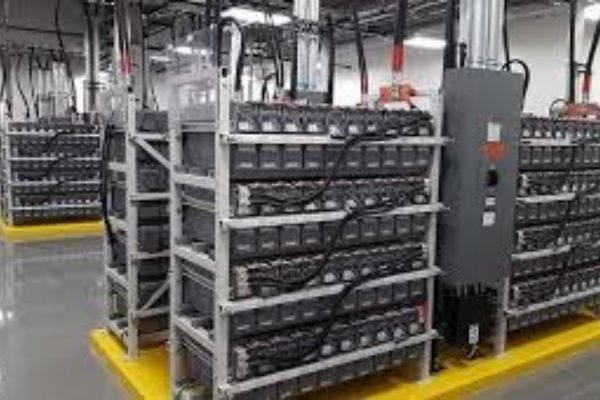
The global Data Center Lithium-Ion Battery Market is undergoing a pivotal transformation, fueled by the exponential rise in cloud computing, data traffic, and energy efficiency demands. According to Precedence Research, The data center lithium-ion battery market size reached USD 5.24 billion in 2024 and is projected to be worth around USD 17.69 billion by 2034, at a CAGR of 12.94% from 2025 to 2034.

Lithium-ion batteries are fast replacing traditional options for data center backup, driven by their superior energy storage, longer lifecycle, scalability, and safety advantages. As businesses intensify their focus on uptime, sustainability, and advanced digital infrastructure, lithium-ion solutions are establishing themselves as the gold standard for uninterruptible power supply (UPS) in hyperscale, colocation, and enterprise data centers.
What Opportunities and Trends Will Define the Future of Data Center Lithium-Ion Batteries?
How are technological advances and sustainability trends shaping market growth?
Powered Battery Management: The latest lithium-ion battery systems are increasingly integrating artificial intelligence (AI) for sophisticated Battery Management Systems (BMS). AI streamlines predictive maintenance, monitors temperature, voltage, and performance attributes in real time, and minimizes risk of thermal runaway or unscheduled downtime. This ensures longer service life and lower total cost of ownership.
Green Energy & Regulatory Push: Stricter global regulations and the pursuit of sustainability goals, particularly in North America and Europe, are accelerating the adoption of lithium-ion UPS solutions. Data centers are rapidly pairing these batteries with on-site solar and wind integrations, as recently highlighted by tech leaders like Google, supporting decarbonization mandates and cost savings.
Solid-State Battery Innovation: Early developments in solid-state lithium-ion batteries are promising even higher energy densities, improved safety, and quicker charging, potentially setting a new benchmark in backup technology for future-readiness in data centers.
Edge Computing Boom: Surging investment in edge data centers, especially across fast-developing Asia Pacific countries, is creating demand for compact, high-density storage that lithium-ion batteries uniquely provide.
Expert Commentary
“The data center landscape is in the midst of a major transformation. Lithium-ion technology is not only elevating operational resilience but is also pivotal in the industry’s journey toward net-zero emissions. AI-driven management and solid-state advances promise even greater value, keeping downtime at bay and advancing both sustainability and profitability for global operators.”
— Dr. Neha Rathi, Principal Consultant, Precedence Research
Data Center Lithium-Ion Battery Market Coverage
| Report Attribute | Key Statistics |
|---|---|
| Market Value (2025) | $5.92 billion |
| Forecast Value (2034) | $17.69 billion |
| CAGR (2025–2034) | 12.94% |
| Forecast Period | 2025–2034 |
| Dominant Region | North America |
| Fastest-Growing Region | Asia Pacific |
| Primary Growth Drivers | Cloud expansion, increased rack density, green mandates, rapid digitalization |
| Top Players | Schneider Electric, Vertiv Group, Samsung SDI, BYD Company, LG Energy Solution |
| Top Applications | Edge data centers, colocation, hyperscale, enterprise backups |
| Top Trends | AI-driven BMS, solid-state batteries, renewable energy integration |
Regional Insights
North America: Dominating Market Share
With the world’s highest concentration of hyperscale facilities and regulatory leadership in energy efficiency, North America holds the largest share. The U.S., in particular, is seeing robust replacement cycles as operators invest in new lithium-ion infrastructure to reduce emissions and maximize uptime.
Asia Pacific: The Hotbed of Growth
Asia Pacific is the fastest-growing region, propelled by massive digitalization in China, India, and Japan. The region’s aggressive rollout of cloud and mobile-first services is matched by soaring investment in scalable, green data center power solutions. The Asian Development Bank estimates a $1 trillion digital economy by 2025, fueling unprecedented demand for advanced batteries.
Europe: Sustainability on the Fast Track
Driven by the EU Green Deal and carbon-neutral policies, key European markets like Germany, France, and the UK are rapidly migrating to next-generation lithium-ion systems for their enterprise and colocation facilities
Data Center Lithium-Ion Battery Market Segmentation Highlights
Battery Chemistry Analysis
The report highlights several chemistry types shaping the data center lithium-ion battery arena. Lithium Iron Phosphate (LFP) stands out for its strong thermal stability, safety profile, and long lifecycle, qualities prized in mission-critical applications. Lithium Nickel Manganese Cobalt Oxide (NMC) dominates in deployments needing high energy density and performance, while Lithium Titanate (LTO) appeals for ultra-fast charging and exceptional longevity, especially in demanding backup scenarios. Lithium Cobalt Oxide (LCO) offers high power density but is typically utilized less in large-scale sites due to cost and durability considerations. The “Others” category, including NCA, captures ongoing innovation toward even higher-performing and more sustainable chemistries.
Data Center Type Analysis
Demand for lithium-ion batteries spans diverse data center settings. Hyperscale data centers, operated by tech giants, lead uptake thanks to their intense scalability needs and stringent uptime demands. Colocation data centers are increasingly turning to lithium-ion for efficient, space-saving energy backup solutions for multiple customers. Enterprise data centers, run by individual organizations, invest in these batteries to modernize legacy infrastructure and improve sustainability. Edge and micro data centers, crucial for supporting latency-sensitive cloud and IoT workloads, leverage lithium-ion technology for lightweight footprints and robust local reliability.
Application Analysis
Within data centers, lithium-ion batteries serve primarily as Uninterruptible Power Supply (UPS) systems, ensuring continuous operation during outages. Energy Storage Systems (ESS) are gaining traction for load balancing, renewable integration, and grid support. Batteries also play a critical role in load management and peak shaving, helping operators optimize energy use and reduce costs. Other applications, such as frequency regulation and power conditioning, further illustrate the flexibility and growing adoption of these advanced storage solutions.
Component Analysis
The battery ecosystem in data centers comprises several vital components. Battery racks and modules serve as the fundamental energy storage units, constructed to maximize capacity within limited space. Battery Management Systems (BMS) are pivotal for monitoring, safety, and life extension, using real-time analytics to prevent faults. Inverters and converters handle the transformation of stored DC energy into usable AC power. Monitoring and cooling systems safeguard performance by mitigating heat and stress. The “Others” segment encompasses ancillary hardware that further boosts overall efficiency and reliability.
End User Analysis
Lithium-ion technologies are being rapidly adopted across a range of end users. Cloud service providers drive the market, leveraging these batteries for always-on uptime and sustainability. Telecom operators deploy them to support distributed, low-latency networks. Banking, Financial Services & Insurance (BFSI) companies rely on resilient power backup for critical financial infrastructure. Government and defense sectors invest in robust storage for secure, mission-ready facilities. The healthcare industry values lithium-ion’s reliability for life-saving equipment and sensitive medical data storage, while IT and tech enterprises adopt the technology to power innovation hubs and R&D centers. The “Others” category, including retail, education, and media, reflects broadening market reach as digital transformation accelerates.
Challenges: Safety and Cost Pressures
- Safety Risks: Lithium-ion batteries pose fire and thermal risks if not properly managed, hence, advancements in BMS and strict compliance are non-negotiable for operators.
- Environmental and Disposal Concerns: Lithium mining and improper disposal remain critical issues. Increased emphasis is being placed on recycling initiatives and cleaner extraction.
- High Upfront Costs: Capital investment for lithium-ion systems is higher than traditional VRLA batteries, posing entry barriers for smaller data centers. However, the total cost of ownership often turns favorable in long-term modeling due to reduced maintenance and longer life.
Latest Breakthroughs and Leading Players
- Schneider Electric advanced its EcoStruxure™ data center battery portfolios, touting higher cycle life and improved BMS with AI-core predictive analytics.
- Vertiv Group introduced lithium-ion UPS solutions for edge and micro data centers, enabling rapid, modular deployments.
- Samsung SDI, LG Energy Solution, and BYD Company are investing in R&D targeting solid-state lithium-ion and greener chemistries.
- Google’s 2024 initiative to co-locate data centers with dedicated renewable energy and integrated storage showcases the industry’s momentum in coupling lithium-ion technology with sustainability objectives.
Data Center Lithium-Ion Battery Market Ecosystem

- Vertiv Group Corp.
- Eaton Corporation
- Schneider Electric SE
- Legrand SA
- Delta Electronics Inc.
- Huawei Technologies Co., Ltd.
- Samsung SDI Co., Ltd.
- LG Energy Solution
- Contemporary Amperex Technology Co. Ltd. (CATL)
- BYD Company Limited
- Toshiba Corporation
- Tesla, Inc.
- Panasonic Holdings Corporation
- Narada Power Source Co., Ltd.
- Lithium Energy Storage
- Saft Groupe S.A. (TotalEnergies)
- ZincFive Inc.
- Exide Technologies
- Hitachi Energy Ltd.
- Riello UPS (RPS S.p.A.)