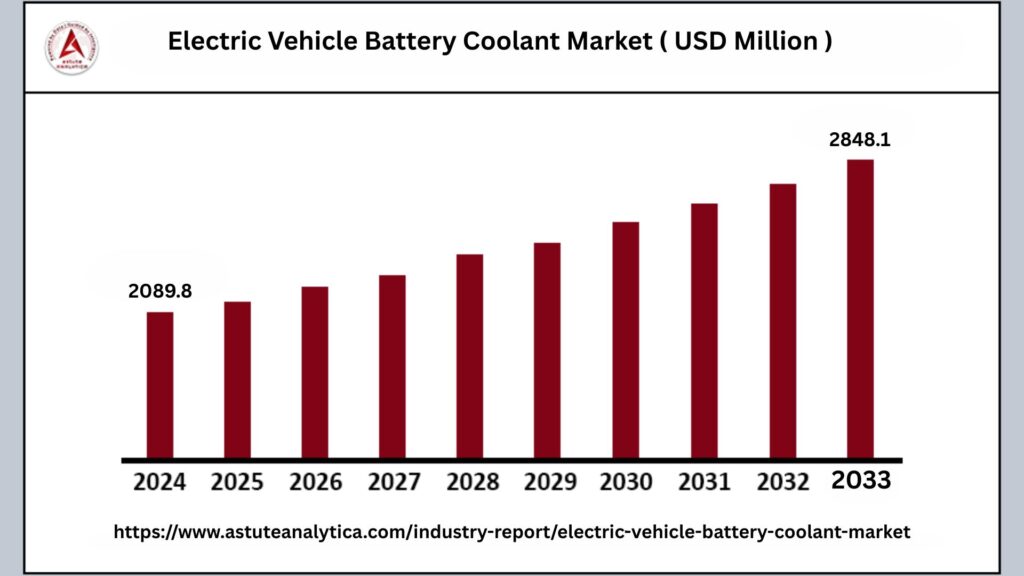
The global electric vehicle battery coolant market was valued at US$ 2,089.8 million in 2024 and is projected to reach US$ 2,848.1 million by 2033, reflecting a Compound Annual Growth Rate (CAGR) of 3.5% during the forecast period from 2025 to 2033.
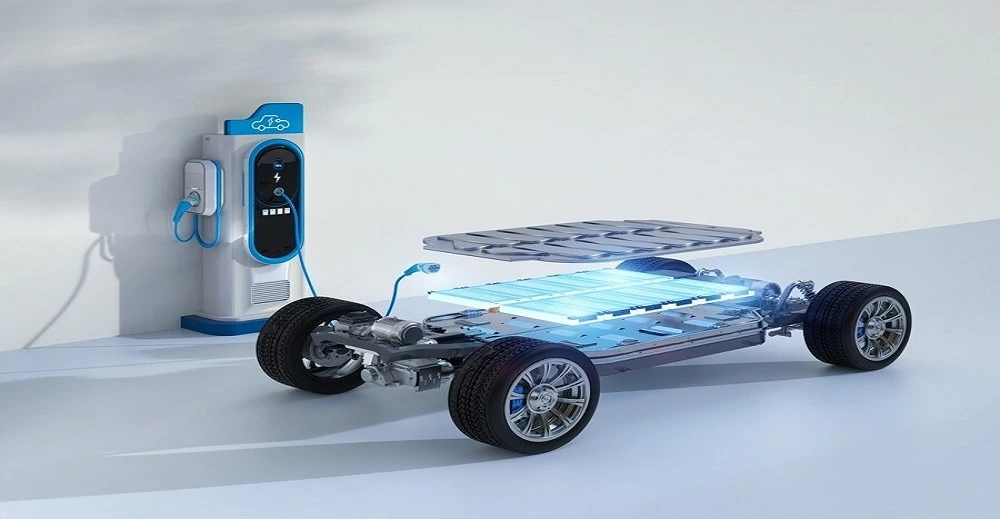
Electric Vehicle (EV) battery coolant plays a vital role in ensuring the safe and efficient operation of EV batteries. Typically composed of a water-glycol mixture, this coolant is specifically designed to maintain optimal battery temperatures under varying environmental conditions. The demand for advanced battery coolant solutions has been intensifying, driven primarily by the increasing adoption of high-density battery packs in electric vehicles. These batteries store more energy but also generate significantly more heat, especially during rapid charging sessions. As a result, managing thermal loads has become more complex and critical.
Electric Vehicle Battery Coolant Market Key Takeaways
- Based on vehicle type, battery electric vehicles (BEVs) dominate the market, holding over 61% of the total share.
- When considering battery type, lithium-ion batteries lead in coolant consumption, accounting for nearly 62% of the market due to their widespread use and thermal management needs.
- Regionally, Asia Pacific stands out as the leader, commanding more than 47% of the global electric vehicle battery coolant market.
Regional Analysis
Asia Pacific: Dominating the Electric Vehicle Battery Coolant Market
The Asia Pacific region continues to cement its status as the undisputed leader in the electric vehicle battery coolant market, commanding over 47% of the global market share.
- China’s Tremendous Electric Vehicle Sales: China’s contribution to this growth is staggering. In the first half of 2025 alone, China sold an incredible 5.5 million electric vehicles, underscoring its pivotal role in shaping the global EV landscape. This immense sales volume generates an unparalleled foundational demand for high-performance battery coolants, essential for managing the thermal stability and safety of the vast number of lithium-ion batteries deployed across the country.
- India’s Strategic Initiatives to Boost EV Infrastructure: India is emerging as a promising growth market within the Asia Pacific region through proactive government initiatives aimed at supporting electric vehicle adoption. The Indian government has announced ambitious plans to develop extensive charging infrastructure nationwide, a critical component for encouraging widespread EV use. Additionally, India’s advanced chemistry battery storage program seeks to enhance the country’s battery technology and infrastructure, fostering improvements in battery efficiency, safety, and thermal management.
Robust Growth in Europe’s Electric Vehicle Battery Coolant Market
Europe’s electric vehicle battery coolant market is experiencing strong and sustained growth, fueled by several key factors that are shaping the region’s transition to electrification.
- Surge in Electric Vehicle Sales Across the Continent: The tangible impact of these drivers is evident in the sales figures for the first half of 2025, where Europe recorded an impressive 2 million electric vehicle sales. This milestone highlights both growing consumer confidence in EV technology and the effectiveness of regional policies designed to promote cleaner transportation.
- Germany’s Remarkable Recovery and Market Leadership: Germany stands out within the European market as a powerhouse for electric vehicle sales and related industries. In the first six months of 2025, electric car sales in Germany soared to nearly 249,155 units, marking a remarkable recovery compared to the previous year’s performance. This surge underscores Germany’s leadership in the EV space, supported by robust industrial infrastructure, strong government backing, and growing consumer acceptance.
North America Dominance in the Market
The North American electric vehicle battery coolant market is undergoing rapid expansion, driven by an aggressive push to develop domestic electric vehicle and battery manufacturing capabilities.
- United States Leading Industrial Transformation: At the heart of this transformation is the United States, which is spearheading efforts to scale up battery production capacity significantly. In 2025 alone, the U.S. plans to bring 10 new battery factories online, marking a substantial leap forward in its manufacturing capabilities. These facilities are expected to collectively boost the country’s EV battery production capacity to an impressive 421.5 gigawatt-hours per year.
- Implications for Battery Coolant Demand and Chemical Suppliers: The dramatic increase in battery manufacturing within North America will directly translate into heightened demand for high-performance battery coolants. Effective thermal management is critical to maintaining battery safety, efficiency, and longevity, making advanced coolants an indispensable component of EV battery production and operation. For chemical suppliers operating in or looking to enter the North American market, this presents a significant growth opportunity.
Top Trends Escalating the Electric Vehicle Battery Coolant Market
Growing Adoption of Advanced Direct-Liquid and Immersion Cooling Technologies: The electric vehicle industry is witnessing a significant shift towards the adoption of advanced cooling methods, particularly direct-liquid and immersion cooling technologies. These innovative approaches offer superior thermal management efficiency compared to traditional air or indirect cooling systems. Direct-liquid cooling involves circulating coolant directly over battery cells, enabling faster and more precise heat dissipation. Immersion cooling takes this concept further by submerging battery components in dielectric fluids, providing uniform temperature control and minimizing hotspots.
Integration of AI and Machine Learning for Smart Thermal Management: Artificial intelligence (AI) and machine learning are increasingly being integrated into thermal management systems to create smarter, more adaptive cooling solutions. These technologies analyze real-time data from battery sensors to predict temperature fluctuations and optimize cooling performance dynamically. By learning from vehicle usage patterns and environmental conditions, AI-driven systems can proactively adjust cooling strategies, improving energy efficiency and preventing overheating.
Development of Sustainable, Eco-Friendly Coolant Formulations with Low Conductivity: Environmental concerns and regulatory pressures are driving the development of sustainable, eco-friendly coolant formulations for electric vehicles. These next-generation coolants are engineered to have low electrical conductivity, which is crucial for safely managing the high-voltage environments of EV battery systems. At the same time, they are designed to minimize environmental impact through biodegradable components and reduced toxicity.
Intensifying Demand for Longer EV Driving Ranges and Faster Charging: Consumer expectations for electric vehicles continue to evolve, with increasing demand for longer driving ranges and faster charging capabilities. To meet these expectations, manufacturers are equipping EVs with larger, more energy-dense batteries, which generate greater thermal loads. Managing this heat efficiently is essential to maintaining battery performance and safety during extended use and rapid charging sessions.
Stringent Government Regulations Mandating Reductions in Vehicle Emissions: Governments around the world are implementing increasingly stringent regulations aimed at reducing vehicle emissions and promoting cleaner transportation alternatives. These policies are accelerating the adoption of electric vehicles and, by extension, the development of advanced battery technologies that require effective thermal management.
Continuous Advancements in High-Energy-Density Battery Technology: Advancements in high-energy-density battery technology are at the forefront of electric vehicle innovation, enabling longer ranges and improved vehicle performance. However, these batteries produce more heat due to their increased energy storage capacity, creating new challenges for thermal management. Sophisticated cooling solutions are essential to handle these heightened thermal loads and prevent battery degradation or failure.
Electric Vehicle Battery Coolant Market Segmentation
By Battery Type
The electric vehicle battery coolant market is overwhelmingly focused on managing the temperature of lithium-ion batteries, which dominate the sector due to their exceptional performance characteristics. Lithium-ion batteries hold a commanding market share of over 62%, underscoring their widespread adoption as the preferred energy source for modern electric vehicles. This dominance is largely attributed to their unparalleled energy density, which allows for extended driving ranges, and their long operational lifespan, which ensures durability and reliability over time. As a result, lithium-ion technology has become the default choice for manufacturers seeking to deliver efficient and high-performing electric vehicles.
By Vehicle Type
The dominance of battery electric vehicles (BEVs) in the electric vehicle battery coolant market, accounting for over 61% of the share, stems directly from their unique design and operational requirements. Unlike other types of electric vehicles, BEVs rely exclusively on large lithium-ion battery packs to power the vehicle, which introduces significant challenges related to heat management. These battery packs generate substantial thermal loads during both normal operation and charging cycles, necessitating advanced and highly efficient cooling solutions.
Recent Developments in the Electric Vehicle Battery Coolant Market
LIQUI MOLY Launches Battery Coolant EV 200: In July 2025, German company LIQUI MOLY introduced Battery Coolant EV 200, a cutting-edge coolant designed specifically for indirect cooling applications in electric vehicles. This new product is distinguished by its low electrical conductivity, which is crucial for safety and efficiency in EV cooling systems. Additionally, it offers robust corrosion protection for a variety of metals commonly used in battery and cooling circuit components.
MAHLE Releases E-CARE Fluid Service Unit: In May 2025, MAHLE began selling its latest service innovation, the E-CARE Fluid, across Europe. This advanced solution is designed to facilitate easy and efficient maintenance of the cooling circuits in vehicles, regardless of their drive type—be it electric, hybrid, or conventional. The E-CARE Fluid service unit enables technicians to empty and refill the coolant circuit in a fully automated way.
Dober’s EV-LC Coolant Passes China’s GB Standard Testing: In March 2025, US-based EV coolant manufacturer Dober announced that its EV-LC Coolant successfully passed the stringent Guo Biao (GB) National Standard testing in China. These standards, issued by the Standardization Administration of China, are critical benchmarks for product safety, quality, and performance within the Chinese market.
Top Companies in the Electric Vehicle Battery Coolant Market
- Arteco
- BASF
- CASTROL LIMITED.
- Exxon Mobil Corporation
- GS Caltex
- Shell plc
- Dober
- VALEO
- Veedol
- Valvoline
- Other Prominent Players
Market Segmentation Overview
By Vehicle Type
- Battery Electric Vehicles
- Hybrid Electric Vehicles
By Battery Type
- Lead Acid Battery
- Lithium Ion Battery
- Others
By Geography
- North America
- Europe
- Asia-Pacific
- Latin America
- Middle East and Africa