
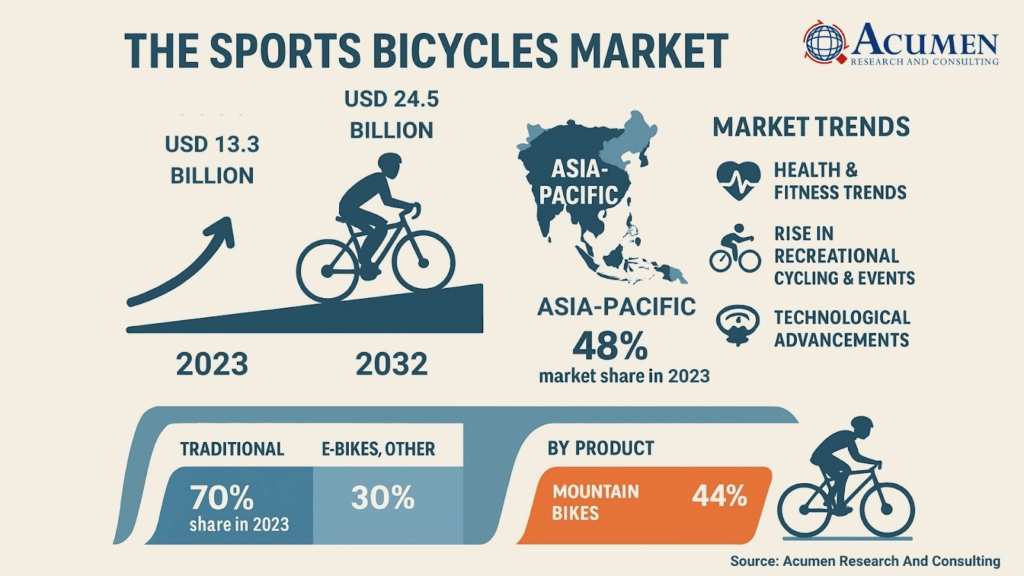
According to Acumen Research And Consulting, the Sports Bicycles Market size was approximately USD 13.3 billion in 2023, with a projected rise to USD 24.5 billion by 2032, reflecting a 7.2% CAGR during 2024–2032. This robust medium-term outlook reflects sustained consumer interest in fitness cycling, mountain biking, and lifestyle mobility options.
The global sports bicycles market is at the intersection of fitness enthusiasm, sustainable urban mobility, and advancing bike technology. As the world races toward healthier lifestyles and greener transport solutions, understanding industry dynamics—from growth forecasts to market drivers—is mission-critical.
Sports Bicycles Market: Acumen Research & Consulting Statistics
| Metric | Value |
|---|---|
| Market Size in 2023 | USD 13.3 B |
| Forecast Market Size by 2032 | USD 24.5 B |
| CAGR (2024–2032) | 7.2% |
| Asia-Pacific 2023 Market Share | ~48% of global market |
| Europe CAGR Forecast (2024–2032) | ~7.9% |
| Technology Segment Share (2023) | Traditional bicycles: 70% |
| Product Segment Share (2023) | Mountain bikes: ~44% of revenue |
| Key Companies Profiled | Cube, Cannondale, Bianchi, Giant, Specialized, Trek, Merida, GT, Scott |
Source: All figures cited from Acumen Research & Consulting report.
Key Players and Market Influencers
Leading global brands such as Cube Bikes, Cannondale Bicycle Corporation, Bianchi, Giant Manufacturing, Specialized, Trek, Merida, GT Bicycles, and Scott Sports are driving the sports bicycles market with innovations in frame materials, geometry, and smart components.
Complementary suppliers such as Shimano—which holds approximately 85% of the global sports bike component market—are also expanding their footprint in Asia-Pacific, including a major facility in Singapore launched in 2023, to meet rising regional demand.
Market Overview & Product Segmentation
Sports bicycles are performance-driven bikes—built for speed, agility, and endurance. They include mountain bikes, road racing bikes, cyclo-cross, and track racing bikes, with designs emphasizing lightweight materials (carbon fiber, titanium), aerodynamic efficiency, and often smart electronics.
Technology Split
In 2023, traditional (non-electric) bikes held 70% of the market, while electric sports bicycles are gaining traction, particularly in urban commuting and recreational segments.
Product Segments
Mountain bicycles accounted for over 44% of revenue in 2023, reflecting the popularity of outdoor and off-road cycling. Road racing bikes follow closely, with cycling tourism and organized events boosting demand across categories.
End-User Segments
Adult cyclists dominate (~70% share), although growth in kids’ and women’s categories continues, supported by safety awareness and accessible cycling programs in key markets.
Regional & Market Share Profile
Asia-Pacific – Growth & Dominance
The Asia-Pacific region remains the dominant hub within the sports bicycles market, capturing nearly 48% of total global share in 2023. Its supremacy stems from a combination of strong cycling culture in countries like China and Japan, rising middle-class disposable income, and large-scale infrastructure investments.
- China leads not only in sales figures but also as the manufacturing heartland—producing over 60% of all global bicycles and exporting performance and mountain models worldwide. Urban cycling lanes, public bike-sharing systems, and annual fitness campaigns further bolster demand.
- India is rapidly catching up. With government-supported wellness initiatives, a growing interest in adventure sports, and mountain biking becoming popular in hilly regions like Himachal Pradesh and Uttarakhand, India’s sports bicycle segment is gaining traction.
- Southeast Asia (e.g., Thailand, Vietnam, Singapore) Countries are now promoting outdoor adventure tourism and urban e-bike adoption. Shimano’s new component hub in Singapore is a testament to Southeast Asia’s rising importance in the supply chain—designed to meet demand for high-end sports bikes and electric versions alike.
Market Dynamics in Asia-Pacific:
- Electrification: Loose regulatory support and reduced battery costs are accelerating the adoption of electric sports bicycles, especially for urban mobility.
- Adventure Tourism: Mountain biking in national parks and regional trail networks supports premium segment growth.
- Demographic Engagement: Family-oriented recreational programs, school sports leagues, and cycling festivals engage youth and women in sport cycling.
Europe – Innovation & Infrastructure Leader
Europe remains a technologically advanced, cycling-first region, accounting for approximately 30% of the global sports bike market in 2023. Regional growth is forecast at about 7.9% CAGR through 2032.
Key drivers include:
- World-class infrastructure: Countries like the Netherlands, Denmark, France, Germany, and Switzerland offer comprehensive cycling lanes, safe urban environments, and cycling tourism routes.
- Health-Focused Mobility Policies: Incentives such as e-bike subsidies, workplace bike-to-work incentives, and city bike-share systems enhance adoption of both traditional and electric sports bicycles.
- Premium Market Positioning: European brands often lead in carbon-fiber innovation, aerodynamics, and custom frame technologies, driving higher average selling prices within road and mountain bike categories.
France’s iconic events like the Tour de France generate aspirational consumer awareness, while gravel biking and regional competitions continue to stimulate performance segment demand.
North America – Health, Lifestyle & Recovering Demand
- Urban Wellness Integration: U.S. and Canadian cities increasingly develop bikeways, green belts, and fitness parks. Cycling is promoted as a lifestyle rather than just a mode of transport.
- Electric Sports Bike Adoption: Older riders and commuters are adopting e-mountain bikes and e-road bikes as practical, assisted options.
- Challenges: Market pressures from tariffs, supply chain disruptions (especially post-2020 import reduction), and inventory overhang continue to impact organic growth rates.
Regional cycling events, recreational marathons, and outdoor fitness programs are reinforcing interest, particularly in youth, adventure, and women’s cycling categories.
Latin America & Middle East & Africa (Emerging Growth Regions)
These markets represent smaller but promising fragments of the Sports Bicycles Market, collectively contributing around 10–15% of global market share.
- Latin America: Countries like Brazil, Argentina, and Chile are witnessing increased participation in mountain biking and recreational cycling, especially in high-altitude regions and during wellness festivals.
- Middle East: In the Gulf region, countries such as the UAE and Saudi Arabia are fostering sports cycling culture via mass-participation events like Dubai Ride and governmental investment in recreation infrastructure.
- Africa: Cycling growth is nascent but emerging, often tied to adventure tourism, conservation fundraising rides, and cycling-in-schools initiatives across South African, Kenyan, and Moroccan markets.
These regions’ development is influenced by expanding middle-class access, improving transport policies, and rising awareness of the health benefits of sport cycling. As infrastructure and e-commerce improve, there’s growing opportunity for sports and mountain bike segment penetration.
Market Drivers & Growth Catalysts
Health & Fitness Awareness
Escalating interest in cardiovascular fitness, wellness, and clean-air transport is pushing consumers toward cycling as a preferred activity—especially among millennials and Gen-X adults.
Technological Innovation
Lightweight materials, aerodynamic and ergonomic designs, electronic shifting, real-time GPS/fitness tracking, and connected diagnostics are reshaping rider expectations and product offerings.
Infrastructure & Urban Policy
Government-led initiatives such as bike-sharing, dedicated lanes, and urban cycling awareness campaigns have solidified cycling as a mainstream solution in major cities across Europe and Asia-Pacific.
Adventure & Recreational Engagement
Mountain biking, gravel rides, and trail tourism are growing in popularity—particularly in the Asia-Pacific region and parts of Europe—bolstering demand for rugged sports bicycle models.
Sports Bicycles Market Trends & Analysis
Electric vs. Traditional
While traditional bikes lead in market share, the electric segment is expanding rapidly, particularly within lifestyle and commuter categories looking for assisted performance. Battery tech improvements and subsidy mechanisms are further boosting adoption.
Channel & Consumer Shifts
Offline retail still dominates thanks to in-store fitting and brand experience. However, online sales are growing fast—especially for customizable bicycles and direct-to-consumer brands leveraging digital configurators.
Demographic & Product Trends
Mountain and road performance bikes enjoy strong demand, with youth and female segments gaining traction as cycling becomes more inclusive and family-oriented.
Industry Challenges & Opportunities
Challenges
- High entry costs for performance and e-bikes limit accessibility in emerging markets.
- Overcapacity in certain regions, especially post-pandemic, has led to pricing pressure and excess inventory.
- Infrastructure gaps in developing cities continue to constrain mass adoption.
Opportunities
- Electric sports bicycles in Asia-Pacific present high growth potential.
- Customization, premium offerings, and women/youth-specific models target underserved niches.
- Brands offering connected fitness integrations are well-positioned to gain traction among health-focused riders.
Why It Matters Now
With the Sports Bicycles Market soaring from USD 13.3 Billion to USD 24.5 Billion by 2032 and Asia-Pacific commanding nearly half of total revenues, the moment is ripe for brands to innovate in product design, distribution models, and sustainability messaging. Europe’s fast-paced growth (~7.9% CAGR) further underscores dynamics in mature cycling markets.
The future of cycling is not just about speed; it’s about sustainability, fitness, and smart design. The Sports Bicycles Market—a mosaic of traditional muscle, electric innovation, and connected experiences—is reshaping recreation and mobility across demographics and regions.