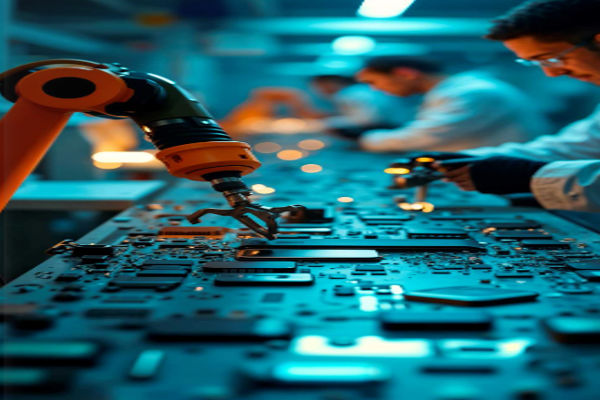
We have entered an era where intelligence is no longer just at the edge of computing, it’s embedded at its core. From autonomous systems to real-time data analytics, modern applications are pushing hardware to do more, faster, and in smaller footprints. What’s powering this leap isn’t just better software or clever architectures, but behind the scenes of this tech revolution lies a quieter—but equally powerful—story: the transformation of the semiconductor industry as it races to keep up.
This transformation goes beyond just shrinking transistors. It’s a fundamental reinvention of how chips are designed—driven by advanced design methodologies and the rapid infusion of AI into Electronic Design Automation (EDA) workflows. Together, these forces are enabling smarter, more efficient silicon that meets today’s demanding performance, size, and power requirements.
The New Shape of Complexity
System-on-Chip (SoC) designs have never been more ambitious—or more intricate. With technology scaling from 10nm to 3nm and now to 2nm and below, chipmakers are now able to pack billions of transistors onto a single die. This level of integration unlocks incredible performance and functionality, but it comes at a cost: design complexity has exploded.
Scaling transistor numbers is only part of the technological hurdle. Modern ASIC Physical Design must comprehensively address Power Integrity, Timing Closure, Multi-Voltage Domains, Thermal effects, Signal Integrity, and Manufacturability, while adhering to increasingly aggressive market timelines. The traditional EDA tools and workflows that once met industry needs are now being pushed to their limits.
This is where change was not just necessary, it was inevitable.
Evolving Design Strategies: Smarter Workflows for Smarter Chips
To manage rising complexity, semiconductor teams have already adopted Advanced Design Methodologies that now serve as the foundation of modern SoC development. Key shifts in the ASIC Physical Design include Hierarchical and Top-Down Design approaches that not only enable partitioning and parallel development, allowing large teams to work concurrently across multiple functional blocks, but also improve design scalability, reuse, and overall time-to-market.
The adoption of Hybrid Standard Cells in advanced-node technologies, with mixed standard cell row heights, is now allowing designers to better balance power, performance, and area (PPA)–a key requirement.
Physical-Aware or Topographical Logic Synthesis brings standard cell and macro placement and related congestion insights into the design process, helping improve timing, area, and routability.
Exploiting useful clock skews starting at Logic Synthesis enables enhanced optimization of Critical Timing Paths by leveraging path-specific clock arrival variations. This practice, in general, is now being utilized by default across the semiconductor development companies in their Physical Design Methodologies.
Early integration of Timing, Power, and Reliability checks helps avoid Signoff Bottlenecks and reduces turnaround time by pushing IR drop Analysis, Physical DRC Analysis, and Thermal checks into the Early Implementation Phases. Concurrent Verification, including Formal Verification and Physical Checks at each successive stage of Physical Design, allows reuse of intermediate results for faster convergence.
These are not trends; they are core engineering strategies that have evolved to meet the realities of lower technology node designs. They allow teams to preserve flexibility, accelerate cycles, and improve predictability, all while maintaining design integrity.
EDA Tools: From Utilities to Intelligent Engines
In the early days of chip design, teams used separate, standalone EDA tools for Logic Synthesis, Place and Route (P & R), and Sign-off. It was a workable system.
As SoC complexity grew, EDA vendors responded by improving tool interoperability and ensuring tighter correlation between Logic Synthesis and detailed standard cell placement. This solved many early-stage timing and convergence issues and brought a level of coherence that made large-scale chip development viable.
However, even tightly integrated platforms have struggled to keep pace with escalating design complexity. As a result, many teams have shifted back to selectively integrating best-in-class tools from multiple vendors, leveraging specific engines that deliver superior PPA (Power, Performance, Area) or faster convergence within the Place-and-Route (P &R) stages. While this hybrid approach introduces additional integration overhead, including frequent import/export of designs between different EDA tools, increased licensing costs, and more complex license management, it provides the essential flexibility and optimization capabilities required for mission-critical designs.
Still, integration alone was not enough. To truly master today’s design challenges, the industry turned to intelligence. Rather than just choosing the right tool for the task, design teams are increasingly adopting tools that learn and adapt—powered by artificial intelligence.
AI: The Next Design Partner
The real breakthrough in EDA came with the integration of Artificial Intelligence and machine learning (AI/ML) into Physical Design workflows. No longer limited to rule-based automation, design tools now learn from data, optimize in real time, and explore vast design possibilities autonomously.
AI-driven platforms are already in production. Synopsys DSO.ai applies reinforcement learning to optimize floorplanning and design convergence. Cadence Cerebrus leverages machine learning to accelerate PPA optimization across hierarchical blocks. Siemens Aprisa is evolving ML-based placement and routing strategies. NVIDIA’s DREAMPlace and AutoDMP explore deep learning and graph neural networks to optimize placement, congestion, and timing.
These tools are reshaping the very nature of design iteration. AI can predict routing bottlenecks before they occur, evaluate thousands of floorplan variants in hours, and automatically rebalance design constraints to optimize PPA. Instead of scripting thousands of manual tweaks, engineers now guide the system—and let AI handle the exploration.
The bottom line: AI has evolved from a mere assistant to an active co-designer.
A New Design Equation: Expertise + Intelligence
The combination of advanced methodologies and AI-assisted tools is creating a new design paradigm—one where engineering teams can achieve more with fewer resources and tighter cycles.
This shift unlocks meaningful advantages: Faster design closure through intelligent iteration and exploration, and smaller, high-performing teams can deliver competitive designs. Better trade-off decisions across performance, area, and power. Higher predictability in timelines, quality, and risk mitigation
AI is not replacing human creativity; it’s augmenting it. It’s enabling engineers to explore broader possibilities, uncover non-obvious optimizations, and eliminate bottlenecks that previously required brute-force effort. This is not just processing acceleration—it’s design intelligence, built into the workflow.
Redefining the Future of Silicon Development
As semiconductor innovation pushes deeper into 3D ICs, chiplets, and heterogeneous integration, intelligent design automation will be the foundation that enables progress. The tools, processes, and decisions of the next decade will be shaped by the ability to integrate AI into every phase of design—from architectural planning to sign-off.
This transformation isn’t about incremental efficiency; it’s about building a fundamentally more scalable, adaptive, and insight-driven path from concept to silicon.
Closing Thought: AI Role in Managing Physical Design Complexity to Mastering It
We’re witnessing a once-in-a-generation transformation in the semiconductor industry. What was once a manual, stage-by-stage process is evolving into an intelligent, integrated, and highly automated design ecosystem.
The most advanced chips of tomorrow won’t just be faster or smaller; they’ll be the product of smarter processes: enabled by AI, guided by mature methodologies, and driven by an unrelenting pace of innovation.
AI isn’t replacing chip designers—it’s amplifying their capabilities and helping them tackle challenges that would have been unthinkable just a few years ago. As we push into the era of ultra-complex designs and ultra-fast delivery timelines, the tools we use—and the ways we use them—will be the biggest difference-makers.
The future of chip design is no longer just about managing complexity. It’s about mastering it through AI