

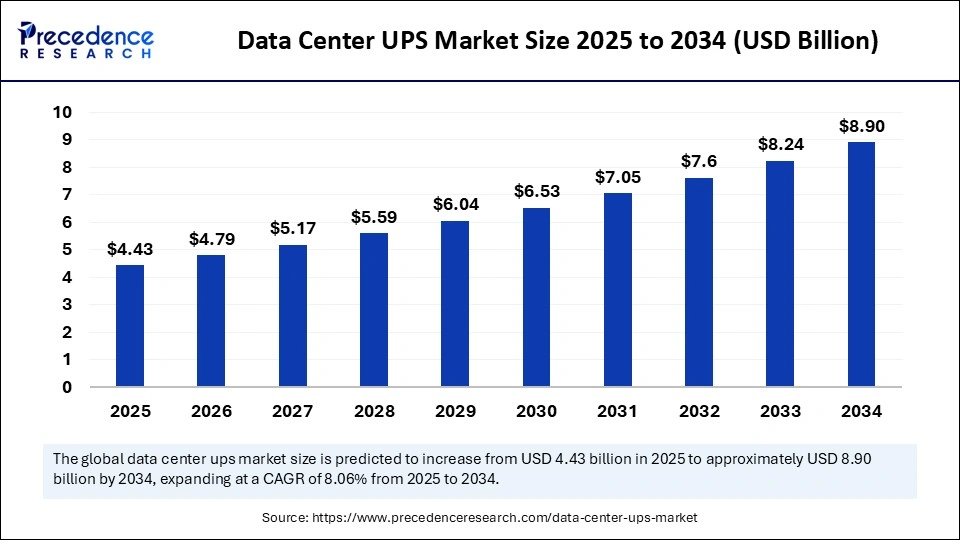
According to Precedence Research, the global Data Center UPS market, valued at USD 4.43 Billion in 2025, is forecast to almost double, reaching USD 8.90 Billion by 2034, a robust CAGR of 8.06%. This accelerated growth stems from government incentives for green data centers, cloud migration strategies, and rising demands for digital reliability. With both traditional and AI-based UPS systems evolving fast, market leaders are adapting to meet surging power, resilience, and operational needs.
Uninterruptible Power Supply (UPS) systems have become the silent guardians of the digital economy, ensuring data centers stay online during blackouts or voltage swings. Modern AI-powered UPS systems are reshaping market dynamics, offering predictive maintenance and optimized energy efficiency for cloud-first enterprises.
Data Center UPS Market Key Insights
- The data center UPS market will nearly double to USD 8.90 Billion by 2034 from USD 4.43 Billion in 2025.
- North America claims the largest market share in 2024, followed closely by Asia Pacific, the fastest-growing region.
- Leading market players are pioneering advanced AI-powered UPS solutions and modular, scalable architectures.
- Online double-conversion UPS systems dominate, with modular units gaining ground for flexibility and cost efficiency.
- The healthcare sector is expected to see the fastest UPS adoption growth, ensuring maximum uptime in critical settings.
Revenue Breakdown
| Year | Market Size (USD Billion) | CAGR (%) |
|---|---|---|
| 2025 | 4.43 | 8.06 |
| 2034 | 8.90 | 8.06 |
Regional Focus
North America led the market with USD 1.15 billion in 2024 and is expected to reach USD 2.54 billion by 2034, propelled by advanced infrastructure and pro-green policies.
Asia Pacific is recognized for the quickest adoption and innovation, supported by government initiatives to strengthen a connected data center ecosystem, exemplified by Karnataka, India.
How Is AI Transforming Data Center UPS Systems?
AI integration is elevating UPS performance, reliability, and agility. In modern data centers, AI-driven UPS units autonomously monitor power loads, analyze energy patterns, and optimize resource allocation in real time. This shift toward predictive management not only averts downtime but slashes operational costs.
Further, AI-enhanced power systems automate everything from voltage regulation to rapid anomaly detection. With deep learning models in play, UPS units can forecast failures, align energy distribution dynamically, and secure mission-critical hardware against unexpected outages. The result: smarter, safer, and more sustainable infrastructure that anticipates – not just reacts to – power threats.
What Drives Market Growth in Data Center UPS?
- Government policies spur building and upgrading green, energy-efficient data centers.
- Cloud migration and digital transformation demand robust power backup and scalability.
- AI-powered monitoring improves uptime, lowers costs, and streamlines preventive maintenance.
- Rapid advances in UPS battery technology boost efficiency and reduce physical space requirements.
- Healthcare and telecom sectors ramp up investments in high-availability UPS for mission-critical services.
What Opportunities and Trends Will Redefine the Market?
Is Modular UPS the New Industry Standard?
Modularity is transforming UPS architecture, allowing for easy upgrades, expansion, and maintenance with zero service disruption. Companies can now scale power resources cost-effectively and dynamically, matching ever-changing workload needs.
Will Lithium-Ion Batteries Replace Lead Acid in UPS Systems?
Lithium-ion batteries are quickly gaining ground due to their longevity, compact form factor, and ability to run at higher temperatures. They reduce cooling loads and are up to 14.6% lighter, streamlining data center operations.
Regional and Segmental Spotlight
North America Leads: Why Is The Region Dominant?
North America, especially the United States, continues to hold the largest share of the global Data Center UPS market. This leadership is fueled by robust government incentives for green data centers, policies promoting energy-efficient IT infrastructure, and rapid integration of advanced digital technologies.
The region benefits from well-established cloud and colocation hubs, which demand reliable, scalable, and smart UPS solutions to maintain uptime and prevent data loss during power disruptions.
Asia Pacific’s Fastest Growth: What’s Powering the Rise?
Asia Pacific is set to be the fastest-growing region and is pivotal to the market’s forward trajectory. Growth is spurred by rapid technological advancements in UPS units, increasing grid instability and power shortages, and strong demand for new data centers.
Regions like Karnataka, India, exemplify this surge local government policies such as the Karnataka Data Center Policy 2022 foster connected data center ecosystems and encourage ongoing innovation and investment in power resilience.
Online Double-Conversion UPS: Why Is It Preferred?
Online double-conversion UPS systems dominate due to their zero transfer time capability, meaning connected equipment never suffers interruptions, even during utility power failures. These systems fully isolate sensitive hardware from raw power sources, maintaining a consistent, high-quality output and protecting against voltage fluctuations. As a result, data centers trust this configuration for mission-critical, uninterrupted operations.
Modular UPS Units: What Drives Demand?
The modular UPS segment is expected to grow fastest, owing to its scalability, flexibility, and ease of maintenance. Modular architecture allows data centers to expand power capacity without service disruption, modules can be installed, replaced, or upgraded on-demand. This “plug-and-play” approach significantly reduces downtime and capital expenditure, making modular UPS units highly attractive for facilities facing fluctuating workloads.
Battery Technology: Why Is Lithium-Ion Rising?
Lead-acid batteries remain standard in legacy installations because of their cost-effectiveness and mature supply chains. However, lithium-ion batteries are surging in adoption. Their compact design allows for smaller UPS footprints (reducing space by 50–80%), and they operate at higher temperatures with less capacity loss, decreasing cooling needs. Lithium-ion systems are up to 14.6% lighter, which facilitates faster deployment and relocation, well-suited for fast-evolving data center environments.
Power Ratings: Which Ratings Lead and Why?
UPS systems in the 10kVA-50kVA range represent the mainstream for mid-sized and enterprise data centers, balancing energy efficiency and availability. These provide the lowest total cost of ownership and prioritize 100% uptime. Conversely, 5kVA-10kVA units are experiencing significant growth, particularly for edge data centers and smaller server facilities. Their primary advantage is providing uninterrupted, clean power to critical devices, crucial for emerging, decentralized network architectures.
End Users: Who Is Adopting Most Rapidly?
IT and data centers are the leading adopters UPS systems are fundamental for protecting servers, networking equipment, and storage devices against power interruptions, ensuring reliability and preventing costly data loss. The healthcare segment is the market’s breakout growth area, with increasing reliance on UPS to guarantee non-stop operation of medical and diagnostic equipment, especially given the sector’s sensitivity to even brief outages.
Case Study: Karnataka’s Data Center Policy Impact
Karnataka’s Data Center Policy 2022 exemplifies how regional strategies can catalyze UPS market expansion. By promoting robust, connected data center ecosystems, the state is setting benchmarks in both scalability and sustainability for the broader Asia Pacific region.
Data Center UPS Market Companies
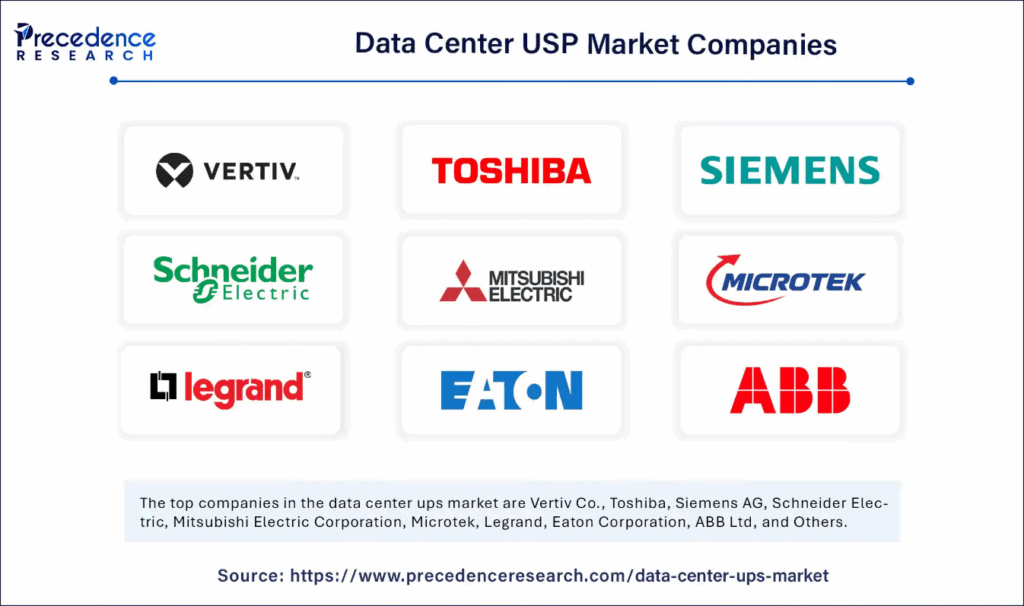
Vertiv
Supplies robust UPS systems like the Liebert series, designed for high-density, AI-ready, and mission-critical data centers.
Focuses on reliability, scalability, advanced thermal management, and efficient deployment for global hyperscale and enterprise data centers.
Recently expanded its UPS lineup for AI clusters and modular rapid infrastructure deployment.
Toshiba
Offers modular UPS solutions with fast-charging SCiB batteries suitable for edge and large-scale data centers needing high reliability.
Products emphasize power backup quality, energy management, and long battery life.
Siemens AG
Provides integrated UPS power solutions, grid-independent backup, and redundancy for continuous operation.
Partners for smart, modular, and sustainable UPS systems targeting hyperscale and colocation data centers.
Schneider Electric
Global market leader with APC UPS and EcoStruxure Data Center management solutions.
Enabling smart power protection, scalability, remote monitoring, and sustainable operation for hyperscale, edge, and hybrid-cloud deployments.
Its Galaxy VXL UPS is highly efficient and compact for high-density environments.
Mitsubishi Electric Corporation
Supplies high-power modular UPS systems with advanced efficiency and reliability, suited for cloud and mission-critical data centers.
Focus on scalability, serviceability, and long-life components.
Microtek
Manufactures online UPS systems up to 120KVA with advanced battery management and surge protection.
Caters mainly to small to medium data centers and essential mission-critical setups.
Legrand
Provides scalable, modular UPS systems optimizing uptime, energy savings, and ease of maintenance.
Emphasis on hot swap features and efficiency at varying load levels.
Eaton Corporation
Offers modular, high-efficiency UPS systems with advanced monitoring, supporting cloud, AI, and edge deployments.
Includes digital lifecycle management tools for rapid deployment and energy savings.
ABB Ltd
Specializes in scalable, efficient UPS systems like MegaFlex, supporting hyperscale and enterprise data centers.
Leads in sustainable technology adoption including nickel-zinc battery integration.
Emerson Electric Co.
Legacy provider through Vertiv’s Liebert UPS line, offering critical data center power solutions.
Socomec Group
Develops modular, energy-efficient UPS with remote monitoring and sustainability priorities.
Huawei Technologies Co., Ltd.
Major UPS provider in Asia, focusing on modular, AI-ready, and energy-efficient systems for hyperscale data centers.
AEG Power Solutions
High-capacity UPS supplier with advanced battery diagnostics, serving large critical infrastructure.
Delta Electronics, Inc.
Innovator in rack-based, lithium-ion UPS solutions for high-density environments.
Fujitsu Limited
Offers intelligent UPS and power management integrated with IT infrastructure management.
KSTAR
Manufacturer of scalable, high-efficiency UPS solutions with advanced remote monitoring.
Rittal GmbH & Co. KG
Provides modular UPS integrated into racks and enclosures for rapid deployment.
Kirloskar Electric Company
Industrial UPS supplier addressing mission-critical environments with local engineering support.
APPC by Schneider Electric
APC-branded UPS range within Schneider Electric’s portfolio, covering diverse backup needs.
Toshiba Corporation & Toshiba Infrastructure Systems & Solutions Corporation
Global UPS and battery integration leaders focusing on sustainability, energy management, and grid compatibility.
S&C Electric Company
Provides UPS and energy storage solutions focused on grid reliability and renewable energy integration.
What Are the Top Challenges and Pressures Facing Data Center UPS?
- High barriers to entry: Significant capital expenditure and power access.
- Technical management: Complexities in data center management, scalability, and cyber protection.
- Cost pressures: High upfront investment, evolving maintenance demands, and sustainability expectations.
- Cooling and space considerations: Power density and heat management stress infrastructure budgets.