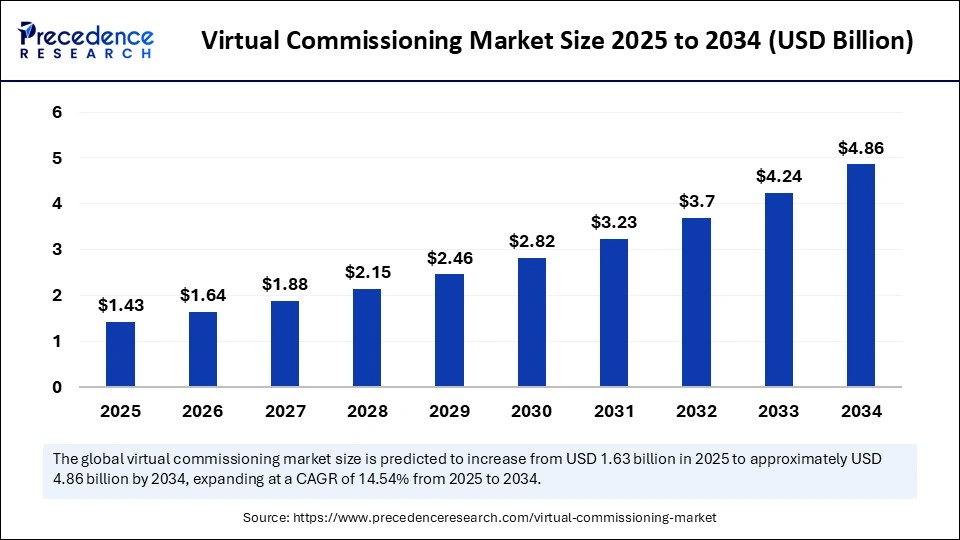
The global virtual commissioning market is experiencing remarkable growth, projected to expand from USD 1.25 billion in 2024 to USD 4.86 billion by 2034, reflecting a CAGR of 14.54%. The momentum is strongly tied to the widespread adoption of Industry 4.0 initiatives, where digital transformation and automation are becoming the foundation of industrial strategies. Organizations are realizing that traditional commissioning methods often lead to costly delays, operational risks, and downtime. Virtual commissioning addresses these challenges by allowing businesses to test, simulate, and refine production systems in a digital environment before deploying them physically.
How Do Digital Twins Transform Industrial Commissioning?
At the core of this transformation lies digital twin technology, which creates virtual replicas of physical systems. By using digital twins, manufacturers can simulate factory layouts, machine interactions, and production processes with high accuracy. This not only ensures safer commissioning but also helps in predicting potential failures and optimizing workflows. For industries like automotive and aerospace, where downtime costs can run into millions, the ability to fine-tune operations virtually offers a critical competitive edge.
“Can Artificial Intelligence Unlock the Next Phase of Growth?”
Artificial intelligence is rapidly reshaping virtual commissioning. Through machine learning algorithms and predictive analytics, AI makes simulations more accurate, self-correcting, and adaptive to real-world uncertainties. AI-driven commissioning allows systems to learn from data patterns, predict potential faults, and improve calibration between virtual models and real assets. This not only enhances reliability but also ensures that commissioning times can be cut by up to 60%, enabling industries to accelerate product rollouts and maintain operational efficiency.
“Why Do Enterprises See Virtual Commissioning as a Strategic Necessity?”
“Virtual commissioning is no longer an optional add-on; it has become a strategic necessity for modern manufacturing. By integrating simulation, AI, and predictive modeling, organizations can significantly reduce risks, avoid costly downtime, and improve overall system reliability,” said Dr. Ananya Mehta, Principal Consultant at Precedence Research.
Virtual Commissioning Market Scope
| Report Coverage | Details |
| Market Size by 2034 | USD 4.86 Billion |
| Market Size in 2025 | USD 1.43 Billion |
| Market Size in 2024 | USD 1.25 Billion |
| Market Growth Rate from 2025 to 2034 | CAGR of 14.54% |
| Dominating Region | North America |
| Fastest Growing Region | Asia Pacific |
| Base Year | 2024 |
| Forecast Period | 2025 to 2034 |
| Segments Covered | Application / End-Use Industry, Deployment / Service Model, Organization Size / End-User Size, and Region |
| Regions Covered | North America, Europe, Asia-Pacific, Latin America, and Middle East & Africa |
U.S. Virtual Commissioning Market Growth 2025 to 2034
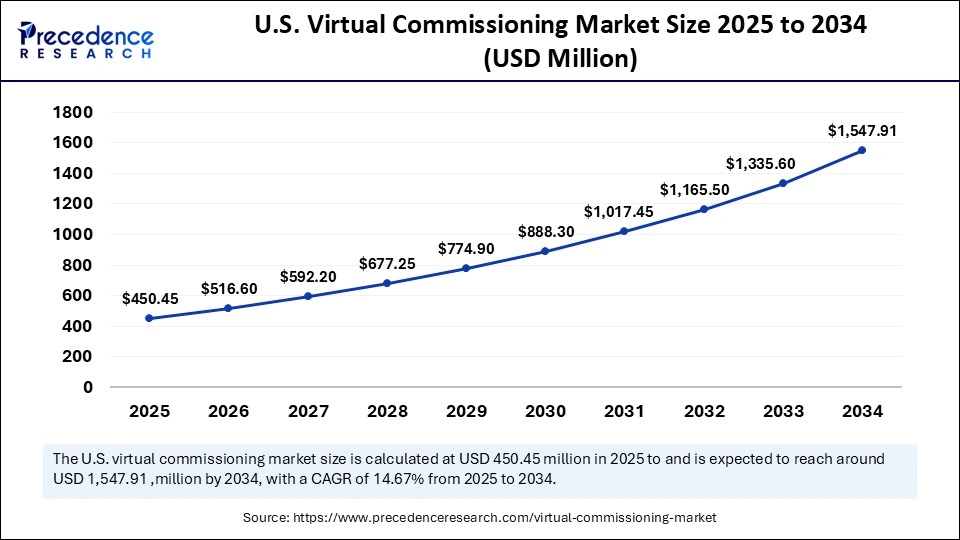
The U.S. virtual commissioning market size was exhibited at USD 393.75 million in 2024 and is projected to be worth around USD 1,547.91 million by 2034, growing at a CAGR of 14.67% from 2025 to 2034.
Why Does North America Continue to Dominate the Market?”
North America held the largest share of the virtual commissioning market in 2024, driven by heavy investments in Industry 4.0 transformation, digital twin adoption, and automation across manufacturing ecosystems. The United States leads the region with its strong automotive, aerospace, and defense industries, where companies are integrating simulation and predictive analytics to reduce commissioning times and operational risks. Canada is steadily expanding its adoption, particularly in industrial equipment, packaging, and energy infrastructure modernization projects. Mexico is also gaining traction as an emerging hub, thanks to its expanding automotive supply chain and integration with U.S. manufacturers seeking efficiency and cost optimization. Together, these dynamics position North America as the innovation leader, where advanced technologies like AI-enabled commissioning and hybrid deployment models are being pioneered
Why Is Asia Pacific Emerging as the Fastest-Growing Region?
Asia Pacific is projected to record the highest CAGR through 2034, making it the fastest-growing regional market for virtual commissioning. China leads this momentum, supported by government-backed smart factory programs, large-scale industrial automation, and rapid digitalization in automotive and consumer electronics sectors. India is following closely, fueled by initiatives like “Make in India” and investments in pharmaceuticals, energy, and packaging industries, where simulation is improving safety, compliance, and efficiency. Japan, with its deep expertise in robotics and precision engineering, continues to integrate commissioning into automotive, electronics, and machinery sectors. Meanwhile, Southeast Asian economies such as Vietnam, Thailand, and Malaysia are accelerating adoption, particularly in electronics assembly and packaging, as they expand their role in global manufacturing supply chains. Asia Pacific’s rapid industrialization and digital-first strategies ensure it will be the growth engine of the global market over the next decade.
Virtual Commissioning Market Segments
Which Industries Are Driving the Adoption of Virtual Commissioning?
The automotive and transportation sector leads in adopting robotics, digital twins, and automated assembly for production streamlining. Aerospace and defense utilize simulation for safety-critical operations, compliance, and error reduction. Machine manufacturing and industrial equipment producers employ virtual commissioning to validate automation sequences and machine motion. The energy and utilities sector uses digital commissioning for grid modernization and predictive maintenance. The packaging industry leverages virtual commissioning to validate flexible machinery and address sustainability. Process industries apply commissioning tools for quality maintenance and regulatory compliance. Consumer electronics, medical devices, and other sectors increasingly use simulation to accelerate innovation and ensure scalable, error-free manufacturing.
Which Deployment Models Are Most in Demand?
On-premises simulation tools are favored by large enterprises and sensitive industries for control and data privacy. Cloud and SaaS platforms show the fastest growth due to affordability, scalability, and collaboration, benefiting SMEs. Hybrid deployments are increasing, blending on-premises control with cloud flexibility. Consulting and professional services are crucial for deployment, customization, and training, aiding ROI.
How Do Different Organization Sizes Leverage Virtual Commissioning?
Small and medium enterprises (SMEs) are increasingly adopting cloud-based virtual commissioning platforms due to their affordability and scalability, enabling them to simulate projects, reduce risks, and accelerate design cycles to compete with larger entities. Large enterprises and OEMs remain the dominant market segment, investing in advanced solutions for complex automation, reduced downtime, and global operational efficiency, particularly as Industry 4.0 and smart manufacturing strategies become critical. SMEs are growing in importance as agile innovators within the virtual commissioning space.
What Opportunities Lie Ahead for Businesses?
Opportunities in the virtual commissioning space are expanding with the adoption of cloud-based deployment models, which make high-end simulation tools accessible even to small and medium enterprises (SMEs). Additionally, the integration of IoT-driven predictive maintenance is opening doors for continuous monitoring and optimization. Another major opportunity lies in the energy and utilities sector, where modernization projects demand robust and safe commissioning strategies.
What Challenges Are Holding Back the Market?
While the benefits are clear, the industry still faces challenges. High upfront investment in software and training often discourages smaller firms from early adoption. Integrating virtual commissioning with legacy systems can be complex, creating barriers for industries reliant on older infrastructure. Furthermore, as more companies shift to cloud deployments, cybersecurity risks are becoming a significant concern. Lastly, there is a noticeable skills gap in simulation engineering and AI-enabled commissioning, which could slow adoption if not addressed through training and upskilling initiatives.
Virtual Commissioning Market Top Companies
- Siemens
- Rockwell Automation
- ABB
- Dassault Systèmes
- Visual Components (and Delfoi)
- Maplesoft
- CENIT
- MathWorks
- Beckhoff Automation
- HEITEC AG
- ISG Industrielle Steuerungstechnik
- Robotmaster (Hypertherm)
- ArtiMinds
- OCTOPUZ
- machineering GmbH & Co. KG
- Xcelgo
- RoboDK
- Drag and Bot
- KEB
Virtual Commissioning Market Recent Developments
- In September 2025, Admiral Dinesh Kumar Tripathi, Chief of the Naval Staff, underscored that future challenges can only be met through the partnerships built today, stressing that the ability to collect, analyze, and share information in real time will be central to strengthening both deterrence and defence. He made these remarks at the commissioning ceremony of INS Aravali, the Indian Navy’s newest naval base, held in Gurugram on Friday. On the occasion, the CNS was accorded a Guard of Honour by 50 personnel. Captain Sachin Kumar Singh, the unit’s first Commanding Officer, led the ceremony by reciting a Sanskrit invocation and reading out the commissioning warrant.
- In September 2025, with passenger numbers surging, sustainability requirements intensifying, and operations becoming increasingly complex, airports can no longer rely on outdated tools to meet future demands. Dassault Systèmes is helping airport operators transform the way they manage infrastructure, streamline operations, and elevate the passenger journey through its Airport Experience solution, driven by the power of the 3DEXPERIENCE platform.
- In August 2025, Muon Space unveiled its MuSat XL platform, a powerful 500-kg-class satellite designed to support the next generation of low Earth orbit (LEO) missions. The company also announced Hubble Network as the platform’s first customer, marking a significant milestone for the new high-performance system.