



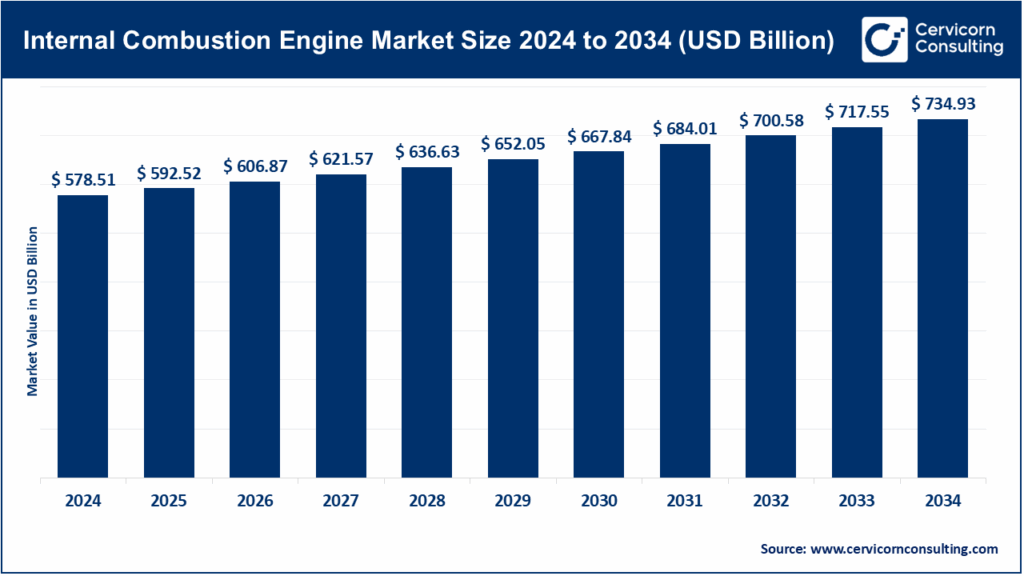
Cervicorn Consulting forecasts, the global internal combustion engine (ICE) market was valued at USD 578.51 billion in 2024 and is projected to reach approximately USD 734.93 billion by 2034, growing at a compound annual growth rate (CAGR) of 2.42% from 2025 to 2034. The ICE market continues to expand as industries rely on dependable and efficient power systems across transportation, agriculture, manufacturing, and energy production. Advancements in fuel efficiency, emission control, and hybrid integration are enabling ICEs to meet modern performance and reliability standards. Despite the rise of electrification, ICEs remain crucial in regions with limited EV infrastructure, offering cost-effective and proven solutions. As companies seek robust technology to support industrial growth and operational stability, the ICE market plays a key role in enhancing efficiency and fostering long-term development worldwide.
Internal Combustion Engine Market Highlights (2024):
- By Region: Asia Pacific accounted for the largest revenue share of 42.2%, driven by industrial growth and high vehicle demand.
- By Fuel Type: The gasoline segment dominated with a 60.38% revenue share, reflecting its widespread use in passenger vehicles.
- By Engine Type: The V-type engine segment led with 55.33% revenue share, preferred in high-performance and heavy-duty vehicles.
- By Power Output: Engines below 100 HP captured 55.42% of the market, driven by demand in passenger and entry-level cars.
- By End-Use: The automotive sector contributed 69.81% of revenue, serving as the primary driver of ICE demand globally.
- By Application: Passenger cars dominated with 65.74% revenue share, reflecting their strong presence in daily-use and affordable vehicle segments.
Internal Combustion Engine Market Regional Analysis
The global internal combustion engine (ICE) market is segmented into key regions: North America, Europe, Asia-Pacific, and LAMEA (Latin America, Middle East, and Africa). The following provides a detailed regional overview.
Asia-Pacific: Leading the ICE Market
The Asia-Pacific ICE market was valued at USD 244.13 billion in 2024 and is expected to reach USD 310.14 billion by 2034.
Countries such as China, Japan, South Korea, India, and Australia dominate the region, driven by strong demand for diesel-powered vehicles, commercial fleets, and off-highway machinery. Despite the growing adoption of electric vehicles (EVs), ICEs—particularly diesel engines—remain essential in infrastructure and agriculture. Innovations continue to improve efficiency and emissions, exemplified by FAW Group’s launch of a 1.5L turbo-diesel engine for light trucks and commercial vehicles in August 2022, demonstrating ongoing investment in ICE technology.
North America: Industrial and Commercial Drivers
The North America ICE market was valued at USD 149.83 billion in 2024 and is projected to grow to USD 190.35 billion by 2034.
The market includes the US, Canada, Mexico, and smaller regions, where demand is fueled by heavy vehicles, commercial transport, and legacy vehicle fleets. ICEs remain dominant in industrial and agricultural sectors despite the increase in EV adoption. For instance, General Motors announced a $1 billion expansion of its engine plant in Canada in March 2024, focusing on V8 and inline engines for trucks and SUVs, underscoring the continued reliance on ICE technology in North America.
Europe: Transitioning to Cleaner ICE Solutions
The European ICE market reached USD 123.80 billion in 2024 and is forecasted to grow to USD 157.28 billion by 2034.
While emission regulations are strict, ICEs continue to be used in commercial and rural industries. Europe is witnessing a gradual transition to hybrid and cleaner fuels, balancing innovation with existing ICE infrastructure. In June 2023, Volkswagen Engine Division opened a Plug-in Hybrid engine plant in Germany, producing ICEs with electrified components compliant with Euro 7 norms, representing a strategic shift toward hybridization.
LAMEA: Emerging Market Growth
The LAMEA ICE market was valued at USD 60.74 billion in 2024 and is expected to reach USD 77.17 billion by 2034.
The region, including Brazil, Middle Eastern countries, and African nations, continues to rely heavily on ICE due to limited EV infrastructure and high electrification costs. ICEs, such as Low-Temperature Electronic Valve (LTEV) engines, are widely used in agriculture, mining, and heavy transport. In October 2024, Embraer introduced a biofuel-compatible diesel engine for agricultural aircraft, demonstrating efforts to modernize ICEs with sustainable alternatives.
Internal Combustion Engine Market Segmental Analysis
Fuel Type Analysis
- Gasoline: Spark ignition engines are prevalent in passenger vehicles due to smooth operation, quieter performance, and rapid acceleration, though torque is lower than diesel. In 2025, General Motors invested $0.88 billion in New York for next-generation V8 gasoline engine development, confirming ongoing demand in trucks and SUVs despite global EV adoption.
- Diesel: Diesel engines use compression ignition, offering higher torque and better fuel efficiency, particularly for commercial, marine, and heavy-duty vehicles. At the Bharat Mobility Expo 2025, Škoda introduced a 2.0L TDI Superb diesel engine in India, highlighting continued innovation for lower emissions and improved fuel efficiency.
Engine Type Analysis
- Inline Engines: Cylinders arranged in a straight line provide simplicity and easier maintenance. Common in compact cars and small SUVs, these engines continue to evolve for better performance and lower emissions, as seen in Mazda’s Skyactiv-D inline 6-cylinder engines in the CX-60 SUV.
- V-type Engines: Cylinders arranged in a “V” shape allow compact design with higher power density, suitable for high-performance sedans, sports cars, and trucks. GM’s $0.88 billion investment in a new V8 V-type engine for its Tonawanda plant emphasizes the segment’s continued relevance in premium vehicles.
Power Output Analysis
- Below 100 HP: Used in small vehicles, two-wheelers, and light machinery, these engines are fuel-efficient with low emissions. For example, Kia introduced a diesel Carens MPV engine in 2023 to meet cost-sensitive markets.
- 100–300 HP: Found in mid-range SUVs, sedans, and light trucks, offering a balance between performance and fuel efficiency. In 2024, Isuzu launched a 2.2L engine for D-MAX and MU-X models in Thailand, catering to rising demand in Southeast Asia.
End-User Analysis
- Automotive: Encompasses passenger and commercial vehicles. ICEs remain primary, though EV adoption is rising. Stellantis invested over $1 billion in Italy in 2023 to modernize ICE and hybrid production for Jeep and Fiat models.
- Marine: ICEs power small boats, ships, and yachts, with diesel engines dominating due to efficiency over long distances. Wärtsilä expanded its marine engine portfolio in 2024 with low-emission dual-fuel systems, enhancing environmental performance while retaining ICE relevance.
Application Analysis
- Passenger Cars: ICEs in passenger cars typically range from 80–200 HP. Gasoline engines dominate, while diesel retains popularity in some regions. Toyota launched hybrid ICEs for Camry and Corolla in 2023, emphasizing fuel economy and thermal efficiency.
- Commercial Vehicles: Includes buses, vans, and trucks requiring high torque and durability. Diesel ICEs remain dominant for heavy loads. Cummins announced a $2 billion investment in 2022 for fuel-agnostic engines capable of operating on diesel, natural gas, and hydrogen, ensuring compliance with evolving regulations.