An IoT chip is a small electronic component that acts like the brain and nervous system of any smart device. It enables the device to process information, connect to networks, and communicate with other devices. Without IoT chips, products like smart speakers, fitness trackers, or connected cars would simply be ordinary gadgets without “smart” features. IoT chips combine multiple functions, such as computing, sensing, and communication, into one compact design. This makes them essential for the Internet of Things (IoT), a vast network of connected devices that exchange data to make life easier, safer, and more efficient.
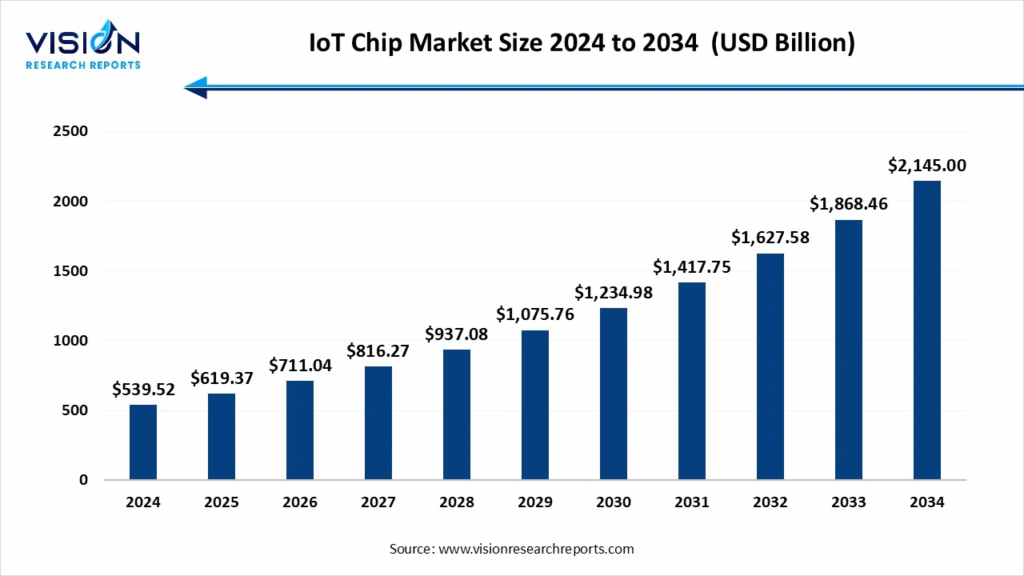
According to Vision Research Reports, the global IoT chip market size was valued at USD 539.52 billion in 2024 and is expected to reach approximately USD 619.37 billion in 2025. The market is projected to surge to USD 2,145 billion by 2034, growing at a strong CAGR of 14.8% during the forecast period from 2025 to 2034.
IoT chips are tiny but powerful components that make devices smart by processing data, connecting to networks, and enabling communication. They are used in gadgets like fitness trackers, smart homes, connected cars, medical devices, and industrial machines. Modern trends include edge AI, low-power designs, 5G connectivity, and enhanced security, powering innovations in healthcare, automation, and smart cities.
Where Are IoT Chips Used?
IoT chips are an integral part of many modern devices, helping them become smarter and more efficient. In consumer electronics, these chips power gadgets like fitness trackers, smartwatches, and home assistants, enabling features such as health monitoring, voice control, and automated home management.
Beyond consumer devices, IoT chips play a crucial role in automotive, healthcare, and industrial sectors. In connected cars, they support navigation, safety systems, and vehicle-to-vehicle communication. In healthcare, IoT chips enable wearable medical devices and remote patient monitoring, providing real-time insights to doctors.
Latest Trends in IoT AI Chips
The rapid growth of IoT (Internet of Things) and AI (Artificial Intelligence) is driving innovation in chip technology. IoT AI chips are no longer just about basic connectivity they are evolving to handle intelligence, efficiency, and security within smart devices. Here are some of the latest trends shaping this market:
- AI at the Edge: Edge AI is transforming IoT devices by enabling on-device data processing. Chips with built-in AI capabilities allow devices to analyze data locally rather than sending it to cloud servers. This reduces latency, enhances real-time decision-making, and lowers dependency on external networks.
- Low-Power Chips: Energy efficiency is a critical factor in IoT devices, especially for wearables, remote sensors, and battery-powered gadgets. The latest IoT chips are designed to consume minimal power while maintaining high performance.
- 5G-Enabled Chips: The rollout of 5G networks has opened new possibilities for IoT devices. Chips with 5G capabilities can handle faster data transfer, lower latency, and high reliability, enabling real-time applications such as connected cars, industrial IoT, telemedicine, and smart city solutions.
- Security-Focused Chips: As IoT devices become more interconnected, cybersecurity has become a top priority. Modern IoT AI chips are incorporating advanced security features such as encryption, secure boot, and hardware-level authentication.
Is a Single IoT Chip Enough for IoT Solutions?
In an ideal scenario, IoT applications aim for a single-chip design that reduces energy consumption while maintaining a compact form factor. This has driven the development of IoT System-on-Chips (SoCs), which integrate multiple functions into one chip. IoT SoCs are designed using advanced techniques to optimize the three critical performance metrics known as PPA Power consumption, Performance, and Area.
However, a single-chip solution is not always practical or suitable for every IoT application. Many businesses require more than just one chip to meet complex demands. IoT modules often need to connect with other nearby devices or the cloud to ensure seamless data exchange and interoperability
Types of IoT Chips Available in the Market
IoT chips are the backbone of smart devices, enabling them to connect, process data, and interact within the Internet of Things (IoT) ecosystem. They perform essential functions such as data sensing, wireless communication, data processing, energy management, and device security.
The market offers various IoT chips for different applications, broadly classified as processor chips, sensor chips, connectivity ICs, memory chips, and logic chips. In AIoT (Artificial Intelligence of Things), four core chips are widely used:
- System on Chip (SoC): The central hub for data processing, enabling intelligence in devices.
- Microcontroller Unit (MCU): Handles data collection and executes commands to support the SoC.
- Connectivity Chip: Ensures reliable communication between devices and the cloud.
- Sensor Chip: Captures environmental signals like temperature, humidity, pressure, and motion, converting them into digital data for processing.
Four Applications of IoT
- Smart Homes – Devices like smart speakers, lighting systems, and connected appliances create comfortable, automated living spaces.
- Healthcare – IoT enables remote monitoring, wearable health trackers, and connected medical equipment for better patient care.
- Industrial IoT (IIoT) – Manufacturing, logistics, and energy sectors use IoT for automation, predictive maintenance, and improved safety.
- Smart Cities – IoT powers traffic management, smart energy grids, and waste management, making cities more sustainable and efficient.