



The movement of liquid chemicals across seas is one of the unsung yet critical pillars of global trade. The Chemical Tanker Shipping Market plays a crucial role in transporting petrochemicals, organic and inorganic chemicals, acids, edible oils and more, safely and efficiently. As industrialization accelerates—particularly in emerging economies—and environmental, safety, and regulatory requirements tighten, chemical tankers are being redesigned, retooled, and rethought.
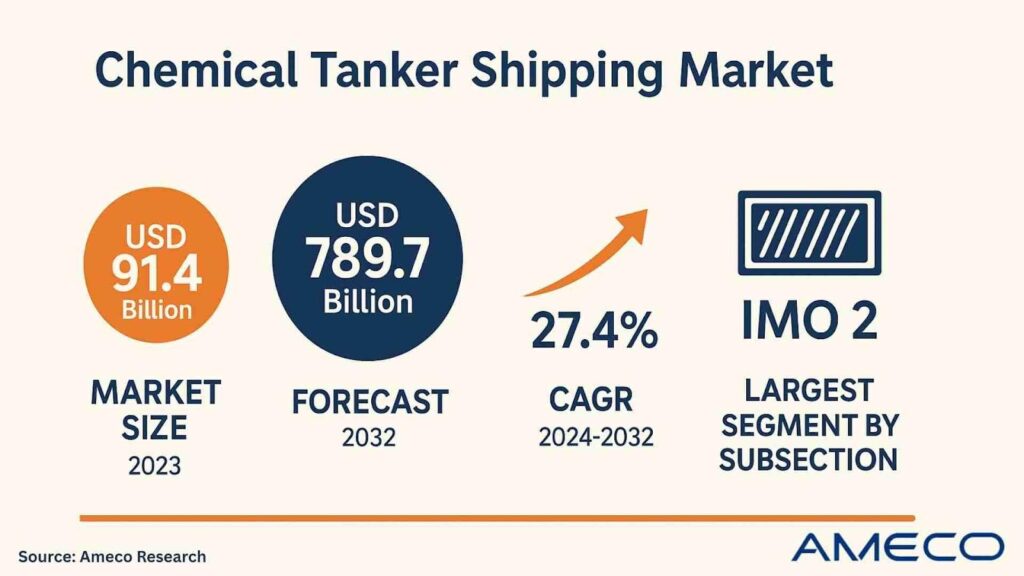
According to Ameco Research, the Chemical Tanker Shipping Market size was approximately USD 91.4 billion in 2023, and forecasts suggest the market will grow to around USD 789.7 billion by 2032, maintaining a notable compound annual growth rate (CAGR) of 27.4% from 2024 to 2032. This explosive growth underscores both expanding demand for chemical logistics and increasing complexity in what is shipped, how, and under what regulatory frame.
Market Size & Forecast
- 2023 Market Size: USD 91.4 billion
- Forecast for 2032: USD 789.7 billion
- CAGR (2024-2032): ~27.4%
These figures indicate that the Chemical Tanker Shipping Market Growth is anything but incremental. Over the forecast period, this sector is expected to nearly multiply more than eight-fold in value—a sign of deep structural demand, evolving shipping technologies, and intensifying global trade in specialty and bulk chemicals.
Key Drivers of Chemical Tanker Shipping Market Trends
Several dynamics are pushing the Chemical Tanker Shipping Market toward this robust expansion:
- Industrialization & Chemical Demand Growth
Industries including pharmaceuticals, agriculture, petrochemicals, food processing, and consumer goods are increasing their usage of both foundational and specialty chemicals. This means higher volumes of liquid chemicals need safe shipping. Ameco Research cites especially high demand in emerging chemical manufacturing clusters in Asia-Pacific (e.g. China, India). - Technological Innovation in Tanker Design
Modern chemical tankers are adopting advanced safety features: multi-compartment arrangements enabling transport of different chemicals simultaneously, coatings resistant to corrosion, heat treatment technologies, and better compartmentalization. These improve safety, versatility, and reduce risk of contamination. - Regulatory and Environmental Pressures
Regulations such as those from IMO (International Maritime Organization), MARPOL, and the IMDG codes demand stricter safety, environmental standards, and containment rules. These regulatory demands push fleet operators to upgrade older vessels, adopt greener fuels, and build vessels that comply with more stringent norms. - Digitalization, Operational Efficiency & Green Shipping
Trends like predictive maintenance, advanced routing, IoT, and digital fleet supervision are being leveraged to reduce downtime, fuel usage, and emissions. Green shipping technologies (alternative fuels, design modifications, hull efficiency) are increasingly critical due to both regulation and stakeholder scrutiny. - Emerging Market Growth & Trade Liberalization
Asia-Pacific stands out as a region with fast industrial growth, rising chemical export/import volumes, and expanding port infrastructure. Countries’ policies facilitating trade, chemical production, and investment in shipping capacity amplify demand for chemical tanker services.
Chemical Tanker Shipping Market Segmentation & Market Share Insights
Understanding how the Chemical Tanker Shipping Market Share is distributed across segments yields insight into where value lies now and where it may shift.
By Fleet Type (IMO Classification)
- The IMO 2 fleet segment (moderately hazardous chemicals, vegetable oils, fats, etc.) is the largest segment, capturing over 51% of the total market in 2023.
- IMO classes 1 and 3 — which handle more hazardous or highly regulated cargoes — are growing too, spurred by regulatory demands, but from a smaller base.
By Product / Vessel Size
- Deep-Sea Chemical Tankers (10,000-50,000 DWT) are among the vessel/product categories with the highest share, due to their capability to transport large volumes over long distances.
- Coastal and inland chemical tankers also have roles in specific supply chains, particularly for less hazardous chemicals or shorter trade routes.
By Application
- Organic Chemicals dominate the application segment in the forecast period, driven by demand in pharmaceuticals, plastics, agrochemical sectors, etc.
- Other applications include inorganic chemicals, vegetable oils & fats, liquefied gases, and “others” — each with varying growth potential depending on region.
Chemical Tanker Shipping Market Regional Analysis
Geographical dynamics are central in shaping the Chemical Tanker Shipping Market Trends and competitive positioning.
- North America is projected to be the largest revenue-generating region over the forecast period. Industrial chemical production (including via shale gas feedstocks) and established port and shipping infrastructure support this dominance.
- Asia-Pacific is expected to be the fastest growing region from 2024-2032, driven by heavy chemical production, growth of specialty chemicals, rising trade, industrialization, and policy support for infrastructure and green shipping.
- Europe also remains significant, especially in specialized and high-value chemicals, as well as in regulatory pressure pushing fleet modernization and adoption of cleaner technologies.
Challenges & Restraints
While the projections are highly optimistic, several challenges could affect the pace of growth:
- Fuel Price Volatility & Operating Costs
Shipping costs are quite sensitive to fluctuations in fuel prices, labor costs, port charges, and maintenance. These can squeeze margins, especially for smaller operators or those with older fleets. - Regulatory Compliance Costs
Upgrading or building tankers compliant with IMO, MARPOL, and specialized containment/safety requirements comes with high capital cost. Environmental regulations are tightening, meaning retrofit or replacement costs. - Risk & Safety Concerns
The transport of hazardous and flammable chemicals is inherently risky; accidents or chemical spills carry environmental, financial, and reputational risk. Safety, contamination, and insurance concerns remain critical. - Logistical Complexity & Infrastructure Limitations
Ports specialized in handling chemical tankers, with appropriate containment, loading/unloading, safety equipment, and inspection, are not uniformly available. Regulatory and customs delays may also hamper efficiency. - Environmental Pressure & Green Transition
The industry is under pressure to decarbonize. Shifting to alternative fuels, retrofitting vessels, or building new green tankers is expensive, and technological / fuel supply challenges remain.
Strategic Implications & Recommendations
Given the market dynamics, stakeholders in the Chemical Tanker Shipping Market should consider several strategic priorities:
- Fleet Modernization & IMO Compliance
Upgrading fleets to newer classifications (IMO 1/3 where required), using corrosion-resistant materials, implementing multi-compartment designs, and improving containment and safety will not just satisfy regulation but offer competitive advantage. - Invest in Green Technologies and Alternative Fuels
Fuel efficiency, emissions control, hull design optimization, and use of low-sulfur or alternative fuels (LNG, biofuels) will increasingly differentiate providers. Early adopter advantage may also help in securing regulatory incentives and customer trust. - Digitalization and Operational Efficiency
Predictive maintenance, optimized routing, IoT-enabled monitoring, better scheduling, and logistic chain improvements reduce downtime and cost. Investing in data and analytics capabilities is becoming essential. - Focus on High Value Applications & Organic Chemical Logistics
With organic chemicals leading applications in both volume and value, companies that specialize in safe, flexible shipping of organic chemicals stand to gain. Diversification into specialty chemicals may yield better margins. - Geographical Expansion & Market Entry in Asia-Pacific
Given Asia-Pacific’s high growth, there are opportunities for fleet operators, shipping firms, port infrastructure providers, and chemical manufacturers to collaborate or expand operations here. Local regulations and logistics partnerships will be key. - Safety, Compliance & Risk Management
Continuous monitoring of regulatory changes, adherence to safety protocols, rigorous crew training, better insurance, and contingency planning for accidents or environmental liabilities will be imperative.
What This Means for Related Industries
The growth in the Chemical Tanker Shipping Market has ripple effects across several industries:
- Chemical Manufacturers & Exporters will increasingly rely on specialized shipping capacities, safe transport, regulatory compliance, and speed. Having access to reliable chemical tanker services becomes part of supply chain strategy.
- Pharmaceuticals & Specialty Chemicals industries, often needing high-purity organic compounds and reagents, benefit from improved shipping safety and scheduling. They may also demand more stringent handling and contamination prevention.
- Port & Logistics Infrastructure Providers will see demand for upgraded handling facilities, containment systems, inspection, and safety installations.
- Investors & Fleet Operators who invest early in green technologies, alternative fuels, and modern, compliant vessels may capture outsized returns.
Chemical Tanker Shipping Market Future Outlook: 2024-2032 & Beyond
- With a CAGR of ~27.4%, the Chemical Tanker Shipping Market Size growth is forecasted to be dramatic: from USD 91.4 billion in 2023 to USD 789.7 billion by 2032.
- Fleet types such as IMO 2 are expected to continue to hold the largest market share for their flexibility, while demand for IMO 1 and IMO 3 may rise with stricter safety and chemical hazard handling requirements.
- Organic chemicals will dominate application segments, while special purpose vessels (e.g. stainless steel, coated, specialized compartments) will become more common.
- Asia-Pacific will likely emerge as the fastest growing region, followed by significant investments in North America and Europe for fleet upgrades.
- Sustainability and regulation will shape not just fleet construction but fuel types, vessel coatings, digital safety systems, and green propulsion systems.
The Chemical Tanker Shipping Market is entering a period of accelerated transformation. With the market expected to grow nearly ninefold by 2032, driven by rising industrial demand, regulatory pressure, and technological innovation, the sector will not remain static. Companies that anticipate these shifts—especially in fleet design, environmental compliance, and operational efficiency—will likely lead.
As reported by Ameco Research, the Chemical Tanker Shipping Market Report offers an essential resource for stakeholders to grasp how fleets, applications, and geographies will evolve. For supply chain managers, shipping firms, chemical producers, and investors, staying ahead of these trends isn’t optional—it’s mission-critical.