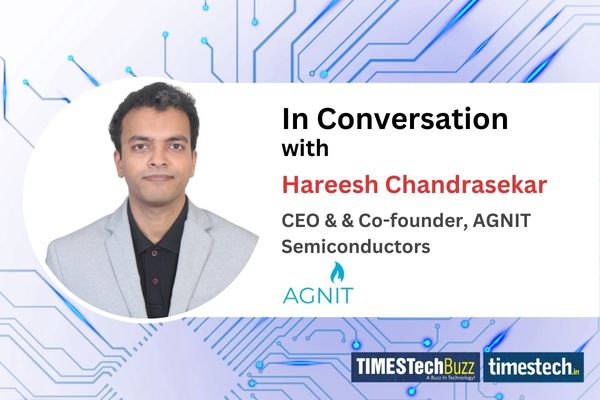
In an interview, Hareesh Chandrasekar, CEO & Co-founder, AGNIT Semiconductors, speaks with TimesTech on how India can carve a competitive position in the global semiconductor value chain. He discusses GaN’s strategic importance across telecom, EVs, defence, and aerospace, AGNIT’s vertically integrated model, and the journey from IISc-led research to building a deep-tech, IP-driven Semiconductor Company from India.
Read the full interview here:
TimesTech: India aims to become a global semiconductor hub, yet many challenges persist. From your perspective, what unique strengths or opportunities can India leverage in the semiconductor value chain to carve out a competitive position globally?
Hareesh: India is emerging in the semiconductor landscape as global supply chains are being restructured. With decades of expertise in chip design, EDA, and embedded software, backed by strong academic institutions and homegrown firms. The country is transforming design leadership into a product-driven ecosystem with companies developing and owning critical semiconductor IP. Restrictions on advanced RF and power devices create a strategic opportunity to produce Made in India chips. By focusing on high-value niches, particularly compound semiconductors, the nation is not just keeping pace but leading innovation, positioning itself as a global competitor in specialized semiconductor domains.
TimesTech: AGNIT’s GaN solutions span telecommunications, EVs, defense, and aerospace. Could you highlight some specific applications or innovations where GaN is creating the most impact, and how AGNIT is contributing to these high-priority sectors?
Hareesh: GaN gives India an opening to lead in a fast-growing technology space that isn’t dominated by legacy players. Its strengths in high power, high frequency, and efficiency make it ideal for 5G radios, EVs, radars, and aerospace systems places where silicon falls short. AGNIT is pushing this shift by building GaN devices for telecom, mobility, defense, and space. We develop RF power amplifiers, high-efficiency power devices, and mission-grade components for critical systems. Through our MoU with the Ministry of Defence,we are co-developing strategic GaN technologies within India, ensuring the country builds critical capability in areas where self-reliance is essential. This helps India build its own capability and gives AGNIT a clear role in shaping next-generation semiconductor innovation.
TimesTech: AGNIT is India’s first GaN-focused semiconductor startup, born from 15 years of research at IISc. Can you walk us through this journey from academic R&D to building a deep-tech company and what gaps or opportunities inspired the creation of AGNIT?
Hareesh: Our founding team, five professors and several PhD scholars, spent over 15 years building a deep R&D foundation. We published 100 papers and developed a strong IP portfolio in GaN epitaxy, device architectures, and fabrication processes. This work ultimately seeded the company. Technology alone doesn’t become a product, and products alone don’t become a business. That translation requires engineering at scale and real customers. We realized India needs not just design centers for global players, but homegrown companies building next-generation semiconductor products from the ground up. AGNIT was created to do exactly that, convert taxpayer-funded research into market-ready solutions and build a defensible IP stack from materials to systems that advances India’s strategic and global ambitions. This was the right moment. India is moving from service work to creating its own semiconductor products and IP, and AGNIT is proud to be a part of this shift.
TimesTech: AGNIT emphasizes a vertically integrated business model. How does this model strengthen your technological capabilities, and what advantages does it offer in scaling GaN innovation within India?
Hareesh: While many Indian semiconductor startups avoid capital-heavy manufacturing, AGNIT has chosen a vertically integrated path. We develop GaN materials, process our own wafers, fabricate dice, and deliver complete RF and power subsystems enabling simultaneous optimization of efficiency, power density, reliability, and form factor without dependence on off-the-shelf wafers or black-box processes. Instead of building a greenfield fab from day one, we strategically leverage India’s government-funded GaN foundry at IISc. This approach positions us to scale toward deploying up to 100,000 chips in the field with under USD 5 million in funding, while retaining the flexibility to transition high‑volume products to larger foundries as demand accelerates.
TimesTech: AGNIT has secured major recognitions like the IESA Technovation Startup Award and NASSCOM Deep Tech Emerge 50, along with an MoU with the Ministry of Defence. How have these milestones influenced your growth, credibility, and future roadmap?
Hareesh: Milestones such as the IESA Technovation Startup Award, NASSCOM Deep Tech Emerge 50 recognition, and Ministry of Defence support through iDEX and MoUs validate our technology maturity, execution strength, and national relevance. These recognitions accelerate customer adoption, attract top talent and partners, unlock scale-up capital, and advance India’s path toward volume manufacturing in advanced semiconductors. We see them not as rewards, but as a responsibility to deliver technologies that strengthen India’s critical industries. Our mission is clear to build a globally influential compound-semiconductor product company from India shaping the future of the industry.