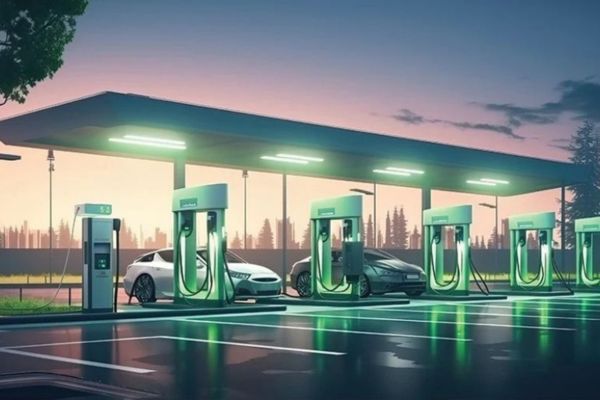
The Global EV Charging Infrastructure Market is a cornerstone of the electric vehicle (EV) revolution. As electric cars, buses, and commercial fleets grow in popularity worldwide, demand for reliable and widespread charging infrastructure is skyrocketing. These systems encompass public charging stations, private/residential chargers, fast-charging hubs, and smart grid integration collectively forming the backbone of sustainable transportation.
Market Overview

The EV charging infrastructure market is experiencing rapid global expansion driven by the exponential adoption of EVs and supportive government policies. The sector includes a range of charging technologies from AC home chargers to high-power DC fast chargers and aims to ensure convenient access to charging across cities, highways, workplaces, and residential areas.
According to recent industry estimates:
- The global market size was valued at USD ~23.7 billion in 2023 and grew to ~USD 30.1 billion in 2024, with forecasts projecting a massive increase to USD ~204.9 billion by 2032 at a CAGR of about 27%.
- Other estimates suggest the market could reach USD ~667.7 billion by 2035, expanding at a CAGR exceeding 30% over the decade.
This remarkable growth reflects how electric charging infrastructure is becoming integral to both consumer confidence and EV adoption worldwide.
Key Market Drivers
1. Surging EV Adoption Worldwide
Electric vehicle sales continue to rise sharply, driving demand for accessible charging solutions globally. A growing EV fleet means more charging points are needed not just in cities, but also along highways and in residential areas.
2. Government Policy and Incentives
Governments in Asia-Pacific, Europe, and North America are incentivizing infrastructure deployment through subsidies, regulatory frameworks, and installation targets fueling investment and accelerating build-outs.
3. Technological Advancements
Rapid innovation in fast-charging, ultra-fast charging, smart grid integration, and IoT connectivity is making EV charging faster, more efficient, and user-friendly.
Industry Trends
Fast-Charging Expansion
High-power DC chargers capable of replenishing EV batteries in minutes are among the fastest-growing segments, especially on major travel corridors and urban hubs.
Smart & Integrated Infrastructure
Smart charging stations with connectivity and energy management systems are rising, enabling optimized load balancing, predictive maintenance, and integration with renewable energy sources.
Vehicle-to-Grid (V2G) Development
V2G technology, which allows EVs to feed energy back to the grid, is gaining traction and is expected to enhance grid stability while providing new revenue streams for EV owners.
Regional Dynamics
- Asia-Pacific: Leads globally due to massive EV adoption and extensive infrastructure deployment, especially in China and rapidly developing markets across South and Southeast Asia.
- North America: Strong growth supported by corporate networks, government funding, and expanding fast-charging stations in urban and rural corridors.
- Europe: Focused on meeting ambitious emissions goals, with dense charging networks and interoperability standards gaining traction.
Market Segmentation
The EV charging infrastructure market can be broadly segmented by:
- Charger Type: AC Charging (home and workplace), DC Fast Charging (public and highway)
- Deployment Site: Public charging stations, residential chargers, commercial hubs
- Technology: Smart chargers, networked stations, renewable-integrated systems
These segments reflect different use cases from daily overnight charging at home to high-speed public stations enabling long-distance travel.
Challenges and Restraints
Despite rapid growth, the market faces several hurdles:
- High Installation Costs: Setting up fast-charging infrastructure requires significant capital investment, grid upgrades, and land planning.
- Grid Capacity Limitations: Increasing demand for electricity from EV clusters can strain local grids, requiring infrastructure reinforcement.
- Policy & Standardization Differences: Variation in regional regulations and connector standards can slow global deployment efficiency.
Future Outlook & Opportunities
The EV charging infrastructure market is poised for sustained expansion as governments, automakers, and energy companies accelerate their commitments to electrification. The growth outlook includes:
✔ Expanded public and private charging networks
✔ Continued investment in ultra-fast and smart charging technologies
✔ Greater integration with renewable energy sources
✔ New business models such as charging-as-a-service (CaaS)
As electric vehicles become increasingly mainstream, charging infrastructure will no longer be a barrier it will be a catalyst for the global electrification of transport.