

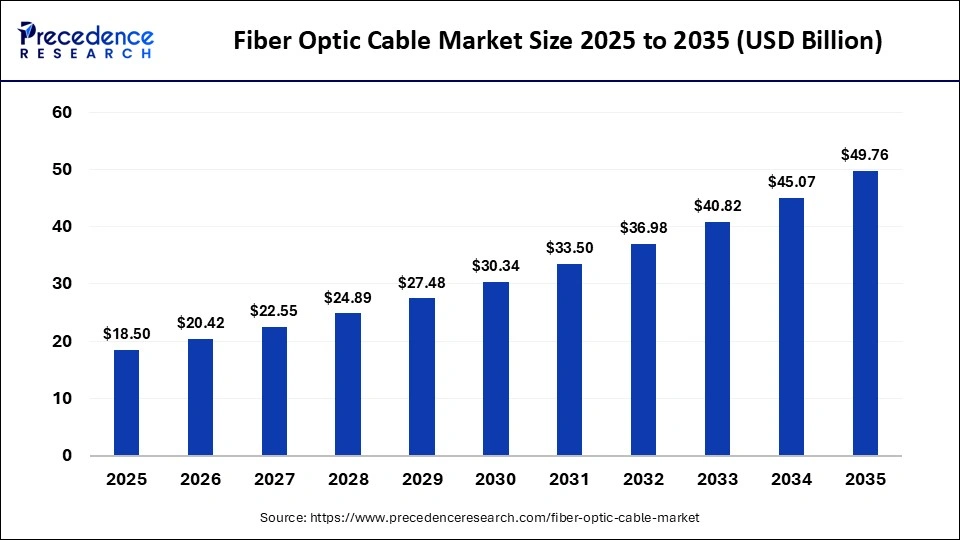
The global fiber optic cable market size was valued at USD 18.50 billion in 2025 and is projected to rise from USD 20.42 billion in 2026 to approximately USD 49.76 billion by 2035, expanding at a CAGR of 10.40% during the forecast period. The market is witnessing rapid acceleration due to the explosive growth of data consumption, widespread 5G deployment, and increasing reliance on high-bandwidth digital infrastructure across industries.
Fiber optic cables have become the backbone of modern communication systems, enabling ultra-fast, low-latency, and high-capacity data transmission across telecommunications networks, data centers, enterprise IT systems, and submarine communication lines. The ongoing shift toward cloud-native ecosystems, AI-driven workloads, and edge computing is further strengthening demand for robust fiber optic infrastructure globally.
Quick Insights
- The market was valued at USD 18.50 billion in 2025 and is projected to reach USD 49.76 billion by 2035.
- Expected CAGR is 10.40% from 2026 to 2035.
- North America led with ~38% market share in 2025.
- Asia Pacific is expected to grow at the fastest CAGR of ~11%.
- Telecommunications segment dominated with ~40% share in 2025.
- Data centers are the fastest-growing application segment (~10.5% CAGR).
- Single-mode fiber optic cables held ~60% share in 2025.
- Underground installation dominated with ~50% share in 2025.
Why Is the Fiber Optic Cable Market Growing So Rapidly?
The fiber optic cable market is expanding due to the global surge in digital connectivity requirements. The rapid adoption of high-speed broadband, 5G networks, and cloud-based applications has significantly increased the need for reliable, high-capacity data transmission infrastructure.
Additionally, the exponential growth of data centers driven by AI, machine learning, and cloud computing workloads is pushing telecom operators and enterprises to upgrade legacy copper networks to fiber-based systems. Governments across multiple regions are also investing heavily in national broadband expansion projects, further accelerating market growth.
How Is AI Transforming the Fiber Optic Cable Ecosystem?
Artificial intelligence is reshaping the fiber optic cable ecosystem by optimizing network design, predictive maintenance, and real-time performance monitoring. AI-driven analytics help telecom operators identify signal degradation, network congestion, and potential failures before they impact service quality.
AI is also enhancing fiber network planning by simulating traffic loads and optimizing cable routing for maximum efficiency. In data centers, AI is improving bandwidth allocation and reducing latency by dynamically managing fiber optic traffic based on workload demand patterns.
What Are the Key Growth Drivers in the Market?
One of the primary growth drivers is the global rollout of 5G infrastructure, which requires dense fiber optic backhaul networks to support ultra-fast data transmission and low-latency communication. Without fiber optics, 5G networks cannot achieve their full performance potential.
Another major driver is the rapid expansion of hyperscale data centers. Companies like Meta, Google, and Microsoft are investing heavily in fiber-based interconnects to support AI workloads and cloud services. For example, Meta recently signed a multi-billion-dollar deal with Corning to secure fiber optic supply for AI data centers.
Increasing internet penetration, remote work trends, and streaming services are also significantly contributing to rising bandwidth consumption globally.
Why Is Telecommunications the Dominant Application Segment?
The telecommunications segment dominated the market with a 40% share in 2025 because fiber optic cables are essential for long-distance, high-speed communication networks. Telecom operators rely on fiber infrastructure for broadband services, mobile networks, and international connectivity.
Fiber optics provide extremely low signal loss and high bandwidth capacity, making them indispensable for 5G base stations, metro networks, and backbone communication systems.
What Opportunities Are Emerging in the Fiber Optic Cable Market?
Why are data centers becoming the biggest opportunity?
Data centers are emerging as one of the fastest-growing segments due to increasing cloud adoption, AI computing, and hyperscale infrastructure expansion. Fiber optic cables are critical for interconnecting servers, storage systems, and network switches within and between data centers.
How is submarine connectivity shaping global demand?
Submarine fiber optic cables are becoming increasingly important for international communication and global internet traffic exchange. Growing cross-border data flow and cloud globalization are driving investments in undersea cable projects.
What role does 5G expansion play in future growth?
5G expansion is creating massive demand for fiber backhaul networks that connect base stations and edge computing nodes. This is expected to significantly boost fiber deployment across urban and rural regions worldwide.
Which Segments Are Leading the Market?
By Type
Single-mode fiber optic cables dominated the market with a 60% share in 2025 due to their ability to support long-distance, high-speed transmission with minimal signal loss. Multi-mode fibers continue to grow in short-range applications such as data centers and enterprise networks.
By Installation
Underground installation led the market with a 50% share due to higher durability, security, and reduced risk of environmental damage. Aerial and submarine deployments are also growing due to cost efficiency and international connectivity demand.
By Application
Telecommunications remained the largest segment, followed by data centers, which are expected to grow at the fastest rate due to rising cloud computing and AI workloads.
Why Is North America Leading the Market?
North America dominated the market with a 38% share in 2025 due to early adoption of advanced communication technologies, strong presence of hyperscale data centers, and large-scale 5G deployment initiatives.
The United States leads regional growth with major investments in fiber networks supporting cloud computing and AI infrastructure. Meanwhile, Asia Pacific is expected to grow the fastest due to rapid digitalization, expanding telecom networks, and government-led broadband expansion programs.
What Are the Latest Innovations in the Market?
Recent innovations include ultra-low-loss optical fibers, bend-insensitive cables, high-density ribbon fiber technology, and advanced submarine cable systems. Companies are also developing AI-integrated fiber monitoring systems to detect faults in real time and reduce network downtime.
Major players are expanding production capacity and investing in next-generation fiber manufacturing technologies to meet rising global demand.
What Challenges Are Restricting Market Growth?
Despite strong growth, the market faces challenges such as high installation costs, complex deployment in rural and remote areas, and dependency on skilled labor for network maintenance.
Supply chain disruptions and raw material constraints can also impact production timelines and pricing stability, especially for large-scale infrastructure projects.
Case Study: Big Tech Driving Fiber Expansion for AI Data Centers
In a major development, Meta signed a multi-billion-dollar agreement with Corning to secure fiber optic cables for its AI-driven data centers. This deal highlights the growing importance of fiber infrastructure in supporting high-performance computing and large-scale AI workloads.
The agreement reflects a broader industry trend where hyperscale cloud providers are investing heavily in fiber optic capacity to support next-generation digital ecosystems.
Get Sample Link: https://www.precedenceresearch.com/sample/8315