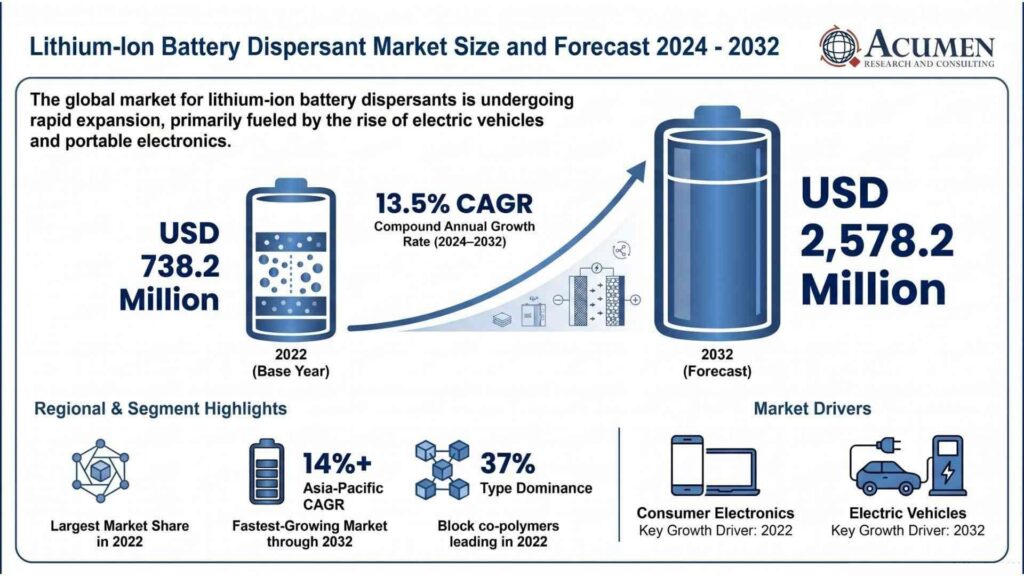
According to Acumen Research and Consulting, the Global Lithium-Ion Battery Dispersant Market was valued at USD 738.2 Million in 2022 and is forecasted to reach USD 2,578.2 Million by 2032, growing at a CAGR of 13.5% from 2024 to 2032.
The global Lithium-Ion Battery Dispersant Market is witnessing explosive growth due to rising electric vehicle production, rapid expansion of energy storage systems, and increasing demand for advanced consumer electronics. As lithium-ion batteries continue dominating the global energy transition, dispersants are becoming critical materials for improving battery performance, conductivity, stability, and longevity.
What is Driving the Lithium-Ion Battery Dispersant Market Growth?
The Lithium-Ion Battery Dispersant Market is growing rapidly due to the accelerating adoption of electric vehicles (EVs), renewable energy storage systems, and portable electronic devices.
Dispersants play a crucial role in lithium-ion battery manufacturing by ensuring uniform particle distribution in electrode slurries. These additives improve:
- Battery conductivity
- Energy density
- Charging efficiency
- Cycle life
- Thermal stability
- Electrode consistency
The increasing need for high-performance batteries in EVs and consumer electronics is significantly boosting the demand for advanced dispersant technologies.
Additionally, battery manufacturers are investing heavily in next-generation electrode materials requiring highly efficient dispersant formulations for enhanced electrochemical performance.
Lithium-Ion Battery Dispersant Market Size & Forecast
The industry outlook remains highly promising as governments and automotive manufacturers continue accelerating electrification initiatives worldwide.
Key Market Statistics
- Market Size in 2022: USD 738.2 Million
- Forecast Market Size by 2032: USD 2,578.2 Million
- CAGR (2024–2032): 13.5%
- North America Market Share (2022): 32%
- Fastest Growing Region: Asia-Pacific
- Leading End-Use Segment: Consumer Electronics
- Dominant Type Segment: Block Co-Polymers
The Lithium-Ion Battery Dispersant Market’s double-digit growth trajectory highlights the increasing importance of dispersant materials in the evolving lithium-ion battery ecosystem.
Electric Vehicle Boom Accelerating Demand
One of the strongest drivers fueling the Lithium-Ion Battery Dispersant Market is the unprecedented rise in electric vehicle adoption globally.
Governments across major economies are aggressively promoting EV manufacturing through:
- Subsidies
- Tax incentives
- Emission reduction policies
- Battery localization programs
- Clean mobility initiatives
As EV production scales rapidly, demand for high-quality lithium-ion batteries is increasing substantially. This directly creates massive opportunities for dispersant manufacturers.
For instance, the opening of a USD 408 million EV manufacturing facility by M Glory Holding Group in Dubai and the rapid surge in EV sales across India are strengthening battery material demand globally.
Consumer Electronics Segment Holds Major Market Share
The consumer electronics industry remains a dominant end-use segment in the Lithium-Ion Battery Dispersant Market.
Lithium-ion batteries are widely used in:
- Smartphones
- Tablets
- Laptops
- Smartwatches
- Wireless earbuds
- Gaming devices
- Portable medical electronics
As global consumers demand thinner, faster, and longer-lasting electronic devices, manufacturers are developing advanced battery chemistries that require high-performance dispersants for optimized electrode functionality.
According to Acumen Research insights, the consumer electronics segment accounted for approximately 32% market share in 2022.
Block Co-Polymers Leading the Market
Among dispersant types, block co-polymers currently dominate the market due to their superior ability to stabilize particles and improve electrode slurry dispersion.
Key advantages include:
- Enhanced electrode uniformity
- Improved conductivity
- Better battery lifecycle
- Reduced sedimentation
- Higher mechanical stability
Manufacturers increasingly prefer block co-polymer dispersants for advanced lithium-ion battery systems, particularly in electric mobility and high-density energy storage applications.
The segment generated nearly 37% market share in 2022.
Asia-Pacific Emerging as the Fastest Growing Region
Asia-Pacific is projected to witness the fastest growth during the forecast period due to massive battery manufacturing expansion across:
- China
- Japan
- South Korea
- India
China remains the global leader in lithium-ion battery manufacturing and EV production, while India is rapidly scaling domestic battery manufacturing capacity under government-backed initiatives.
The rising penetration of portable electronic devices and increasing EV production are major factors strengthening regional demand for lithium-ion battery dispersants.
North America Dominates the Global Lithium-Ion Battery Dispersant Market
North America currently holds the largest market share due to:
- Strong R&D investments
- Presence of major battery manufacturers
- Growing EV production
- Advanced energy storage infrastructure
- Government support for clean energy technologies
The U.S. automotive sector and large-scale investments in battery gigafactories are significantly boosting demand for battery dispersant materials across the region.
Declining Battery Costs Creating New Opportunities
The continuous reduction in lithium-ion battery costs is creating substantial growth opportunities for dispersant manufacturers.
Battery manufacturers are optimizing materials and production processes to improve affordability and scalability. According to industry reports, lithium-ion battery prices have declined significantly over recent years, enabling broader EV and energy storage adoption.
As battery adoption expands into new industries, demand for advanced dispersants is expected to increase proportionally.
Key Companies Operating in the Lithium-Ion Battery Dispersant Market
Several global chemical and specialty materials companies are actively competing in the market through innovation, partnerships, and sustainable product development.
Major market players include:
- Ashland
- Borregaard AS
- Croda International PLC
- The Lubrizol Corporation
- Dow Chemical Company
- Toyocolor Co. Ltd
- LG Chem
- Kao Corporation
- Solvay S.A.
- Akzo Nobel N.V.
These companies are focusing heavily on next-generation dispersant formulations to support high-capacity and fast-charging battery technologies.
Recent Developments and Investments in the Market
Increasing Investments in Battery Gigafactories
Governments and private companies are investing billions into battery gigafactory projects globally, creating long-term opportunities for battery material suppliers.
Eco-Friendly Dispersant Innovations
Manufacturers are increasingly developing environmentally friendly dispersants to align with sustainability regulations and green manufacturing practices.
Expansion of EV Battery Supply Chains
Automotive companies are partnering with chemical manufacturers to secure advanced battery material supply chains, including dispersants and electrode additives.
Technological Advancements in Electrode Formulations
The growing adoption of high-nickel cathodes and silicon anodes is increasing demand for advanced dispersants capable of supporting complex battery chemistries.
Competitive Landscape Analysis
Competition within the Lithium-Ion Battery Dispersant Market is intensifying as companies race to improve battery efficiency and sustainability.
Major strategic priorities include:
- Product innovation
- Sustainable chemistry development
- Capacity expansion
- Strategic collaborations
- Battery performance optimization
- Advanced material R&D
Companies with strong technological expertise and global supply chain capabilities are expected to maintain competitive advantages over the coming decade.
Future Trends Shaping the Lithium-Ion Battery Dispersant Market
Several transformative trends are expected to reshape the market landscape:
Solid-State Battery Development
The emergence of solid-state batteries will create demand for specialized dispersant materials compatible with advanced battery architectures.
AI-Driven Battery Manufacturing
Artificial intelligence and machine learning technologies are improving battery manufacturing precision and slurry optimization.
Growth in Renewable Energy Storage
Grid-scale energy storage systems are becoming increasingly dependent on lithium-ion battery technologies, boosting dispersant consumption.
Sustainable Battery Recycling
Battery recycling and circular economy initiatives are encouraging the development of eco-friendly battery additives and dispersants.
Challenges Impacting the Industry
Despite strong growth prospects, the industry faces several challenges:
- Raw material price volatility
- Safety concerns in lithium-ion batteries
- Regulatory compliance complexities
- Supply chain disruptions
- High R&D costs
However, ongoing technological advancements and growing electrification trends are expected to offset these challenges over the forecast period.
Why Businesses are Investing in this Market
The Lithium-Ion Battery Dispersant Market presents lucrative opportunities for investors and manufacturers due to:
- Rapid EV adoption
- Strong battery demand growth
- Expansion of renewable energy storage
- Rising consumer electronics consumption
- Government electrification initiatives
- Long-term sustainability trends
As lithium-ion batteries continue dominating the global energy transition, dispersant manufacturers are positioned for significant revenue growth opportunities.
Businesses seeking comprehensive forecasts, regional insights, and competitive intelligence can review full sample pages of market research report here.
Frequently Asked Questions About the Lithium-Ion Battery Dispersant Market
What is the size of the Lithium-Ion Battery Dispersant Market?
The global Lithium-Ion Battery Dispersant Market was valued at USD 738.2 Million in 2022 and is projected to reach USD 2,578.2 Million by 2032, growing at a CAGR of 13.5% from 2024 to 2032.
What are lithium-ion battery dispersants used for?
Lithium-ion battery dispersants are used to stabilize and evenly distribute particles in battery electrode slurries, improving battery performance, conductivity, energy density, and lifecycle.
What factors are driving the Lithium-Ion Battery Dispersant Market growth?
Major growth drivers include increasing electric vehicle adoption, rising consumer electronics demand, expansion of renewable energy storage systems, and advancements in battery technologies.
Which region dominates the Lithium-Ion Battery Dispersant Market?
North America currently dominates the market with approximately 32% share due to strong R&D investments and growing EV manufacturing activities.
Which segment holds the largest market share?
The block co-polymers segment dominates the market owing to superior dispersion efficiency and improved electrode performance characteristics.
Who are the major players in the Lithium-Ion Battery Dispersant Market?
Leading companies include Ashland, Croda International PLC, Dow Chemical Company, Solvay S.A., Kao Corporation, and LG Chem.
What are the future trends in the Lithium-Ion Battery Dispersant Market?
Future trends include solid-state battery development, AI-powered battery manufacturing, sustainable dispersant formulations, and rapid expansion of battery recycling ecosystems.