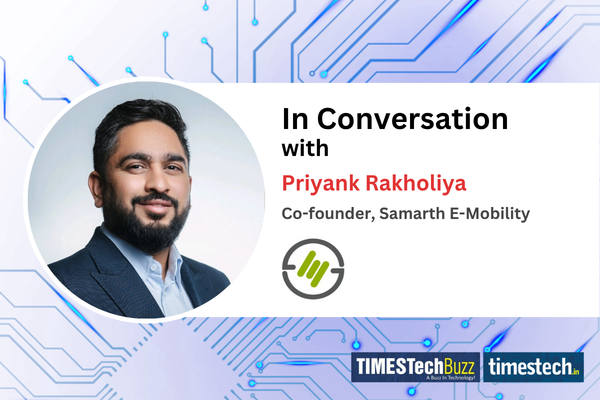
In an interview, Priyank Rakholiya, Co-founder of Samarth E-Mobility, spoke with TimesTech about the next phase of India’s electric two-wheeler revolution. He highlighted the company’s three-year journey of building a fully indigenous EV technology stack, the importance of deep-tech innovation, localization, and sustainable scaling, while sharing how Samarth aims to bridge critical gaps in performance, reliability, safety, and long-term ownership confidence.
Read the full interview here:
TimesTech: India’s EV market is evolving rapidly, especially in the two-wheeler segment. How do you see the next phase of growth shaping up, and what gaps is Samarth E-Mobility aiming to address?
Priyank: India’s EV market is now entering a much more mature and technology-driven phase of growth, particularly in the two-wheeler segment. The initial phase of adoption was largely driven by affordability and early experimentation, but going forward, consumers will increasingly expect higher levels of performance, reliability, safety, connectivity and long-term ownership confidence. We believe the next phase of growth will be led by products that can genuinely replace conventional petrol motorcycles in terms of riding experience and practicality, especially in the highly important 125cc–200cc segment.
At Samarth E-Mobility, we identified a major gap in the market where many existing EV offerings are either focused on low-speed commuting or are heavily dependent on imported systems and assembly-led models. Our core philosophy is centered around bringing intelligence into electric mobility, building products that are not only electric, but also adaptive and engineered for real-world Indian usage. Over the last three years, we have developed a 100% indigenous full-stack EV technology platform with in-house battery systems, motor, BMS, power electronics, onboard fast charger and proprietary operating system. Our goal is not just to launch electric motorcycles, but to build a reliable, scalable and self-reliant EV ecosystem from India.
TimesTech: Samarth E-Mobility has spent the last three years developing a 100% indigenous EV technology stack. What were the biggest technical and operational challenges in building critical components entirely in-house?
Priyank: One of the biggest challenges was building a truly indigenous EV technology platform instead of following the conventional assembly-led approach that exists across much of the industry today. From the beginning, our vision was very clear, we did not want to depend on imported plug-and-play systems. We wanted to engineer core EV technologies in-house and optimize them specifically for Indian riders, road conditions and climatic environments. Achieving this level of vertical integration required significant investments in deep R&D, software development, validation and manufacturing capabilities over the last three years. Building seamless integration between the battery pack, proprietary BMS, motor, motor controller, power electronics and operating system was both technically intensive and time-consuming. Additionally, ensuring safety, thermal stability and long-term reliability across all systems require extensive validation, including over 61,000 km of real-world riding tests, more than 3,400 km of torture testing and extensive dynamometer testing.
Operationally, developing a strong domestic engineering and manufacturing ecosystem was another major challenge. However, today, that has become one of our biggest strengths and differentiators. With our 150+ member engineering team and dedicated R&D facility in Gujarat, we have been able to build critical EV intellectual property within India while reducing dependency on imported technologies.
TimesTech: Your upcoming products are targeting the 125cc–200cc ICE motorcycle alternative segment, which remains highly competitive in India. What consumer pain points are you specifically trying to solve through your electric motorcycles?
Priyank: The 125cc–200cc motorcycle segment is one of the largest and most aspirational categories in the Indian two-wheeler market. Consumers in this segment are looking for a balance of performance, daily practicality, reliability, styling and affordability. However, many current EV products do not fully address these expectations, particularly when it comes to riding dynamics, range confidence, charging convenience and long-term ownership experience.
We are focused on solving these real-world consumer pain points through a technology-first approach. Our platform has been engineered to deliver strong performance, intelligent connectivity, improved system efficiency and enhanced safety while also reducing running and maintenance costs compared to conventional ICE motorcycles. We are also addressing concerns around battery reliability and charging convenience through our proprietary battery management system and AI-controlled onboard fast charger with approximately 1500W charging capacity. Since our hardware and software ecosystem has been developed entirely in-house, we are able to optimize the overall riding experience much more effectively for Indian usage conditions. Ultimately, our goal is to make electric motorcycles feel practical, dependable and aspirational enough to become a true alternative to petrol-powered motorcycles in this segment.
TimesTech: Samarth E-Mobility has developed several in-house technologies, including a patented BMS and an onboard fast charger. How important do you believe deep-tech innovation and localization are for achieving true Atmanirbhar Bharat in the EV sector?
Priyank: Deep-tech innovation and localization are absolutely critical for achieving true Atmanirbhar Bharat in the EV sector. India’s long-term EV success cannot rely solely on assembling imported components. To build a globally competitive and sustainable EV ecosystem, the country must develop its own intellectual property, engineering capabilities and manufacturing ecosystem. At Samarth E-Mobility, this philosophy has been central to our journey. Over the last three years, we have developed and engineered key EV technologies in-house, including our battery pack, proprietary and homologated BMS, motor, motor controller, power electronics, onboard fast charger and operating system. This level of vertical integration gives us greater control over safety, efficiency, software integration and overall vehicle performance while simultaneously reducing dependency on imports.
We also believe localization drives faster innovation because technologies can be developed specifically for Indian consumer behaviour, road conditions and climatic requirements. Additionally, indigenous R&D and manufacturing create stronger supply chains, generate skilled employment opportunities and contribute toward building India as a global EV technology hub. Our ongoing work on rare-earth-free motor technology is another important step toward creating a more sustainable and future-ready electric mobility ecosystem from India.
TimesTech: Many EV startups focus heavily on funding and rapid expansion. From your perspective, what does sustainable scaling mean in the Indian mobility ecosystem, and what lessons have you learned from real-world execution?
Priyank: Sustainable scaling in the Indian mobility ecosystem means building strong technological and operational foundations before pursuing aggressive expansion. In a category like electric mobility, long-term success depends on product reliability, safety, manufacturing quality, after-sales confidence and continuous innovation rather than only rapid market entry or short-term volume growth.
We consciously spent the last three years focusing on deep engineering, extensive testing and validation before introducing our products to the market. Our approach has been to build a scalable technology platform with strong in-house capabilities across hardware, software and manufacturing. This includes establishing our dedicated R&D facility in Gujarat, building a 150+ member engineering team and setting up a 1,50,000+ sq. ft. manufacturing facility with an annual production capacity of over 5 lakh units. One of the biggest lessons from real-world execution is that EV adoption in India requires trust and consistency. Consumers expect products to perform reliably across different terrains, weather conditions and daily usage patterns. That is why we have invested heavily in real-world validation, including over 61,000 km of riding tests and extensive torture testing. We believe sustainable growth comes from building dependable products, strong technology ownership and long-term customer confidence rather than chasing scale at the cost of quality or reliability.