According to our Growth Market Report, the global medical electronics marketsize in 2024 stands at USD 102.8 billion, driven by rapid technological advancements and increasing healthcare investments worldwide. The market is projected to expand at a robust CAGR of 8.7% from 2025 to 2033, reaching a forecasted value of USD 219.7 billion by 2033. Key growth factors include the rising prevalence of chronic diseases, the growing adoption of digital health solutions, and the continuous integration of artificial intelligence and IoT in medical devices. These dynamics underscore the sectorÂ’s pivotal role in shaping the future of healthcare delivery and patient outcomes.
Introduction: India’s Next Healthcare Revolution Is Not Starting in Hospitals
When people imagine the future of healthcare, they often think about advanced hospitals, robotic surgeries, or artificial intelligence diagnosing diseases. Very few imagine that the next healthcare revolution may begin inside a semiconductor manufacturing facility. Yet that is exactly where India is witnessing an important transformation.
The medical electronics market is entering a new phase where technology is becoming as important as medicine itself. Medical devices are no longer just machines that doctors use for treatment. They are evolving into intelligent systems capable of monitoring patients continuously, predicting health risks, and improving clinical decisions through real-time data analysis. India, which has traditionally relied on imported technologies and components, is now moving toward a future where healthcare innovation can be developed and manufactured within the country.
Understanding the Medical Electronics Market Beyond Traditional Machines
Medical electronics refers to electronic systems and technologies used for healthcare diagnosis, monitoring, treatment, and medical research. However, modern medical electronics extends beyond the idea of large equipment installed inside hospitals. Today, healthcare technology exists in smart watches measuring heart activity, portable diagnostic devices in rural clinics, wearable sensors tracking health conditions, and AI-powered imaging systems assisting doctors in making decisions.
The transformation is changing the role of healthcare devices. Earlier generations of medical equipment primarily recorded patient information. The new generation increasingly understands and interprets information. A monitoring device today is not simply showing numbers on a screen; it is analyzing trends and detecting unusual patterns before they become serious health issues.
Why Semiconductor Manufacturing Has Become Important for Healthcare
The word semiconductor generally brings smartphones, laptops, and computers to mind. However, healthcare systems increasingly depend on semiconductor technology because every intelligent medical device contains electronic processing components.
Modern patient monitoring systems, diagnostic scanners, wearable devices, and surgical equipment rely on tiny chips that process enormous amounts of information every second. These chips manage data flow, sensor communication, image processing, and artificial intelligence functions.
Medical Electronics Is Shifting from Reaction to Prediction
Traditional healthcare generally followed a predictable sequence. A patient experienced symptoms, visited a healthcare professional, received diagnosis, and then began treatment. Medical electronics is changing this process fundamentally.
Healthcare systems increasingly focus on identifying risks before visible symptoms appear. Wearable devices continuously monitor heart activity, oxygen levels, sleep patterns, and physical movement. Intelligent software systems analyze collected information and identify patterns that may indicate future health complications.
India’s Healthcare Challenges Are Creating Opportunities for Medical Electronics
India faces unique healthcare conditions because of its large population, varying healthcare accessibility, and increasing burden of lifestyle-related diseases. Urban regions continue to witness growth in diabetes, cardiovascular disorders, respiratory conditions, and stress-related health problems. Rural areas frequently experience limitations in healthcare infrastructure and specialist availability.
Medical electronics can play an important role in addressing these challenges because technology can bring healthcare closer to patients rather than requiring patients to travel toward healthcare systems.
The Emerging Era of Made-in-India Medical Technology
For years, India has largely functioned as a consumer market for sophisticated medical technologies developed elsewhere. The changing semiconductor landscape creates an opportunity to shift that role.
As manufacturing capabilities expand, India may increasingly participate in designing and producing medical devices, healthcare sensors, and advanced electronic systems. The impact extends beyond economic growth because domestic manufacturing can improve supply reliability and potentially reduce costs associated with imported technology.
Competitive Landscape
- Siemens Healthineers
- GE Healthcare
- Philips Healthcare
- Medtronic
- Boston Scientific Corporation
- Abbott Laboratories
- Johnson & Johnson
- Canon Medical Systems Corporation
- Fujifilm Holdings Corporation
- Samsung Medison
- Hitachi Medical Systems
- Becton, Dickinson and Company (BD)
- Stryker Corporation
- Shimadzu Corporation
- Mindray Medical International
- Drägerwerk AG & Co. KGaA
- Smith & Nephew plc
- Zimmer Biomet Holdings
- Baxter International Inc.
- Terumo Corporation
Future Outlook: The Future of Healthcare May Begin with a Microchip
Healthcare and electronics once belonged to different worlds. One focused on medicine and patient care, while the other focused on engineering and technology. Today those worlds are merging rapidly.
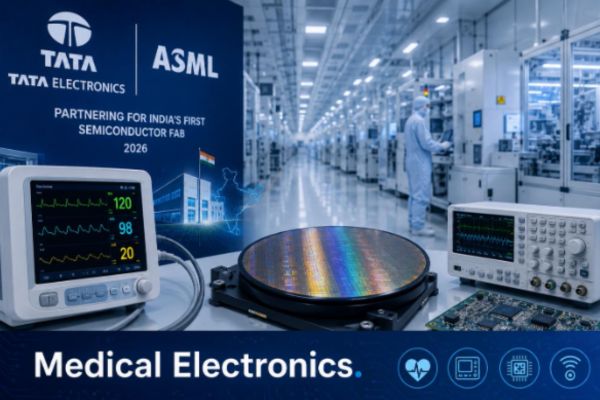
The medical electronics market represents more than a business opportunity; it represents a shift in how healthcare systems may function in the coming decades. The recent momentum surrounding India’s semiconductor ecosystem, including developments involving Tata Electronics and ASML, highlights that technological infrastructure can influence sectors far beyond manufacturing.