
The global electric vehicle (EV) charger market is entering a transformative growth phase, fueled by accelerating electric vehicle adoption, supportive government policies, and significant investments in charging infrastructure.
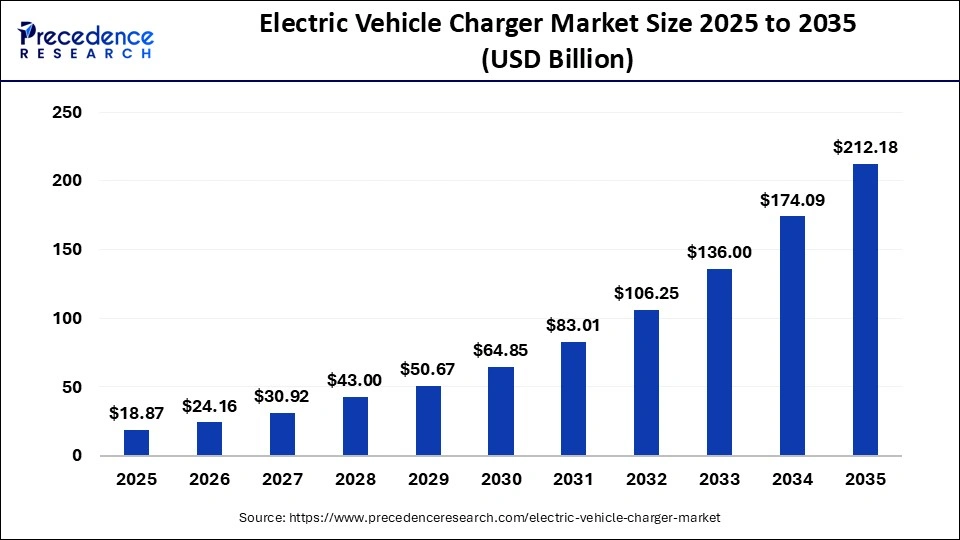
According to Precedence Research, the global electric vehicle charger market size was valued at USD 18.87 billion in 2025 and is projected to surge to approximately USD 212.18 billion by 2035, expanding at a remarkable CAGR of 27.38% between 2026 and 2035.

As countries intensify efforts to reduce carbon emissions and transition toward sustainable transportation, the deployment of reliable and accessible charging networks has become a critical component of the global mobility ecosystem.
EV Charging Infrastructure Becomes a Cornerstone of Clean Transportation
The rapid growth of electric vehicle ownership is creating unprecedented demand for charging solutions across residential, commercial, and public environments. Governments worldwide are introducing incentives, subsidies, and infrastructure development programs to encourage EV adoption while addressing concerns related to charging accessibility.
Growing environmental awareness, rising fuel costs, and ambitious net-zero emission targets are accelerating the shift toward electric mobility. Simultaneously, advancements in charging technologies including ultra-fast charging systems, smart chargers, automated payment solutions, load management capabilities, and bidirectional charging are enhancing user convenience and network efficiency.
Asia Pacific Leads Global Market Expansion
Asia Pacific emerged as the largest regional market in 2025, accounting for 38% of global revenue. The region’s dominance is supported by strong EV adoption rates, expanding charging networks, and government-backed electrification initiatives across major economies such as China, India, Japan, and South Korea.
China continues to play a pivotal role in global EV infrastructure development. According to industry estimates, nearly two-thirds of global public charger growth since 2020 has occurred in China, which now hosts approximately 65% of the world’s public charging stations.
Meanwhile, Europe is expected to register the fastest growth during the forecast period, driven by stringent emission regulations, robust consumer demand for electric vehicles, and significant investments in sustainable transportation infrastructure.
Public Charging Network Expansion Accelerates
While residential charging remains the preferred option for many EV owners, the expansion of public charging infrastructure is becoming increasingly important for urban populations and drivers without dedicated parking facilities.
Global charging networks are growing rapidly, with more than 1.3 million public charging points added worldwide in 2024 alone. Fast and ultra-fast charging technologies are gaining popularity as consumers seek shorter charging times and greater convenience during travel.
The development of charging stations across shopping centers, office complexes, residential communities, highways, and public parking facilities is further strengthening the EV ecosystem and supporting long-term market growth.
Segment Highlights
Plug-in Hybrid Vehicles Maintain Market Leadership
By vehicle type, the Plug-in Hybrid Vehicle (PHEV) segment captured the largest market share in 2025. Strong government incentives and growing consumer interest in alternative fuel vehicles continue to support segment growth.
However, the Battery Electric Vehicle (BEV) segment is anticipated to witness the fastest growth throughout the forecast period. Declining battery costs, technological innovations, and increasing manufacturing capacity are expected to boost BEV adoption globally.
On-Board Chargers Dominate Charging Type Segment
The on-board charger segment accounted for the largest revenue share in 2025, largely due to the widespread availability of AC power and the convenience of home charging solutions.
At the same time, off-board chargers are experiencing rapid adoption as public charging networks expand. Their ability to deliver significantly faster charging speeds makes them particularly attractive for commercial applications and long-distance travel.
Residential Segment Leads End-Use Demand
The residential segment remained the largest end-user category in 2025, reflecting consumer preference for overnight charging at home. Rising investments in modern residential infrastructure and EV-ready parking facilities are expected to further support segment growth.
The commercial segment is projected to record the fastest growth over the coming decade, driven by increasing investments in public charging stations, workplace charging solutions, and fleet electrification programs.
Government Initiatives Strengthen Market Outlook
Government-led initiatives continue to play a crucial role in shaping the future of the EV charger industry.
India’s PM E-DRIVE initiative and plans to install approximately 72,000 EV chargers by fiscal year 2026 are accelerating nationwide infrastructure deployment. Similarly, the United States’ National Electric Vehicle Infrastructure (NEVI) program is supporting the development of an extensive national charging network.
Across Europe, subsidies, tax benefits, and regulatory frameworks are encouraging both private and public investments in charging infrastructure, while promoting interoperability and standardization across charging networks.
Industry Innovation and Strategic Investments Gain Momentum
Leading companies are actively investing in next-generation charging technologies and manufacturing capabilities to meet growing global demand.
Key Companies Shaping the Electric Vehicle Charger Market
Several industry leaders are driving innovation and expanding the global EV charging ecosystem through advanced technologies, smart infrastructure, and integrated energy solutions.
- ABB Ltd. specializes in DC fast-charging technologies, smart charging platforms, and grid integration solutions designed for commercial, urban, and highway charging networks.
- Robert Bosch GmbH delivers a comprehensive portfolio of residential and commercial EV charging solutions, supported by intelligent energy management systems and connected mobility technologies.
- Siemens AG offers smart charging infrastructure and IoT-enabled charging management platforms that help optimize EV charging operations and energy utilization.
- Delphi Automotive develops advanced electronics, powertrain technologies, and integrated systems that support efficient and reliable EV charging applications.
- Chroma ATE provides testing and validation solutions for EV chargers, batteries, and power electronics, helping manufacturers maintain performance and safety standards.
- AeroVironment Inc. supplies Level 2 and DC fast-charging solutions for residential, workplace, and public charging environments, supported by network connectivity capabilities.
- Silicon Laboratories contributes semiconductor technologies that enhance charger intelligence, connectivity, energy efficiency, and overall system performance.
- Chargemaster PLC offers home and public charging solutions, flexible payment models, and extensive charging network services to support growing EV adoption.
- Schaffner Holdings AG provides power quality technologies, EMC filters, and critical electronic components that improve the reliability and efficiency of EV charging systems.
- Pod Point focuses on smart charging solutions for homes, workplaces, and public locations, enabling users to manage charging activities through mobile applications and digital platforms.
Recent industry developments include EVRE’s launch of a dedicated EV charger manufacturing facility in Hyderabad, Schneider Electric’s introduction of its next-generation Charge Pro commercial charger, and Delta Electronics India’s strategic collaboration with ThunderPlus to enhance fast-charging infrastructure through advanced rectifier technology.
The market remains moderately fragmented, with industry participants pursuing partnerships, acquisitions, product launches, and technology collaborations to strengthen competitive positioning and expand market reach.
Looking Ahead
As electric vehicles move from early adoption to mainstream transportation, charging infrastructure will become one of the most critical enablers of future mobility. Supported by favorable policies, technological innovation, and expanding public-private investments, the global EV charger market is positioned for sustained double-digit growth over the next decade.
With market revenues expected to exceed USD 212.18 billion by 2035, the EV charging industry is set to play a pivotal role in shaping a cleaner, smarter, and more connected transportation future.