
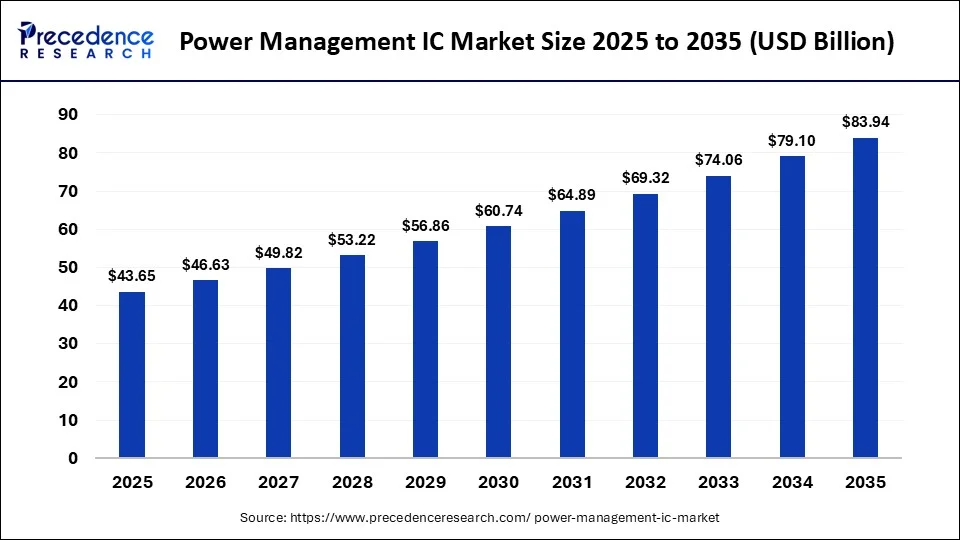
The global power management IC market size accounted for USD 43.65 billion in 2025 and is expected to exceed USD 83.94 billion by 2035, growing at a CAGR of 6.76% from 2026 to 2035.
Power Management IC Market Key Insights
- Asia Pacific dominated the global market with the largest market share of 44% in 2025.
- North America is projected to host the fastest-growing market in the coming years.
- By product, the switching regulators segment contributed the highest market share in 2025.
- By product, the power management ASICs/ASSPs segment is expected to grow at the fastest CAGR from 2026 to 2035.
- By application, the consumer electronics segment captured the biggest market share in 2025.
- By application, the automotive segment is anticipated to grow with the highest CAGR during the studied years
Role of AI Power Management IC Market
The advancement of artificial intelligence and machine learning in consumer electronics and smart grid and energy storage systems is likely to open new growth opportunities for the power management IC market. AI power solutions are incorporated into engineering solutions since engineers use AI algorithms to analyze big data and create improved power solutions. Machine learning makes renewable energies easily incorporable due to the active control of the dynamic electrical load and maintaining system reliability.
A primary application of machine learning in the manufacturing industry is to improve production efficiency and minimize costs. Moreover, AI-driven predictive analytics enables the prediction of failure areas in power systems, hence increasing their reliability. Such advancements help position AI as an enabler, reframe the industry, and advance intelligent energy management systems.
Regional Outlook for Power Management IC Market
North America is projected to host the fastest-growing power management IC market in the coming years due to developments in automotive electrification, renewable energy systems, and a shift towards smarter technologies. The United States is seeking to quickly expand infrastructure associated with electric vehicles and invest in clean energy generation and storage, which leads to increased demand for power management ICs, which are unique to each specific application.
Moreover, there is a growth in connectivity of more IoT devices, such as smart connections to household appliances, industrial applications, and wearable electronics.
Asia-Pacific dominated the global power management IC market in 2025. Asia’s most developed countries, such as China, Japan, South Korea, and India, are steering the movement in regard to the manufacture and use of innovative technologies, including electric automobiles, electronics for households and industries, and robotics.
The region is experiencing a large chunk of smartphone production and selling around the world, in addition to the electrification of automobiles. Additionally, the semiconductor companies and technology developers have increased their research expenditure to cater to the increasing demand for low-power and high-performing ICs in this region.
Europe is expected to grow substantially during the coming years, due to accelerated transition toward electric mobility, renewable energy systems, and energy-efficient industrial electronics.
Automotive manufacturers across countries such as Germany, France, and Italy are increasingly integrating advanced battery management ICs, voltage regulators, and power conversion chips into electric vehicle architectures, particularly in 800V EV platforms that require highly efficient silicon carbide (SiC)-based power devices.
Market Scope
| Report Coverage | Details |
| Market Size by 2025 | USD 43.65 Billion |
| Market Size in 2026 | USD 46.63 Billion |
| Market Size in 2035 | USD 83.94 Billion |
| Market Growth Rate from 2026 to 2035 | CAGR of 6.76% |
| Dominating Region | Asia Pacific |
| Fastest Growing Region | North America |
| Base Year | 2025 |
| Forecast Period | 2026 to 2035 |
| Segments Covered | Product, Application, and Regions |
| Regions Covered | North America, Europe, Asia-Pacific, Latin America, and Middle East & Africa |
Segmental Insights of Power Management IC Market
By Product Insights
The switching regulators segment held a dominant presence in the power management IC market in 2025, as they are highly efficient and versatile. They have become the most popular type of power management IC in circulation. Several such regulators are imperative in applications where power conversion is needed, such as automotive systems, industrial facilities, and portable electronics.
Due to the capacity to transform power with less output as heat, they are critical in devices with tight form factors and stringent energy standards. IEA states that energy-efficient technologies, such as switching regulators, play a role in reducing energy intensity in international systems. Furthermore, technology development is constantly being improved by incorporating even more compelling GaN and SiC materials.
By Application Insights
The consumer electronics segment accounted for a considerable share of the power management IC market in 2025 due to the increasing need for mobile, power-conscious gadgets. These modern ICs are mainly used to regulate power consumption in devices such as smartphones, laptops, and smart home appliances. This segment has been growing due to the rising demand for power backup for longer durations, in addition to the growth of smart devices.
Recent Developments
- In June 2024, Magnachip Mixed-Signal, Ltd. launched a new multi-functional Power Management Integrated Circuit (PMIC) and a multi-channel level shifter designed for display panels in IT devices. As part of Magnachip Semiconductor, MMS has been a key supplier of power ICs, including LED drivers for TVs and lighting, and has successfully partnered with top manufacturers in the TV, OLED panel, and smartphone industries to expand its global customer base.
- In December 2024, ST introduced the SPSB100, a flexible power-management IC for automotive microcontrollers. It allows users to program power-up sequences and adjust output voltages and current ranges, making it suitable for applications in zonal control units, vehicle control platforms, body control modules, and gateway modules across vehicles.
Power Management IC Market Companies
Texas Instruments is a global semiconductor company specializing in analog and embedded processing chips used in automotive, industrial, communications, and consumer electronics applications. It is recognized as one of the world’s leading analog chip manufacturers.
Analog Devices develops high-performance analog, mixed-signal, and digital signal processing solutions that bridge the physical and digital worlds. Its technologies are widely used in healthcare, industrial automation, automotive, and communications sectors.
onsemi (ON Semiconductor) is a leading supplier of intelligent power and sensing technologies, serving automotive, industrial, cloud, and energy infrastructure markets. The company focuses on energy-efficient semiconductor solutions for electric vehicles and advanced electronics.
Renesas Electronics is a Japanese semiconductor manufacturer known for microcontrollers, analog devices, power management ICs, and system-on-chip solutions. Its products are widely used in automotive, industrial, IoT, and consumer electronics applications.
Microchip Technology provides microcontrollers, analog semiconductors, embedded controllers, and connectivity solutions for industrial, automotive, aerospace, and consumer markets. The company is particularly known for its PIC and AVR microcontroller families.
Circuito Integrado S.A. is a semiconductor company focused on the design, development, and manufacturing of integrated circuit solutions. It supports various electronic applications with customized semiconductor technologies and engineering expertise.
Dialog Semiconductor is known for its power management, Bluetooth low-energy, Wi-Fi, and mixed-signal integrated circuits. Its technologies are widely adopted in mobile devices, IoT products, automotive systems, and consumer electronics.