
Research Scholar, Amity University Gwalior
The automotive industry is witnessing a paradigm shift from mechanical non-connected vehicles to highly connected transportation ecosystems. Vehicle-to-Everything (V2X) communication has emerged as a technology that enables vehicles to exchange information with other vehicles, roadside infrastructure and cloud platforms. As V2X becomes a critical component of Intelligent Transportation Systems (ITS) as it is rapidly becoming one of the most significant challenges facing the automotive sector. While V2X promises enhanced driving experiences and user safety, it also expands the attack surface available to cyber adversaries. The communication channels can be exploited to manipulate vehicle behaviour, disrupt transportation services, or compromise user privacy that can affect the vehicle functionality. Therefore securing V2X communication is essential for the successful protecting cyberattack that affects vehicle function.
The Rise of Connected Transportation
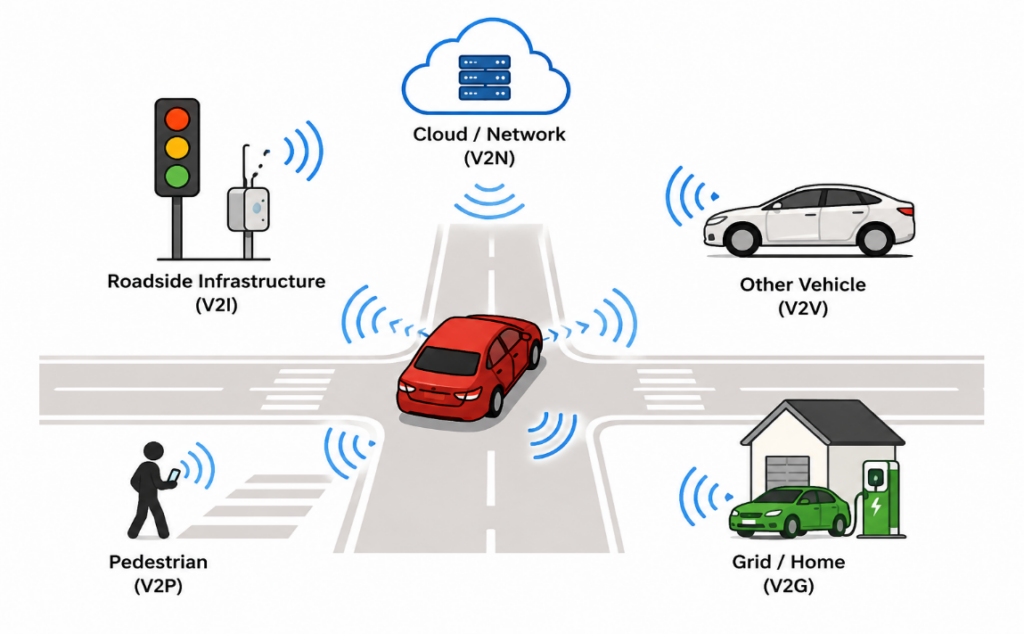
Modern vehicles generate enormous amount of data. Through V2X communication, this information is allowed to be shared with surrounding entities to improve its decision-making and secure it against attacks.
The V2X system includes:
- Vehicle-to-Vehicle (V2V) communication
- Vehicle-to-Infrastructure (V2I) communication
- Vehicle-to-Pedestrian (V2P) communication
- Vehicle-to-Network (V2N) communication
- Vehicle-to-Grid (V2G) communication
Together, they form a networked transportation system that can support the capabilities of collision avoidance, emergency coordination, traffic optimization, and autonomous vehicles.
But with increased connectivity comes a set of vulnerabilities that conventional car systems have not been designed to counteract.
Why Cybersecurity Matters in V2X
In contrast with traditional automotive systems, V2X systems rely heavily on constant transmission of wireless messages. Information obtained from outside sources could prove critical for safety decisions. The impact of any alteration or falsification of information would therefore be considerable.
Take, for example, an instance when an attacker sends out false messages regarding emergency braking for the vehicles in the vicinity. Such messages could trigger false responses, resulting in traffic jams and even accidents. The same applies to compromised roadside units that send false traffic information resulting in misrouting and traffic jamming.
Moreover, a transportation system operates in a dynamic and distributed environment where there are several thousands of such entities communicating simultaneously.
Cyber-attacks on V2X systems can thus have serious effects not only on individual vehicles but on the entire transportation network.
Major Cyber Threats in V2X Environments
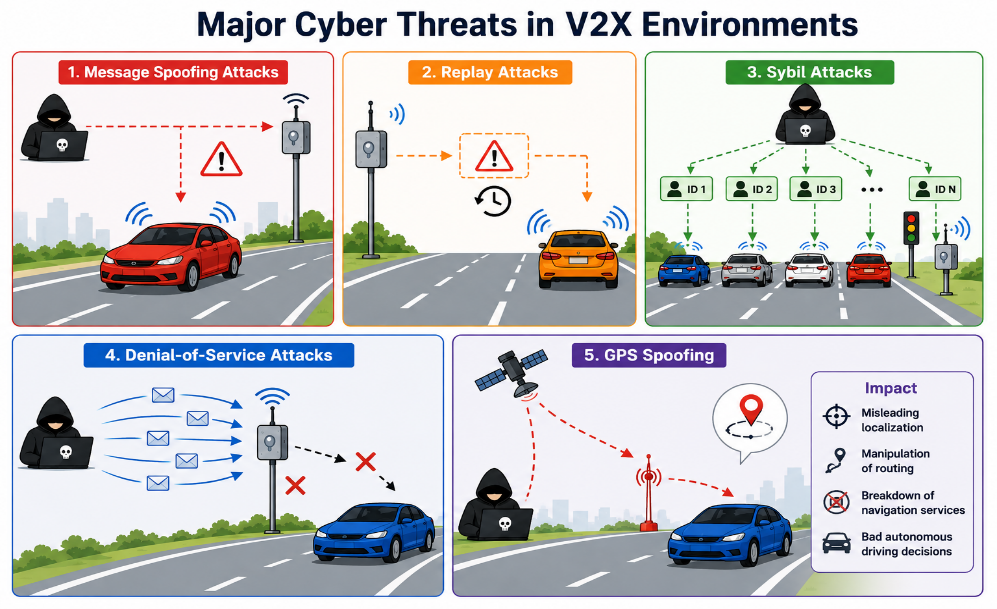
Message Spoofing Attacks
Spoofing attacks entail sending fraudulent messages that seem to emanate from trusted vehicles or network infrastructure elements. Some attacks include the transmission of fake data concerning:
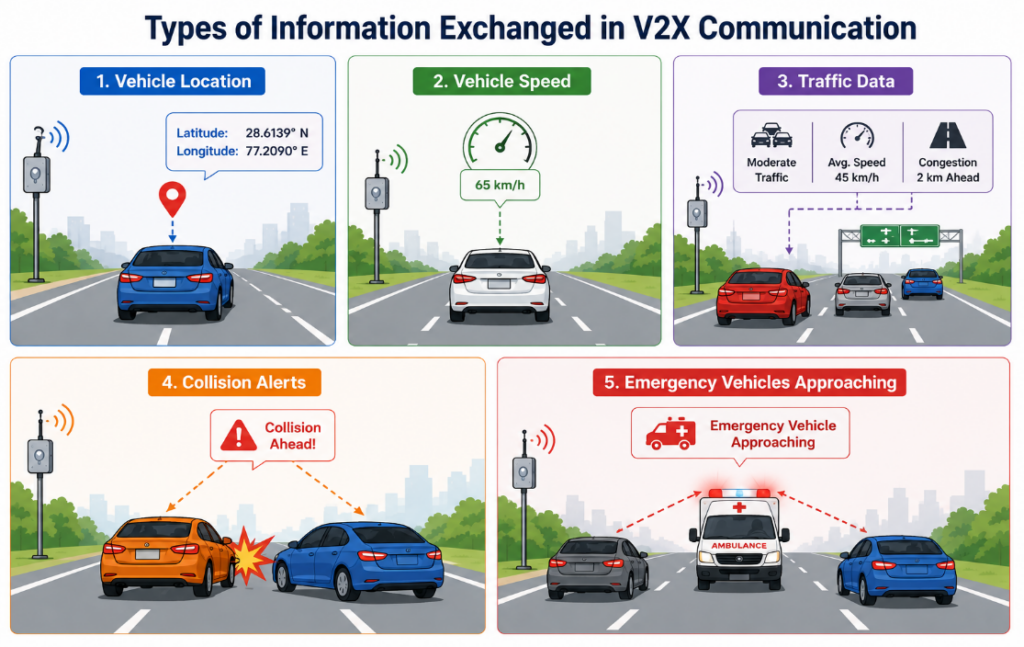
• Vehicle location
• Vehicle speed
• Traffic data
• Collision alerts
• Emergency vehicles approaching
Such spoofing attacks can affect connected vehicles and lead to hazardous behaviour.
Replay Attacks
The technique used for replay attacks entails intercepting valid V2X communication and resending them later. For instance, an old alert about congestion may be resent when the traffic situation has become normal. In such cases, the recipient vehicles will consider the alert legitimate because the information originated from a trusted source.
Sybil Attacks
Sybil attacks are attacks where a malicious node generates multiple fake identities. In doing so, the attacker is able to influence traffic management systems and report false information to them.
Denial-of-Service Attacks
Denial-of-Service (DoS) attacks are aimed at congesting communication networks by sending a large number of requests or other data.
This way, the attacker makes it impossible to send important safety-related communications to the destination point.
GPS Spoofing
V2X systems require accurate geographical location details. GPS spoofing exploits the location data of vehicles by sending false navigation signals.
Impact includes:
• Misleading localization of vehicles
• Manipulation of routing
• Breakdown of navigation services
• Bad autonomous driving decisions
Advanced Persistent Threats (APTs)
With the digitization of transportation systems, nation-state adversaries and threat actors might carry out prolonged stealth operations against transportation infrastructure.These advanced persistent threats leverage vulnerabilities in cloud-based services, roadside infrastructure, communication gateways, and vehicle software to maintain persistent access to transportation networks.APTs can go unnoticed for a long time before launching further operations.
Security Needs for V2X Systems
There are some security needs that need to be fulfilled in order to guarantee trustworthiness in V2X networks.
Authentication
The need to ensure that received messages have been transmitted by genuine senders is important.Authentication can prevent attacks of impersonation and spoofing.
Integrity
Integrity measures prevent message modification during transmission.This can be done using digital signatures and cryptography.
Whereas there is no need to secure some of the safety communications, others must be secured from unauthorized access and interception.
Encryption is one way through which such communication can be secured.
Availability
For transportation systems to function properly, they must operate reliably regardless of any adverse conditions.
Use of redundancy and robust networks architectures helps to assure continued system availability.
Privacy
The constant collection of location and behavior data by vehicles.
The security protocols used should ensure that user privacy is maintained without compromising the functioning of the system.
The Role of Public Key Infrastructure
There have been many instances in which PKI has proved to be essential for V2X cybersecurity.In a PKI architecture:
· Vehicle certificates issued by authorities are distributed to all vehicles.
· The message is then digitally signed before being sent.
· The receivers use public keys to check authenticity.
Thus, trust can be established without the need for each vehicle to establish direct trust with all its correspondents.Pseudonymous certificates are commonly used to achieve increased privacy by changing identifiers.
Artificial Intelligence for V2X Security
Traditional signature-based security approaches may struggle to detect previously unseen attacks. Consequently, artificial intelligence and machine learning are becoming increasingly important components of V2X cybersecurity frameworks.Machine learning techniques can identify anomalous communication patterns that deviate from normal network behaviour.
Common approaches include:
- Isolation Forest
- Auto encoders
- One-Class Support Vector Machines
- Deep Neural Networks
- Graph-Based Anomaly Detection
These techniques can detect:
- Abnormal message frequencies
- Suspicious vehicle behaviour
- Coordinated attack campaigns
- Evolving threat patterns
- Insider attacks
As V2X environments continue to evolve, AI-driven security solutions will play a crucial role in identifying sophisticated cyber threats.
Promises of V2X Using 5G Network Infrastructure
The introduction of 5G communication technology signifies a crucial step towards developing connected transportation infrastructures.
The use of this technology compared to earlier communication technologies makes it possible to achieve:
• Ultra-low latency
• High-reliability connections
• Mass connectivity
• Edge computing abilities
• Network slicing capabilities
By leveraging these advantages, it becomes possible not only to develop more interactive and responsive V2X application services but also to provide an additional layer of security by deploying edge-based traffic monitoring techniques.
India’s Potential for a Secure Future for V2X Technologies
India is increasingly embracing smart transportation, connected infrastructures, and digital transformations. As the adoption of electric cars increases and intelligent traffic control systems and 5G communication networks become more popular, V2X technology may become an integral part of future mobility solutions.
Nevertheless, securing systems by design, threat modelling, continuous monitoring, and using anomaly detection based on AI solutions will be needed for future implementations. Collaboration between automobile companies, telecommunications, cybersecurity scientists, and regulatory organizations will be key.
Looking Ahead
V2X communication technology promises to transform the mobility landscape through improved safety, intelligence, and efficiency in transport systems. However, the effective implementation of the technology is contingent upon developing trust within the V2X communication framework.
Given that vehicles are evolving to intelligent software-controlled units, security would take precedence as much as reliability and safety. Companies that succeed in embedding security measures in their V2X communication designs stand to gain much from their efforts in terms of realizing the full value of autonomous and connected transport. Future mobility will depend not just on connectivity but on secure connectivity.