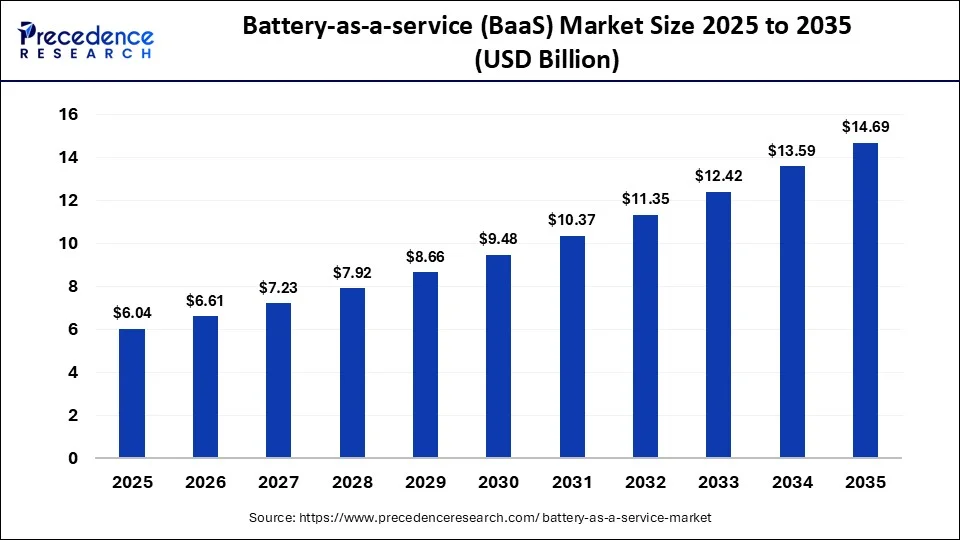
The global battery-as-a-service (BaaS) market was valued at USD 6.04 billion in 2025 and is projected to grow from USD 6.61 billion in 2026 to approximately USD 14.69 billion by 2035, registering a CAGR of 9.29% during the forecast period from 2026 to 2035. The market is experiencing strong growth due to the increasing adoption of electric vehicles (EVs), supportive government initiatives for EV charging and battery-swapping infrastructure, and continuous advancements in battery technologies and swapping solutions. The report provides comprehensive insights into market trends, production volumes, technological innovations, and the competitive landscape across North America, Europe, and Asia Pacific (APAC) from 2025 to 2030.
Key Takeaways
- Asia Pacific held the largest market share of 80% in 2025.
- The North America is expected to grow at the fastest CAGR from 2026 to 2035.
- By service type, the subscription model segment accounted for the dominating share of 75% in 2025.
- By vehicle type, the three-wheeler segment held the major share of 40% in the battery-as-a-service (BaaS) market during 2025.
- By battery capacity, the below 50 kWh segment held a dominant presence in the market in 2025, with 45%.
- By end-user demographics, the individual consumers segment registered its dominance with 55% over the battery-as-a-service (BaaS) market in 2025.
- By distribution channel, the direct-to-consumer (D2C) segment dominated the market with the largest share of 65% in 2025.
Battery-as-a-service (BaaS) Market Overview
The battery-as-a-service (BaaS) market is expected to witness significant growth during the forecast period, driven by the high upfront cost of electric vehicles (EVs), increasing EV adoption, and the need to overcome long charging times. By separating battery ownership from vehicle ownership, BaaS reduces the initial purchase cost of EVs while offering users greater convenience and operational flexibility.
Battery-as-a-service (BaaS) is a business model that provides battery leasing, swapping, and subscription services for electric vehicles (EVs) and other electric mobility solutions. It enables users to replace depleted batteries with fully charged ones or access batteries through subscription plans, eliminating the need to own the battery. This approach supports efficient energy management, extends vehicle lifespan, and lowers maintenance costs. BaaS caters to a wide range of end users, including individual consumers, commercial fleets, shared mobility operators, and industrial EV applications worldwide.
Key Artificial Intelligence (AI) Shifts in the Battery-as-a-Service (BaaS) Market
Artificial intelligence (AI) is driving a major technological transformation in the battery-as-a-service (BaaS) market, making battery management more intelligent, efficient, and data-driven. As electric vehicles (EVs) continue to reshape the global transportation industry, AI-powered BaaS solutions are playing a crucial role in accelerating EV adoption by improving battery performance, operational efficiency, and overall user experience.
Regional Outlook of the Battery-as-a-service (BaaS) Market
Asia Pacific
Asia-Pacific dominated the global battery-as-a-service (BaaS) market in 2025, accounting for the largest share in both production and consumption. This region dominance is primarily due to the robust manufacturing ecosystems of steel manufacturing in China and India, which serve as critical hubs for industries such as construction and automotive. Manufacturers in these countries have established global networks, leveraging regional players and strategic partnerships or collaborations to distribute products globally. The growth of the region is attributed to the growing demand for Ultra-High Power (UHP) graphite electrodes, rising steel production, rapid infrastructure development, increasing environmental awareness, and a supportive government framework. The rapid urbanization and industrialization have resulted in a surge in construction activities in the region, fuelling the overall market’s growth. The rapid technological innovations have led the steel industry to shift toward more sustainable electric arc furnace (EAF) production.
North America
North America is anticipated to grow at the fastest CAGR. The region’s growth is driven by the rapid expansion of the steel manufacturing industry and the increasing adoption of electric arc furnaces (EAFs), growing demand for sustainable steel manufacturing methods, growing environmental consciousness, and a rise in construction activities. The steel industry is experiencing rapid advancements, which is fueled by increased demand for EAF-produced steel and rising focus on sustainability, accelerating innovation in high-power graphite electrodes to enhance performance and environmental compliance.
Battery-as-a-service (BaaS) Market Companies
- Ample: Ample is revolutionizing EV energy infrastructure through its modular battery-swapping technology, allowing vehicles to replace depleted batteries in under 10 minutes. Its AI-driven stations identify vehicle types and optimize energy delivery, targeting fleet operations and urban electric mobility networks across the U.S., Japan, and Europe.
- NIO: NIO is redefining EV ownership with its Battery-as-a-Service (BaaS) model and an expansive network of over 2,500 automated battery-swapping stations across China and expanding into Europe. The company’s advanced battery technology, combined with fast swap infrastructure, enhances driving range flexibility and reduces upfront EV costs for consumers.
- CATL (Contemporary Amperex Technology Co. Limited): CATL is the world’s largest EV battery manufacturer, producing LFP, NCM, and high-nickel cathode batteries for major automakers including Tesla, BMW, and NIO. The company leads in innovation with its Qilin battery and condensed-state cells, delivering higher energy density, rapid charging, and greater safety performance.
- Tesla: Tesla continues to set global standards in EV battery technology with its 4680 cylindrical cells, offering higher energy capacity and manufacturing efficiency. Through its Gigafactories, Tesla maintains vertical integration across battery design, energy storage, and recycling, positioning itself at the forefront of sustainable mobility innovation.
- Gogoro: Gogoro operates the world’s most established battery-swapping network, with over 12,000 stations enabling 400,000+ daily swaps for electric two-wheelers. Its partnership model with OEMs like Hero MotoCorp and Yamaha allows rapid expansion of smart, connected EV ecosystems across Asia’s urban centers.
Segmental Insights of the Battery-as-a-service (BaaS) Market
Service Type Insights
The subscription model segment dominated the battery-as-a-service (BaaS) market in 2025, as this segment includes monthly subscription, annual subscription, and tiered subscription (based on battery capacity or range). Subscription model involves battery leasing, renting, or swapping for electric vehicles (EVs) and other applications. Subscription model alleviating range anxiety through faster battery exchanges, reducing upfront vehicle costs, and improving sustainability by promoting recycling.
Vehicle Type Insights
Three-wheelers have emerged as the dominant vehicle type with a 40% share in the Battery-as-a-Service (BaaS) market due to their extensive use in last-mile connectivity, logistics, and urban transportation. The rapid adoption of electric three-wheelers, especially in emerging economies like India and Southeast Asia, has accelerated the demand for battery-swapping and subscription-based energy solutions. One of the key factors driving this dominance is high vehicle utilization. Three-wheelers, particularly those used for goods delivery and passenger transport, operate for long hours daily, making frequent charging impractical. BaaS offers a convenient and time-efficient solution by enabling drivers to quickly swap depleted batteries for fully charged ones—minimizing downtime and maximizing earnings.
Battery Capacity Insights
The below 50 kWh segment held a dominant presence in the battery-as-a-service (BaaS) market in 2025 because the below 50 kWh segment is driven by the increasing demand for scooters, three-wheelers, and moderate-use passenger vehicles. Below 50 kWh provides budget-conscious consumers with a more affordable way to own EVs. On the other hand, the above 100 kWh segment is expected to grow at a notable rate, owing to the rising adoption of electric buses and heavy-duty trucks. Large vehicles require significant energy and benefit from solutions that reduce downtime and allow for rapid battery swaps.
End-User Demographics Insights
The individual consumers segment held a 55% share of the battery-as-a-service (BaaS) market in 2025 because individual consumers prefer paying a monthly fee to lease a battery for their electric vehicle, which reduces the significant barrier of purchasing an expensive EV battery. Individual consumers get flexibility through subscription-based models or pay-per-use structures.
Distribution Channel Insights
The direct-to-consumer (D2C) segment accounted for a 55% share in the battery-as-a-service (BaaS) market in 2024, as the segment includes mobile apps & subscription platforms and battery swap stations. Direct-to-consumer (D2C) distribution is a significant distribution channel in the battery-as-a-service (BaaS) market.