

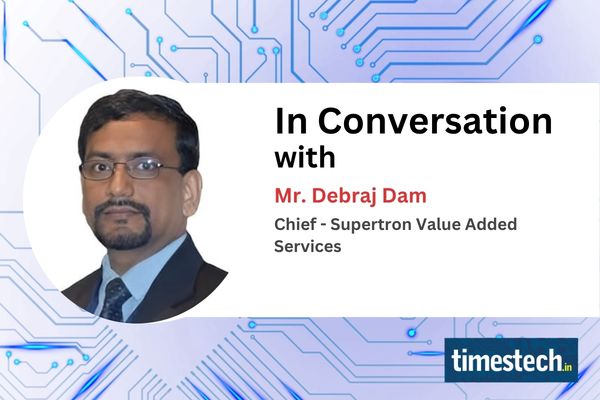
In an interview with TimesTech, Mr. Debraj Dam, Chief – Supertron Value Added Services, discusses the evolving role of technology distributors amid India’s expanding electronics market. He highlights the growing importance of AI, cloud, cybersecurity, enterprise networking and edge infrastructure, while outlining Supertron’s focus on value-added capabilities, solution-led ecosystems, channel partnerships and deeper reach across Tier II and Tier III markets to support India’s digital growth.
Read the full interview here:
TimesTech: India’s electronics market is expanding rapidly across both consumer and enterprise segments. What technology trends do you believe will define the next decade of the electronics industry, and how is Supertron positioning itself to capitalise on them?
Debraj: The next decade will be shaped by AI, Hybrid cloud adoption, cybersecurity, enterprise networking, edge infrastructure, and connected devices. More importantly, technology investments will increasingly be driven by business outcomes rather than hardware alone. Customers today are looking for integrated, scalable, and secure technology ecosystems that can support long-term growth.
This shift is redefining the role of technology distributors. At Supertron, we are strengthening our enterprise portfolio and expanding our value-added capabilities across cloud, networking, cybersecurity, and digital infrastructure. We work closely with our OEM and channel partners to deliver complete technology solutions rather than individual products. Our focus is on enabling businesses to adopt technology with confidence while creating sustainable value for our partners and customers.
TimesTech: The role of technology distributors has evolved significantly over the years. How has the shift from product distribution to value-added technology enablement changed customer expectations and business models across the industry?
Debraj: Technology distribution today is far more than product availability and logistics. In the age of digital transformation, customers expect distributors to provide technical expertise, solution design, deployment support, training, financing, and post-sales engagement alongside products.
Recognising this shift early, Supertron established its Value Added Distribution business back in 2019, expanding into enterprise infrastructure, cloud, cybersecurity, unified communications, and digital workplace solutions. This has strengthened our ability to support partners in addressing increasingly complex customer requirements.
Today, success in distribution depends on building capabilities across the channel ecosystem rather than simply moving products. The focus has shifted from transactions to long-term partnerships, where distributors play an active role in helping partners adopt new technologies and create lasting business value.
TimesTech: With the government’s continued push for electronics manufacturing and ‘Make in India’, what opportunities do you see for India to become a global electronics and technology hub? What gaps still need to be addressed?
Debraj: India has a tremendous opportunity to become a global technology hub, supported by strong policy initiatives, a rapidly growing digital economy, and increasing manufacturing capabilities. However, sustained growth will depend on strengthening the complete technology ecosystem—not just manufacturing, but also component production, R&D, logistics, innovation, and skilled talent.
We are also seeing increasing confidence among global technology brands in India’s long-term potential. As the ecosystem matures, robust distribution networks and strong channel partnerships will play an equally important role in ensuring that technology reaches businesses and consumers efficiently across the country.
India’s next phase of growth will be driven by its ability to build a complete technology ecosystem, not just manufacturing capacity.
TimesTech: As enterprises invest more in data centres, networking, storage, cybersecurity, and digital workplace infrastructure, which technology categories do you expect to witness the strongest growth over the next three to five years?
Debraj: We expect cybersecurity, cloud infrastructure, enterprise networking, storage, and digital workplace solutions to remain the fastest-growing technology segments over the next few years. With AI becoming integral to business operations, organisations will also invest more in secure, scalable infrastructure capable of supporting increasingly data-intensive workloads.
Another important trend is the shift from standalone products to integrated technology solutions. Businesses are looking for partners who can combine infrastructure, software, and services into solutions that address long-term business needs rather than individual technology requirements. The future belongs to solution-led technology ecosystems rather than isolated products.
TimesTech: India’s technology consumption is no longer limited to metro cities. How are changing demand patterns in Tier II and Tier III markets reshaping the electronics distribution ecosystem, and what does this mean for technology companies looking to expand nationally?
Debraj: Tier II and Tier III markets are emerging as major growth drivers for India’s technology industry. Businesses, educational institutions, MSMEs, and consumers in these regions are adopting increasingly sophisticated digital solutions, creating opportunities well beyond traditional metro markets.
For technology companies, expanding nationally now requires more than product availability. Success depends on strong regional partnerships, efficient logistics, local market understanding, and reliable post-sales support. At Supertron, our extensive pan-India network enables us to support partners across both established and emerging markets, helping them scale with confidence while delivering consistent customer experiences. India’s digital growth story will increasingly be written beyond the metros, making regional reach a strategic advantage rather than just an operational capability.