What is Automotive Electronics?
Automotive electronics refers to the electronic components, control systems, sensors, software, communication networks, and semiconductor technologies used to monitor, control, and operate functions within a vehicle.
These systems convert information from sensors and driver inputs into electrical signals, process the information through controllers or processors, and then trigger an appropriate action.
For example, when a vehicle detects that a driver is approaching an obstacle too quickly, its electronic systems can process information from cameras, radar, wheel-speed sensors, and other inputs. Depending on the vehicle’s capabilities, the system may warn the driver, apply the brakes, or assist with steering.
How Automotive Electronics Work
Automotive electronics operate through a continuous cycle involving sensing, processing, communication, and action. Sensors first collect information from the vehicle or its surroundings. This information can include speed, temperature, pressure, acceleration, battery voltage, current, steering angle, distance from nearby objects, and road conditions.
The collected information is then transmitted to an ECU, microcontroller, processor, or centralized computing platform. Embedded software analyzes the data and determines whether an action is required. For example, if an ADAS system identifies a potential collision, the electronic control system can issue a warning or, where the vehicle’s capabilities permit, initiate braking.
The global automotive electronics market size is accounted at USD 307.61 billion in 2025 and predicted to increase from USD 334.13 billion in 2026 to approximately USD 680.56 billion by 2035, expanding at a CAGR of 8.26% from 2026 to 2035.
Major Benefits of Automotive Electronics
Improved Vehicle Safety
How Automotive Electronics Work
Automotive electronics operate through a continuous cycle of sensing, processing, communication, and control.
Sensors Collect Information
Sensors collect information about the vehicle and its surrounding environment.
For example, wheel-speed sensors can measure wheel rotation, while cameras and radar can identify objects around the vehicle.
Other sensors measure:
- Temperature
- Pressure
- Voltage
- Current
- Vehicle speed
- Steering angle
- Acceleration
- Battery conditions
Electronic Controllers Process the Data
The information collected by sensors is sent to an electronic control unit, microcontroller, or high-performance processor.
The controller analyzes the data using embedded software and control algorithms.
For example, an electronic stability-control system can compare wheel-speed information with steering and vehicle-motion data to determine whether the vehicle is losing stability.
Electronic systems enable rapid monitoring and intervention.
Airbags, electronic stability control, ADAS, tire-pressure monitoring, electronic braking, and driver-monitoring technologies all contribute to vehicle safety.
- Higher Energy Efficiency: Electronics allow vehicles to manage electrical energy and powertrain operation more precisely.
This is particularly important in EVs, where efficient battery, inverter, thermal, and charging management directly influence driving range and operating costs.
- Better Driving Assistance: Sensors and processors can help drivers maintain speed, remain within lanes, identify potential collisions, and park more easily.
The technology does not eliminate the need for driver attention, but it can provide additional layers of assistance.
- Greater Connectivity: Connected vehicles can exchange information with cloud services and external devices. This enables features such as remote vehicle monitoring, navigation updates, predictive maintenance, and connected emergency services.
Latest Trends and Innovations in Automotive Electronics
- Software-Defined Vehicles: The shift toward software-defined vehicles (SDVs) is arguably the most important structural change in automotive electronics. In a traditional architecture, individual ECUs control individual functions. In an SDV, more functions can be managed by centralized or zonal computing platforms, allowing software to play a larger role in vehicle functionality.
- Zonal Architecture: Zonal architecture groups electronic functions according to their physical location in the vehicle. For example, a zone controller can manage sensors, actuators, lighting, and other devices located in a particular area of the vehicle, while central computers handle higher-level processing.
- 48-Volt Electrical Architectures: The growing electrical load of modern vehicles is increasing interest in 48-volt systems. Higher voltage can reduce current for a given power requirement, helping engineers manage electrical distribution more efficiently.
Role of Electronic Control Units
Electronic Control Units are embedded computers that control specific vehicle functions. A conventional vehicle can contain multiple ECUs, with different controllers responsible for functions such as engine management, transmission control, airbags, braking, lighting, climate control, and infotainment.
An ECU generally consists of a processor or microcontroller, memory, communication interfaces, input and output circuits, and embedded software. It receives information from sensors, processes that information according to programmed logic, and sends commands to other components. For example, an engine ECU can use information from temperature, oxygen, pressure, and position sensors to adjust engine operation.
Automotive Electronics and Autonomous Driving
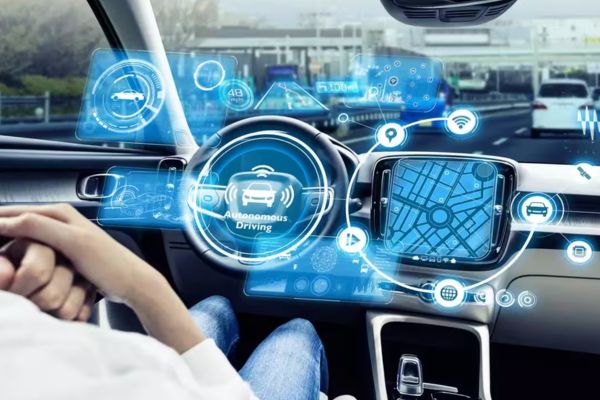
Autonomous driving depends heavily on automotive electronics because a vehicle must continuously collect, interpret, and respond to information about its surroundings. A highly automated vehicle may use multiple cameras, radar sensors, LiDAR, ultrasonic sensors, positioning systems, and other sensing technologies.
Cameras can identify road markings, traffic signs, vehicles, pedestrians, cyclists, and traffic lights. Radar can measure the distance and relative speed of objects and is widely used in applications such as adaptive cruise control and collision warning. LiDAR can provide detailed three-dimensional information about the surrounding environment and is being used or evaluated for selected automated-driving applications.
Artificial Intelligence in Automotive Electronics
Artificial intelligence is expanding the capabilities of automotive electronic systems. Traditional electronic control systems generally operate according to predefined rules, whereas AI systems can identify patterns in large datasets and interpret complex information. This makes AI particularly useful for applications involving images, speech, sensor data, and changing environmental conditions.
One major application is AI-based perception. Computer-vision models can analyze camera data to identify vehicles, pedestrians, road signs, lane markings, and other objects. These capabilities support ADAS and automated-driving systems.
Future of Automotive Electronics
The future of automotive electronics is expected to be strongly influenced by the convergence of electrification, software, AI, connectivity, and automation. Vehicle architectures are likely to continue moving toward centralized computing supported by distributed zonal controllers.
AI-enabled vehicles are expected to become more capable of understanding their surroundings and interacting with drivers. AI may increasingly support perception, driver monitoring, voice interfaces, predictive maintenance, personalization, and automated-driving functions.
Laxmi Narayan
Author | Strategic Research Analyst
Laxmi Narayan is a strategic research analyst with five years of hands-on experience in market intelligence, primary and secondary research, and consulting engagements. His expertise covers the semiconductor, automotive, transport & logistics, and machinery & equipment industries.
He specializes in analyzing emerging market trends, technological advancements, regulatory developments, competitive landscapes, and industry dynamics. Laxmi provides actionable insights that help global clients identify growth opportunities, optimize business and operational strategies, and make informed investment decisions.
Known for his analytical rigor and strategic foresight, Laxmi translates complex market data into clear, practical recommendations that support business growth, strategic planning, and long-term value creation.