
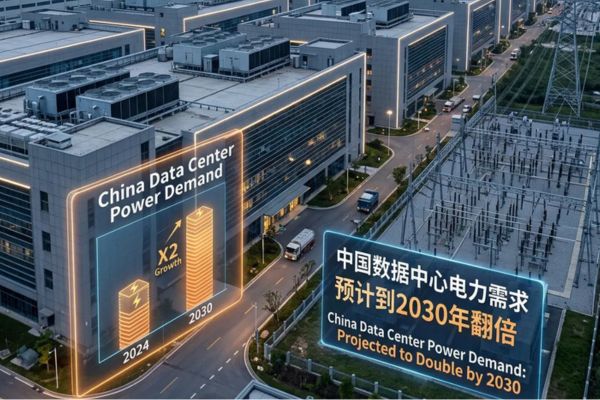
Wood Mackenzie, forecasts China’s data centres to quadruple their electricity consumption to 774 TWh by 2030, as rapid growth in AI workloads drives a structural increase in computing-related power demand. The report called ‘Rewiring China’s grid for the AI era’ noted that by 2060, data centres could account for 17% of China’s total electricity consumption.
“Data centres are becoming an increasingly important part of China’s energy system,” said Wanting Zhao, research analyst, Asia Pacific power and renewables research at Wood Mackenzie. “As AI drives sustained growth in computing demand, access to reliable, cost-competitive and lower-carbon electricity will play a growing role in determining where and how new data-centre capacity is developed.”
AI growth and policy bring compute and power planning together
China’s data centre expansion is being shaped by two reinforcing forces: rapid growth in AI workloads and robust national policy directives.
AI training is driving more energy-intensive infrastructure, while the rapid expansion of inference is adding a growing base of sustained electricity demand. Together, these trends are expected to keep data-centre power consumption growing even as China’s broader electricity-demand growth moderates, Wood Mackenzie noted.
On the policy front, the government is not only driving massive capacity expansion through strategic national targets but also promoting ‘compute-power synergy.’ The 15th Five-Year Plan calls for the coordinated development of computing infrastructure and green electricity. To operationalize this, recent energy policies are driving direct green power supply and the adoption of more flexible computing loads.
From “Power Follows Compute” to “Compute Follows Power”
Historically, data centres have followed computing demand, clustering around major cities and technology hubs to access customers, skilled labour, network infrastructure, and low-latency connectivity. However, China’s AI expansion is now adding another consideration: the availability of abundant, reliable, and low-carbon electricity.
This is accelerating a shift towards a “compute follows power” model, particularly for latency-tolerant workloads. Renewable-rich regions in western China offer abundant land and growing renewable generation capacity, creating opportunities to locate power-intensive AI training, batch processing, and data storage workloads closer to electricity sources.
Eastern demand centres are likely to retain an important role for latency-sensitive applications such as AI inference and financial services. This is creating an emerging division of labour between eastern computing demand centres and western power-rich computing hubs.
Wood Mackenzie expects eight national hubs to remain the dominant centres of China’s computing capacity through 2060, although grid constraints and continued growth in renewable generation are likely to support gradual expansion in renewable-rich locations outside the designated hubs.
Data centres become more flexible load resources
New power architectures, battery storage and intelligent workload scheduling could transform data centres into demand-side flexibility providers, Wood Mackenzie noted. For workloads that do not require immediate processing, computing demand can be shifted towards periods of abundant renewable generation or lower electricity prices, while latency-sensitive workloads remain closer to major demand centres.
This flexibility could allow data centres to move beyond their traditional role as passive base loads and become a more active component of China’s evolving power system. As renewable generation expands, data centres can act as strategic demand sinks to absorb curtailed renewables in oversupplied regions.
Wood Mackenzie expects data-centre demand for green electricity to rise substantially through 2060, while data-centre carbon emissions are forecast to peak by 2035 as renewable-power penetration increases.
“The next challenge extends far beyond physical grid planning,” Zhao concluded. “To truly unlock compute-power synergy, the industry must address data security and SLA concerns during cross-regional migration, stimulate the willingness of operators and tenants to actively participate, and implement targeted mechanisms to alleviate the heavy initial CAPEX burden. The direction of travel is clear: computing is beginning to follow power, but our commercial, security, and institutional architectures must urgently evolve to make this commercially viable.”