
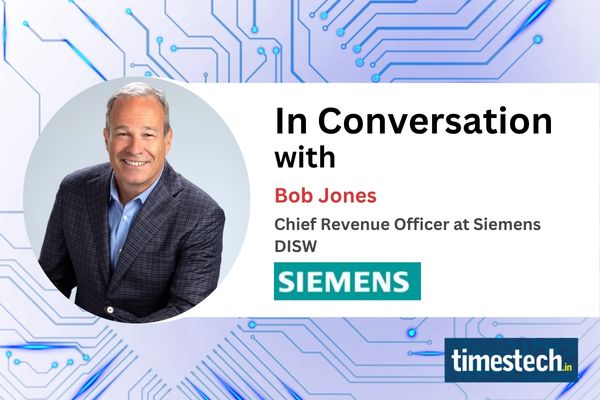
In an interview with TimesTech, Bob Jones, Chief Revenue Officer at Siemens DISW, discusses how AI, simulation and connected data are reshaping engineering workflows. He explains why human oversight will remain critical as AI agents take on routine design and simulation tasks, how data management is becoming central to AI adoption, and why cloud-based engineering could create new opportunities for startups and manufacturers, particularly in India.
Read the full interview here:
TimesTech: Simulation is no longer limited to validating designs. How close are we to a point where simulation begins driving engineering decisions rather than simply supporting them?
Bob Jones: I would argue that we are almost there already.
It depends on what we mean by “driving.” I don’t think AI will drive engineering completely autonomously. But if you look at technologies such as Physics AI Generative Design, an engineer can now interact with AI to generate concepts instead of having to develop every concept from scratch.
For example, if I am designing a new bottle, the system can generate a shape for me. I can then ask it to modify certain aspects of that design and continue refining it. So, is the system driving the process autonomously? No. But it is generating concepts, shapes and structures that would otherwise require the engineer to do much of that work manually.
Customers are already using Physics AI Generative Design in this way. Importantly, this is still happening within the design environment. If I am a designer working in Designcenter X, instead of sketching something myself, the machine can generate the initial concept for me. I can then compare it with other elements of the design that may already exist and start refining it.
We are also seeing the emergence of AI agents. An agent can orchestrate other agents, which means it can drive a significant amount of activity within an engineering workflow. However, we are not asking the agent to operate completely autonomously. There is still a human in the loop guiding that interaction.
Today, AI can already create geometry, perform preliminary analysis of that geometry, and execute many of the workflows that engineers would normally carry out. The difference is that the engineer is still there to guide the process.
I am not someone who likes to predict the future, but I do question whether engineering will become completely autonomous anytime soon. For example, it is going to be a long time before someone allows a computer to independently sign off on something as critical as a car’s seatbelt or brakes.
The same applies to aviation. We already have drones, but you are not going to get into a commercial jet flying across India and find no pilots in the cockpit. There will be a human in the loop for the foreseeable future.
What will change is what that human does. Engineers will increasingly guide AI agents that create geometry, simulate designs and perform many of the routine engineering tasks.
TimesTech: As AI-generated designs become more common, how can companies ensure that greater speed and automation do not come at the cost of engineering trust and product reliability?
Bob Jones: This comes back to what I was saying about keeping a human in the loop. That is why I don’t believe AI-driven speed will come at the expense of engineering reliability. There will still be human oversight.
AI can take over a significant amount of the mundane work that engineers currently spend time on.
Take ASML as an example. It creates one of the most complex machines in the world, with thousands of parts. Despite the sophistication of those machines, engineers still spend hours every day creating and reviewing drawings, preparing documentation and signing off on designs.
If AI can take over some of that routine work, engineers can spend not only their time but also their intellectual energy on ensuring that the design is valid.
That is why I see AI having the opposite effect. Rather than reducing engineering trust, it can actually improve it.
I recently spoke with an automotive OEM, and the feedback was very similar. The company spends a significant amount of money on engineers reviewing drawings and handling documentation. The executive told me that having AI take over that work would be transformational for the business.
Think about what that means. If AI is handling much of the routine work, engineers can spend their time asking the questions that really matter: Is the design correct? Has the simulation been performed correctly? Are the results valid?
I would argue that this can increase both speed and trust in engineering designs because fewer things are likely to slip through the cracks simply because an engineer has spent a 12-hour day, most of it creating drawings and documentation, rather than focusing on engineering decisions.
TimesTech: Many manufacturers have data, AI and simulation tools, yet struggle to connect them. What is the biggest barrier preventing them from building truly connected and increasingly autonomous engineering workflows?
Bob Jones: It really comes down to two things: data silos and data management.
I have been in this business for almost 30 years, and throughout that time, one of the things my organisation has consistently worked on is helping customers understand why they need to manage and connect their data.
Now that customers are talking about AI, they are telling us very clearly that they need their data managed and connected. That is one of the biggest barriers to leveraging AI effectively.
The problem is that data often exists in different locations and systems. You need to connect the data across the entire lifecycle — from the initial concept and detailed design through simulation and manufacturing.
AI needs that connected information to make meaningful decisions.
So, for me, data connectivity and data management are the number one issues.
Interestingly, AI is actually creating more opportunities for Teamcenter because customers are realising that AI is only as good as the data it has access to. They are coming to us saying, “I need to get my data under control. I need to manage my data so that I can layer AI on top of it.”
TimesTech: High-performance computing was once largely accessible only to large enterprises. What has changed to make AI-native simulation and advanced engineering capabilities practical for companies of all sizes?
Bob Jones: There are two major factors.
The first is the cloud. The cloud has significantly lowered the barriers to entry for smaller companies. An entrepreneur today can access almost the same technology and computing capabilities as a large enterprise.
Of course, there are still costs associated with cloud computing. That is where the second factor comes in: the development of tools that allow companies to perform early-stage analysis and simulations at a much lower computing cost.
So, the cloud has made access to technology more widely available, creating a level playing field. At the same time, we are deploying tools that allow companies to perform early validation and simulation without requiring expensive high-performance computing infrastructure.
Together, these developments are making advanced engineering much more accessible.
Anyone with an idea can now log into a system, begin designing and perform early simulation work without spending hundreds of thousands of dollars. The cost can be significantly lower.
I think this is going to be particularly interesting for India. In my experience, India is one of the most entrepreneurial countries in the world, with a huge number of startups.
With the cloud and the ability to perform significant amounts of computing and simulation at relatively low cost, I think we are going to see even more startups emerging.
TimesTech: As simulation, testing, analytics and manufacturing converge into a connected digital workflow, what new competitive advantages can manufacturers gain that were difficult to achieve five years ago?
Bob Jones: The first advantage is that smaller companies will be able to do more because they can move across the value chain much faster.
But I think the bigger change is connected to what we have seen in industry over the past few years: the rise of software-defined products.
Take a car as an example. Ten years ago — and it could have been eight or 12 years ago — when you turned the steering wheel, there was a mechanical shaft connected to a rack and pinion. When you pressed the accelerator, there was a mechanical linkage connecting it to the engine.
Today, many of those functions are drive-by-wire. When you turn the steering wheel, electronics are involved in translating that input. The accelerator pedal no longer has the same kind of direct mechanical linkage to the engine.
As products become increasingly software-driven, the complexity of designing software, electronics and hardware in relation to one another increases significantly.
Connecting these elements across the product lifecycle makes that complexity easier to manage.
What this means is that companies can connect the innovation lifecycle from design through manufacturing. As a design engineer, I can understand the impact of a change I make on manufacturing much faster.
I can get a feedback loop much more quickly, and importantly, that feedback loop extends across mechanical, electrical, electronic and software engineering.
That is a major advantage of connecting the different parts of the engineering and manufacturing lifecycle.
TimesTech: Do you see engineers spending less time on routine design work and more time supervising or interacting with AI-driven engineering systems? What skills and mindset will define the engineer of the future?
Bob Jones: I think it will be the latter. Engineers of the future will definitely be leveraging AI, whether that means supervising it or directly interacting with it.
Interestingly, I don’t necessarily think the fundamental engineering skills will be different.
If you are going to be an engineer, you still need to understand your engineering discipline. You need to understand structures, mathematics, materials and all the other fundamentals of engineering.
The difference is not necessarily in the skills; it is in the mindset.
The question is: Am I going to sit at a computer and draw everything myself, or am I going to let AI do much of that work and supervise the process?
The value of an engineer will increasingly come from using AI to generate much of the design while applying their engineering education and expertise to determine whether that design is valid.
Whether your background is materials science, calculus, statics or another engineering discipline, that knowledge remains critical.
So, I would say it is not necessarily a different skill set. It is a different mindset.
TimesTech: Many companies already have PLM and engineering tools in place. What differentiates Intelligent Center X from existing PLM and engineering platforms?
Bob Jones: Intelligent Center X is really intended to build on the foundational data capabilities that customers already have.
Teamcenter remains one of the foundational data elements. What we want to enable is an ontology that helps customers understand the relationships between different types of engineering information across the lifecycle.
An ontology is essentially about identifying relationships between different types of data.
Intelligent Center X is designed to establish those relationships and, in doing so, provide context.
The more context you have around a particular design element or something happening in a manufacturing facility, the better decisions you can make.
Instead of simply seeing the person’s heart rate, you can see that information alongside other relevant data. That additional context helps you make better decisions.
Ultimately, I would describe it as being about providing as much context as possible, but also providing that context in real time.
That real-time aspect is particularly important. Our approach is somewhat different because we are looking at data that is current and live.
In many other systems, data may be updated once a day, meaning the information you are working with could already be a day old.
For us, it is about context and, importantly, live context with the data.