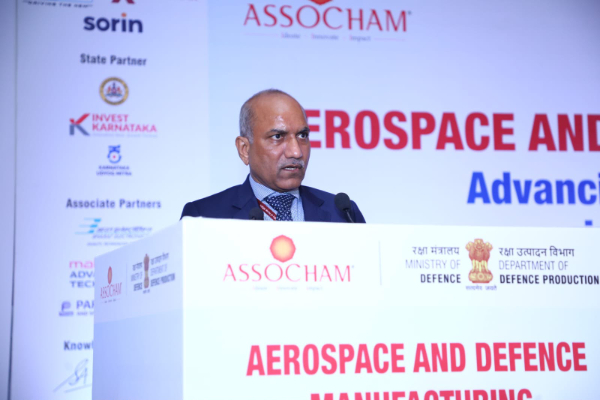
India’s aerospace and defence manufacturing industry is going through a major transformation, positioning the country as a reliable and increasingly competitive global manufacturing hub, said Sanjeev Kumar, Secretary, Department of Defence Production, Ministry of Defence, Government of India. Speaking at the ASSOCHAM National Conference on “Aerospace & Defence Manufacturing – Advancing India’s Leadership in Global Market” in New Delhi, Kumar highlighted how the Atmanirbhar Bharat and Make in India initiatives have helped drive this shift. He said the focus extends beyond reducing reliance on imports to developing world-class manufacturing capabilities and establishing India as a trusted participant in the global defence supply chain.
Highlighting the strategic and economic significance of the sector, Mr. Kumar said, “For a country like India, this sector has tremendous strategic and economic significance. We have a very strong pool of engineers, scientists, skilled workers, and entrepreneurs. What was required was to combine these capabilities along with modern technology, investment, and a conducive policy environment. That’s what the government has tried to do over the last decade or so.” He noted that policy reforms such as reserving 75 per cent of the capital acquisition budget for Indian companies, priority to indigenously designed and developed platforms, and enablers such as the Technology Development Fund, IDEX and the Srijan portal had strengthened the domestic ecosystem, with MSMEs contributing 50-60 per cent of the value in several platforms delivered by defence PSUs. He further underlined that India’s defence exports had grown to nearly Rs 39,000 crore last year, from Rs 686 crore in 2013-14, with over 100 countries now importing Indian defence products, and urged industry to invest in genuine R&D and take up indigenous design and development rather than relying solely on technology transfer, in order to build true self-reliance.
The Chief Guest also spoke about the government’s continuing push to improve the ease of doing business for the sector. He said the process for granting defence manufacturing licenses had been significantly simplified, with a 19-member evaluation committee disbanded and approvals now cleared directly by the concerned Joint Secretary in consultation with DRDO and DGQA. “It doesn’t require now more than three weeks, unless some information is awaited,” he said, adding that export licensing had similarly been rationalised, with powers delegated to the Joint Secretary level and a one-time, multi-year export authorisation regime under consideration for long-term supply partners of global OEMs. He noted that Indian defence exports, including nearly Rs 6,300 crore worth of aerospace products, now reached more than 100 countries, reflecting long-term, stable export relationships that were not dependent on shifting global situations.
In his concluding remarks, the Chief Guest urged Indian industry to move beyond manufacturing under technology transfer and invest in genuine research and development to build indigenous design capability. “No country, no company gives their latest technology to anybody else except their own forces… sometimes, few of us should take the difficult path. And the people who take the difficult path would emerge winners, as has been historically across the world,” he said. He added that the ongoing diversification of global defence supply chains had opened up a significant window of opportunity for India, with advanced countries increasingly looking to partner with Indian manufacturers, and exhorted industry – especially young entrepreneurs and tier 1, tier 2 and tier 3 suppliers – to seize the moment.
Delivering the welcome address, Mr. Anil K Agarwal, Past President, ASSOCHAM, said, “The aerospace and defense sector is at a defining moment in India’s growth story. India is no longer looking only at meeting its domestic defense requirements. We are increasingly positioning ourselves as a global manufacturing, technology, export and supply chain hub for the aerospace and defense industry.” He added that the transformation had been driven by the vision of the Government of India under the leadership of Prime Minister Shri Narendra Modi, and the determined efforts of the Ministry of Defence and the Department of Defence Production, and placed on record his appreciation for the remarkable progress made by the Ministry in recent years.
The conference featured three thematic sessions following the inaugural address – Session I, on “Building a Future-Ready Aerospace and Defence Manufacturing Ecosystem”; Session II, “From ‘Make in India’ to ‘Make for the World’”; and Session III, on “Futuristic Technologies for Defence Manufacturing.”
Speaking at Session II, “From ‘Make in India’ to ‘Make for the World’,” Dr. N Yuvraj, Secretary, Industries and Commerce Department, Government of Andhra Pradesh, highlighted the state’s efforts to strengthen its aerospace and defence ecosystem through the development of testing infrastructure and other supporting facilities. He spoke about ongoing work and planned initiatives across the aerospace, space and defence sectors, including ammunition-related activities and discussions with the Ministry of Defence on common storage infrastructure for munitions, and emphasised the state’s openness to working with stakeholders to build the ecosystem and infrastructure needed for future growth.
Ms. Khushboo Goel Chowdhary, Commissioner for Industrial Development and CEO, Invest Karnataka, Government of Karnataka, said, “For Karnataka, we actually already start from a position of considerable strength, especially in the space and defence sector. I don’t want to quote figures, but we are right now quite dominant in that sector. And we have a deep ecosystem bringing together HAL, BEML, BEL, DRDO and a lot of research institutes. Global OEMs already exist, and not to forget the 2,000-plus MSMEs which are working in this sector.”
Mr. Rajiv Gupta, Chairman, National Council on Aerospace and Defence, ASSOCHAM, speaking as a panelist at Session II, said, “The first step is localisation. What it does is create a positive note for us to start making our products domestically for ourselves. The second is competitiveness of the Indian ecosystem, which is a sum total of my supply chain, my MSMEs, my IT, my ability to do the engineering, and my ability to execute proficiently on the expectations we have on a global stage as we scale up.”
The event also marked the launch of a knowledge report titled “Aerospace and Defence Manufacturing: Advancing India’s Leadership in Global Market,” prepared by ASSOCHAM and Sugosha Advisory.
Delivering the vote of thanks, Mr. D S Rajora, Deputy Secretary General, ASSOCHAM, thanked the chief guest and all speakers, industry leaders, diplomats and state government representatives for their participation.
The event reiterated ASSOCHAM’s continued commitment to working closely with the government and industry to strengthen the country’s aerospace and defence manufacturing ecosystem, deepen indigenous design and innovation capabilities, and position India as a globally trusted and self-reliant manufacturing and export powerhouse – in step with the nation’s larger goal of building a developed India by 2047.