
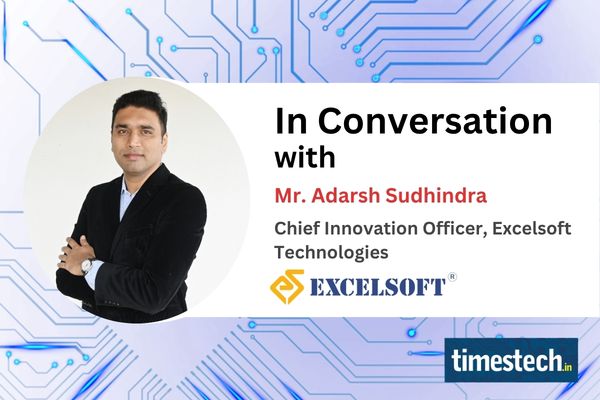
In an interview, Adarsh Sudhindra, Chief Innovation Officer, Excelsoft Technologies Limited, spoke with TimesTech, about how Saras is redefining digital assessment infrastructure for low-connectivity environments. He discussed secure offline examinations, edge computing, AI-driven assessment, candidate authentication and data integrity, while highlighting how distributed infrastructure can expand examination access globally. He also shared his outlook on adaptive testing, privacy, advanced security and the future of high-stakes digital examinations.
Read the full interview here:
TimesTech: What gaps in the existing assessment ecosystem led Excelsoft to develop Saras, and how does it rethink conventional test-centre infrastructure?
Adarsh: The gap we kept running into was not a missing feature. It was an assumption buried in almost every assessment platform: that a candidate will stay continuously connected to a distant server for three hours, and that a test centre is essentially a room that supplies chairs and bandwidth. That assumption holds in London and New York. It does not hold across most of the world we deliver in.

The second gap was fragmentation. Authoring in one system, item banking in another, delivery in a third, marking in a fourth. Every handoff between two systems is a moment when examination content has to exist in readable form, and most integrity failures happen at those handoffs rather than on exam day.
Saras was built to close both. One chain of custody that runs from the author’s keyboard to the candidate’s screen and back, and a delivery model that does not depend on the network staying up.
The rethink of the test centre is the sharper part. Conventional design puts all the intelligence at the centre and treats the venue as a thin window onto it. We invert that. A sealed, encrypted package moves to local infrastructure at the centre before the examination, candidates sit the paper over a local network, and responses are sealed and reconciled centrally afterwards. Connectivity is needed for two short windows, not for three hours. That changes what qualifies as a test centre – a community college, a school hall, a rented room – and therefore who can sit an examination without spending a day travelling to one.
TimesTech: How does Saras enable secure, high-stakes digital examinations in offline or low-connectivity environments?
Adarsh: There are two different problems here, and they need different answers.
The first is intermittent connectivity in a centre that does have a network. There the platform is engineered to ride out the fluctuation. Responses and audit events are written continuously, so a disrupted session resumes at the last saved point rather than restarting or losing work. That is table stakes now.
The second is a location where you cannot assume a network at all, and that is where the distributed model applies. An encrypted package – forms, schedules, candidate manifests – is pushed ahead of the examination to a named local server at that centre, ring-fenced to a known machine. On the day, candidates log in, the start window opens, and their machines talk only to that local server over a local network. The centre needs connectivity for a few minutes to receive the package and a few minutes to return the sealed responses. Not for the three hours in between.
Encryption runs the full length of it. Content is sealed in the bank, in the package, in transit and at rest on the local server, and is opened only on the right machine at the appointed minute. A response is encrypted on the device the moment it is made, encrypted on the way to the local server, encrypted at rest there, and encrypted again on the way back.
Saras in a Box takes that model to places with no server room. It is a palm-sized appliance – a four-core ARM processor, 16 GB of memory, a small GPU, a terabyte of encrypted SSD, an encrypted operating system and built-in Wi-Fi. Running on its own radio with a power bank, it serves a handful of candidates, which is enough for an assessor visiting a single household. Paired with an inexpensive router it serves around fifty in a school hall. Plugged into an equipped centre’s network it serves upward of a hundred and fifty.
I would not claim this makes an examination unbreakable. What it does is remove the two failure modes that cause most cancellations in difficult geographies: a network that drops mid-session, and a central server asked to hold hundreds of thousands of simultaneous connections.
TimesTech: How does Excelsoft address security, candidate authentication, data integrity and malpractice risks in remote exam centres?
Adarsh: I find it useful to separate three things that usually get bundled together: prevention, detection and judgement.
Prevention is deterministic and belongs to the machine. Identity assurance at the door, through integration with the examination body’s identity systems, single sign-on, multi-factor authentication and biometric verification where the programme requires it. A secure browser that locks the machine to the examination and closes the obvious routes out – unauthorised applications, remote desktop tools, virtual machines, screen capture, shortcut keys, a second display the rules do not permit. Encryption at rest and in transit throughout. Role-based access, network restrictions, monitoring and alerting across the central estate, and an audit trail detailed enough to reconstruct a session afterwards. Our assessment environments are certified to ISO/IEC 27001:2022 and Cyber Essentials Plus.
Detection is probabilistic, and I think our industry oversells it. A camera records behaviour and AI recognises patterns in it, but neither knows what the behaviour meant. A face leaving the frame may be a laptop slipping on a cushion. So we read signals in layers – camera, ambient audio, keystroke rhythm, mouse behaviour, an undeclared second screen. A single anomaly is usually noise; several independent layers converging on the same moment is evidence. Layering protects candidates as much as it catches misconduct.
Judgement stays with people. The most valuable thing AI does in review is triage – taking a reviewer facing three hours of footage to the four minutes that matter. It should narrow attention. It should not close the case.
The harder risk in remote centres is not the attacker. It is the legitimate insider. Digitisation does not shrink the circle of people entitled to read an examination – authors, reviewers, translators, packagers – and done carelessly it widens it. So the principle we design to is that a leak should cost an item, not an examination. A deep, well-calibrated bank, with forms drawn late and varied across candidates, turns an escaped question into one that is quietly retired. Security is not the absence of failure. It is the capacity to absorb one.
TimesTech: As AI transforms assessment through adaptive testing and automated evaluation, how could edge-based infrastructure like Saras support this shift?
Adarsh: Adaptive testing is already in the platform – computer adaptive testing built on item response theory, so difficulty follows demonstrated ability and a shorter test carries the same measurement precision. Automated scoring and digital evaluation sit alongside it. On the marking side we run AI pipelines over scanned handwritten scripts for one examination board at a scale of hundreds of millions of pages a year.
The connection to edge infrastructure is not obvious until you look at where the computation has to happen. An adaptive test makes a decision after every item. If the engine making that decision sits on a distant server, every item becomes a network round trip. That is comfortable in a well-connected city and fragile everywhere else, which means the most sophisticated form of assessment ends up reserved for candidates who already have the best infrastructure. Move the selection and scoring engine onto the local node and that dependency disappears. Adaptivity survives the network.
The second reason is privacy, and I suspect it will matter more. Proctoring signals – video, audio, keystroke behaviour – are the most sensitive data an examination produces, and today most of it is streamed to a cloud to be analysed. If the analysis runs on hardware in the room, the video never leaves the room and only the derived signal travels. The European Union’s AI Act already treats systems that monitor candidates for prohibited behaviour as high-risk, and India’s data protection framework rests on purpose limitation and timely erasure. Edge inference is the cleanest answer I know to both.
That is why the appliance carries a GPU rather than just storage. We have been running small language models on edge hardware to understand what genuinely fits inside that thermal and power envelope. Not everything does. But item selection, response capture, signal processing and a good deal of scoring already do, and the envelope keeps widening.
TimesTech: With Excelsoft operating across 30+ countries, where do you see the strongest global use cases for offline-ready assessment infrastructure?
Adarsh: The obvious answer is emerging markets, and it is only half right.
The strongest single use case is any programme whose reach is limited by what a test centre costs to run. National licensure and certification, driving-licence theory testing, school-leaving boards, public-sector recruitment, professional bodies – they all face the same arithmetic. A conventional centre needs a room, machines and a dependable network, so centres cluster where those already exist and candidates travel to them. When a centre can be a school hall with a router and an appliance, the arithmetic changes and the map changes with it. That matters most where assessment access has to extend well beyond the major cities, which is South and Southeast Asia, Africa, the Middle East and parts of Latin America.
But the counter-intuitive market is the well-connected one. Remote testing locations in wealthy countries still have thin connectivity, and a national programme has to serve them to the same standard as its capital city. Offline-ready is not an emerging-market feature. It is a rural feature, and every country has rural.
A third case gets underrated: continuity. Well-resourced examination bodies increasingly want a delivery mode that survives an outage, a cyber incident or a natural disaster without cancelling a national sitting. Distributed delivery is a continuity plan that happens also to be a reach strategy.
India is its own engineering problem and worth naming separately – lakhs of candidates in a single sitting, thousands of centres both urban and remote, uneven power, many languages, and consequences few countries can match. Broadly speaking, what works here will work almost anywhere.
TimesTech: Looking ahead, how will AI, edge computing and advanced security reshape high-stakes examinations over the next five to ten years?
Adarsh: Five things I would be willing to be judged on.
Tests get shorter and measure better. Adaptive delivery becomes the default rather than a premium option, and the length of an examination stops being treated as a proxy for its rigour.
The security conversation moves upstream. Exam-day software is the easy part; the ninety days before it is where an examination is secured or lost. I expect procurement questions to shift accordingly – less about the delivery interface, more about authoring access, item banking, packaging and transport.
Computation moves toward the candidate. The cloud becomes the system of record rather than the delivery path, with intelligence running on hardware in the room. That is a connectivity decision today and it will be a privacy decision tomorrow, because the most sensitive data an examination generates is behavioural, and the safest place to process it is where it is created.
The accountability line hardens. AI will do more of the evaluation, and regulation will simultaneously demand more of it – stated rules, reconstruct able records, an independent human reviewer and a real route to contest an outcome. A proctoring or marking system should be judged not by how much it can see, but by how little it is willing to decide alone.
And cryptography gets refreshed quietly and early. Examination content is sealed today and has to stay sealed for years, so anything harvested now can be stored against future decryption. Post-quantum readiness is not a distant concern for this industry. It is a normal part of designing a chain of custody that must hold for a decade, and it is one reason we have started building quantum capability in-house rather than waiting.
Underneath all of this sits a question technology cannot answer. AI has made answers cheap. If assessment keeps rewarding what a machine now does for nothing, no amount of security will make the result meaningful. The next decade of examination technology is about protecting integrity. The decade after it is about protecting relevance.