
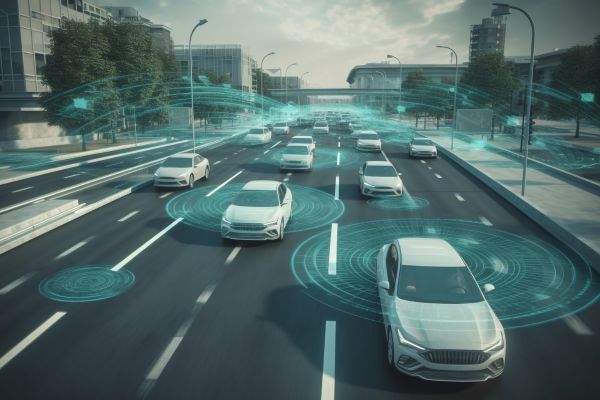
Advanced Driver Assistance Systems (ADAS) was initially introduced as a safety add-on with a suite of features, designed to improve road safety. ADAS features like adaptive cruise control, lane-keep assist, collision warning alert and emergency braking brought measurable safety benefits by allowing drivers to react faster and reduce human error – in turn promoting safer mobility.
Having said that, with vehicles becoming increasingly connected, ADAS is undergoing a deeper transformation. With 9 out of 10 new cars shipped in the USA already being connected, ADAS today is evolving from being a sensor-driven safety assistance feature into a data-powered predictive intelligence system.

At the heart of this transformation is telematics, cloud analytics and real-world driving data. ADAS-equipped vehicles today are reshaping how vehicles understand risk, anticipate hazards and support drivers even before a dangerous situation unfolds.
From Isolated Sensors to Networked Intelligence
Traditional ADAS systems rely heavily on on-board sensors including cameras, LiDAR and radar. These systems though interpret and respond to what is visible around the vehicle’s immediate surroundings. However, road safety is also influenced by other variables including traffic flow patterns, driver behaviour, road design flaws and weather changes – none of which can be understood by sensors operating in isolation. Connected data helps fill this gap by adding context beyond line-of-sight perception.
Telematics: Turning vehicles into data producers
As per reports, a modern connected vehicle typically generates around 25 GB of data per hour, while collecting information from more than 100 different data points. This includes vehicle speed, braking, steering inputs, traffic density, traction control activity and many others, which when aggregated across large vehicle population reveals how roads behave in the real world. Cloud analytics platforms then process this data to identify risk patterns which can be fed to ADAS systems – moving from situational awareness to contextual awareness. This enables them to learn and adapt their behaviour rather than reacting to fixed assumptions.
Taking adaptive cruise control as an example, early versions adjusted speed basis the distance of the vehicle ahead. However, with connected data, these systems can now predict congestion patterns via cloud analytics and proactively modulate the speed before bottlenecks or sharp bends. These predictive systems are continuously refined as more data flows in, with over-the-air software updates recalibrating algorithms without having to change hardware, further extending the vehicles’ relevance long after its sale.
The biggest leap though is with predictive safety. Traditional collision avoidance systems trigger alerts or braking when recognising imminent collisions, however, connected ADAS systems aims to intervene earlier by identifying risk patterns. Cloud-based analytics detect patterns across regions and vehicle models and flag high-risk scenarios, which when fed to ADAS systems allows vehicles to adjust sensitivity dynamically.
Importance of Data Governance
As ADAS becomes more data-driven, data governance has become a safety conversation. Inconsistent data, poor-quality sensor inputs and fragmented platforms can undermine even the most advanced algorithms. As the system grows more autonomous, the goal is simple – ensure the decisions made by ADAS are based on accurate, timely and trusted data, for which increased scrutiny by regulators will be key.
ADAS – A bridge to autonomy
While fully-autonomy in vehicles is still a work in progress, connected ADAS-equipped systems are seen as the foundational infrastructure. By the end of 2025, almost 350 million vehicles on the road globally support OTA updates, while 25% of new vehicles come equipped with 5G connectivity. As vehicles become more connected, the gap between driver assistance and autonomous capabilities will begin to close. ADAS features which today are optional aids, will form the core decision-making layer for autonomous driving tomorrow.
The Road Ahead
ADAS has already evolved from being just a suite of hardware add-on features. While sensors and processors continue to remain essential, the driving factor has now shifted to data. Telematics and cloud analytics are actively turning individual vehicles into an intelligent network which continuously learns, adapts and improves incrementally.
As the ecosystem matures, drivers will move towards smoother journeys, fewer close calls and a system that understand the road better with each drive. The shift will not happen overnight, but in the form of quite progression, moving from assistance to anticipation and finally to full autonomy.