

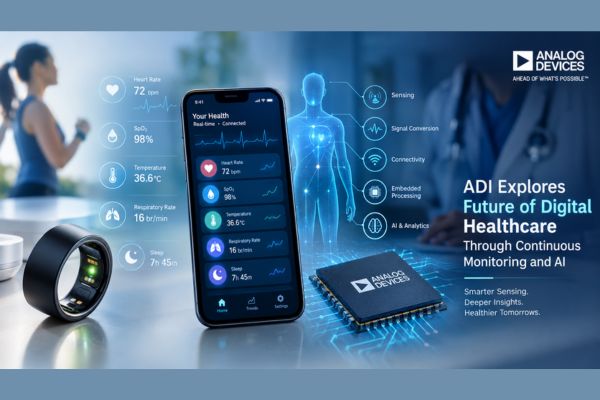
Analog Devices recently hosted a Digital Healthcare Media Briefing focused on the shift from episodic, hospital-centric healthcare towards continuous monitoring, preventive care and remote patient management. The discussion brought together experts from Analog Devices and Sensio Enterprise to explore advances in sensing, AI, low-power technologies and wearable healthcare devices.
The briefing also highlighted the role of semiconductor technologies in enabling compact, accurate and connected healthcare solutions, along with demonstrations covering smart rings, chest patches and wearable sensing technologies.
Q1. Why is digital healthcare becoming an important focus area in India?
Vivek Tyagi, Head of Regional Sales and Head of India, Analog Devices:
Digital healthcare is particularly relevant in India due to its large population and the growing prevalence of lifestyle-related conditions such as hypertension and diabetes. Continuous monitoring of vital signs can support preventive diagnostics and help people act before a condition becomes more critical. Awareness and affordability are also improving, creating opportunities for healthcare companies and semiconductor suppliers to develop solutions suited to the Indian market.
Q2. How can wearable devices balance multiple sensors, compact designs and battery life?
Dr. Venkatesh Vade, Co-founder and CEO, Sensio Enterprise:
Sensor placement, housing and optics are important for obtaining high-quality signals. There is also a balance between signal quality, measurement frequency and usage time. Different vital signs may require different measurement intervals, and reducing the measurement frequency where appropriate can help extend battery life. Devices can also store readings and synchronise them later instead of transmitting data continuously.
Praveen Jose, Sr. Technical Leader of Field Applications, Analog Devices India:
Integrated products, including analog front ends with optics, can help fit more functionality into compact devices such as rings and watches. Algorithms can determine when data needs to be captured, allowing devices to remain in low-power modes for longer periods.
Q3. What needs to change for wearables to move beyond fitness tracking?
Dr. Venkatesh Vade:
Wearables moving into healthcare require reliable, medical-grade devices that can earn the trust of doctors and healthcare professionals. This depends on accurate sensors and algorithms, with vital signs benchmarked as closely as possible against ground truth. Once the required accuracy and trust are established, wearables can support medical judgments, diagnostics and screening.
Q4. How could AI and advanced sensing transform healthcare in the coming years?
Dr. Venkatesh Vade:
Continued progress in VLSI electronics, higher density and better power efficiency can support continuous vital-sign monitoring. Data from multiple wearables and sensors could also contribute to healthcare AI models, with some processing taking place at the edge. Continuous measurements such as glucose and blood pressure could provide health data more frequently than traditional periodic checkups.
Vivek Tyagi:
Advances in semiconductor design and packaging will also be important. More advanced multi-die packages could integrate functions required for devices such as smart rings while reducing size and power consumption. In clinical equipment such as ultrasound systems and other diagnostic devices, improved digital signal processing can enhance imaging and support more accurate views inside the body.
Q5. What role do AI and edge processing play in wearable healthcare?
Dr. Venkatesh Vade:
Edge AI can process data directly on the wearable and generate inferences from the vital signs being measured. A smartphone can provide another layer of intelligence by combining different signals, while cloud-based AI can analyse longitudinal data collected over months or years. This layered approach can support more personalised healthcare.
Vivek Tyagi:
Edge AI is particularly useful when wearable devices are not continuously connected to a network. Larger datasets can be processed in hospitals and used to train models, which can then be embedded into edge devices for local inference.
Q6. What are the biggest challenges to making continuous health monitoring mainstream in India?
Vivek Tyagi:
Awareness and affordability remain challenges, although both are improving. Another important factor is developing products around Indian requirements rather than simply sourcing and relabelling products designed for other markets. Building the market will require awareness, affordability and stronger capabilities to design, develop and manufacture healthcare products in India.
Q7. How can wearable data become reliable enough for clinical decision-making?
Praveen Jose:
Accurate data is essential as healthcare moves closer to the patient. The quality of the signal captured by monitoring devices, including in noisy environments, must meet the requirements of clinical applications. Semiconductor companies provide the signal chain, while device companies develop the algorithms and software that turn the data into meaningful information. AI can then help analyse data collected over time.
Q8. What is needed for wearable-generated data to become part of routine patient care?
Vivek Tyagi:
Certification is a central requirement. Wearable devices need to reach an appropriate level of certification for hospitals and doctors to accept them and integrate their data with healthcare systems.
Dr. Venkatesh Vade:
Quality and accuracy are also key. One potential starting point is using certified devices to monitor admitted patients outside the ICU, including wards and private rooms. Over time, the same devices could support monitoring after discharge. Validation, certification, affordability and healthcare-system readiness will all influence adoption.
Q9. How is the industry addressing motion artifacts, signal quality and power consumption in wearable devices?
Praveen Jose:
Optics play an important role in obtaining accurate signals. Analog Devices has developed an analog front end with integrated optics to address integration challenges and support accurate data collection in compact form factors.
Vikash Singh, Product Application Staff Engineer, Healthcare Marketing & Applications, Analog Devices India:
Noise is a major challenge for PPG and ECG data. Working closely with customers to co-design systems can help minimise noise and achieve the performance specified for the devices.
Dr. Venkatesh Vade:
Motion artifacts, power consumption and signal quality are interconnected. Sensor placement, optics and mechanical design can all affect the quality of the PPG signal. Inertial measurement units can help identify motion artifacts so that only higher-quality data is accepted.
Q10. How can continuous health monitoring become more affordable in India?
Dr. Venkatesh Vade:
Mainstream silicon CMOS processes can help keep semiconductor costs low, while greater process scale and efficiency can improve cost structures. At the wearable-device level, higher-quality products may initially carry higher prices, but increasing volumes can help bring costs down.
Praveen Jose:
Greater integration can also reduce costs. Integrating multiple functions into a single device can help address space constraints while reducing the overall bill of materials. Efficient components that continue to operate accurately as battery voltage drops can further improve device performance and efficiency.