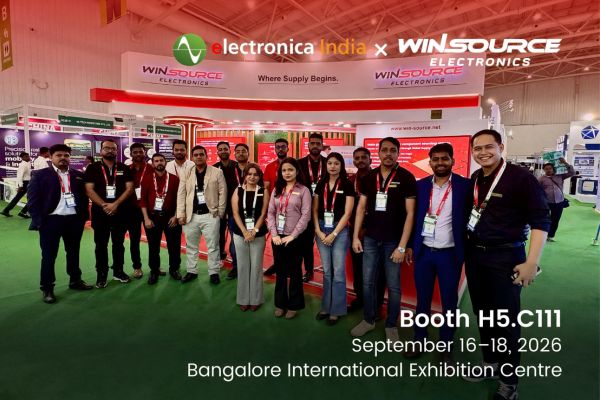
After electronica India 2026, AI, automation, and advanced electronics manufacturing-related applications emerged as key areas of focus at the exhibition. As a global independent electronic components distributor, WIN SOURCE participated in the event and gained further insights into local companies’ concerns regarding lead times, supply stability, and BOM risks through discussions with customers and industry partners. As AI servers and high-density electronic systems continue to evolve, supply changes for certain high-spec components are receiving increasing attention. Among them, lead time fluctuations and supply differentiation in high-spec MLCCs have become important factors for procurement teams to monitor.
1. High‑Spec MLCC Supply Is Dividing
In August, TrendForce cited market and channel data. Standard MLCC lead times are about 14–18 weeks. Some high‑capacity and high‑voltage products extended to 15–20 weeks. A few high‑capacity models even approached 40 weeks. AI servers and data center platforms are also pushing up demand for high‑capacity and high‑temperature MLCCs. Some products have tight inventory.
This does not mean all MLCCs are in shortage. Pressure is concentrated in specific high‑spec products. Procurement teams need to identify which specifications in the BOM are hardest to replace and have the longest lead times.
2. Why Does the India Market Deserve Attention?
On the supply side, high‑spec MLCCs depend on specific materials, processes, and manufacturing capabilities. Capacity expansion takes time. As AI server demand grows, some capacity is shifting to AI‑related specifications.
On the demand side, India’s electronics manufacturing is still expanding. Data from India’s Ministry of Electronics and Information Technology shows that by August 2026, the Electronics Component Manufacturing Scheme (ECMS) approved 106 projects. These projects expect investment of ₹69,548 crore. They cover fields such as PCBs, passive components, and electromechanical components.
For companies in India’s electronics manufacturing sector, expanding manufacturing scale means greater exposure to the global electronic component supply chain. As a result, businesses need to pay closer attention to supply changes for critical components such as high-spec MLCCs.
3. The Real Problem for Procurement Is Not Just “Is It Available?”
When lead times for an original model stretch out, procurement teams often look for other supply sources or evaluate alternative models. But for high‑capacitance MLCCs, “similar parameters” does not mean direct replacement.
Engineering teams still need to check capacitance and tolerance, rated voltage, package, DC Bias, temperature characteristics, ESR, and actual circuit performance. Automotive electronics applications also need to confirm reliability requirements such as AEC‑Q200.
What really affects emergency switching speed is often not whether a similar part number exists. It is whether the alternative has completed validation. When teams temporarily turn to other sources, they also need to pay attention to traceability and quality risks.
4. How Can Procurement Teams Prepare in Advance?
Step 1: Check high‑risk materials one full procurement cycle ahead. For high‑capacity, small‑size, high‑voltage, single‑source, and long‑lead‑time MLCCs, teams can combine actual lead times and expand the risk window to 3–6 months.
Step 2: Confirm supply for key models early. Teams should verify deliverable quantities and supply pace. This reduces the impact of sudden lead time extensions on production plans.
Step 3: Build a backup BOM early. During normal supply periods, teams should complete parameter, package, and reliability validation for second sources and backup models.
Step 4: Expand supply range and monitor inventory, lead times, and prices. When conventional channels cannot fully meet demand, independent distributors can serve as a supplementary supply source, helping companies explore additional sourcing options and evaluate procurement solutions based on inventory availability, batch information, and source traceability. Leveraging its global supply network, WIN SOURCE provides procurement teams with additional supply insights to support more informed decisions for key electronic components.
Conclusion
What electronica India reflects is not only new technology directions. It also includes changes in India’s electronics manufacturing structure. As AI infrastructure and high‑density electronic systems develop, components such as high‑spec MLCCs—whose unit value is not prominent—can also become key materials that affect production stability. Procurement teams need to move from passive response after a shortage to earlier identification of hard‑to‑replace models and supply risks.
©2026 Win Source Electronics. All rights reserved. No part of this content may be reproduced, distributed, transmitted, cached, or otherwise used in any form without prior written permission from Win Source Electronics.