
The Next AI Infrastructure Boom Will Be About More Than GPUs
The artificial intelligence industry has spent the past several years building increasingly powerful computing systems to train advanced AI models. Technology companies have invested heavily in graphics processing units (GPUs), specialized accelerators, high-performance networking and hyperscale data centers.
But the next phase of AI infrastructure development could look considerably different.
The industry’s biggest challenge is shifting from training increasingly capable AI models to running those models efficiently for millions of users and businesses.
This transition is creating a new infrastructure investment cycle.
AI-powered search, enterprise copilots, autonomous AI agents, industrial automation and real-time decision-making applications require computing capacity that remains available continuously.
Unlike model training, which can be scheduled around large computational jobs, inference workloads must often respond to unpredictable demand while meeting strict requirements for latency, reliability and operating costs.
This is fundamentally changing how AI infrastructure is designed, financed and deployed.
According to Acumen Research and Consulting, the global AI Infrastructure Market was valued at USD 60 billion in 2025 and is projected to reach USD 621.14 billion by 2035, expanding at a 26.3% CAGR during 2026–2035.
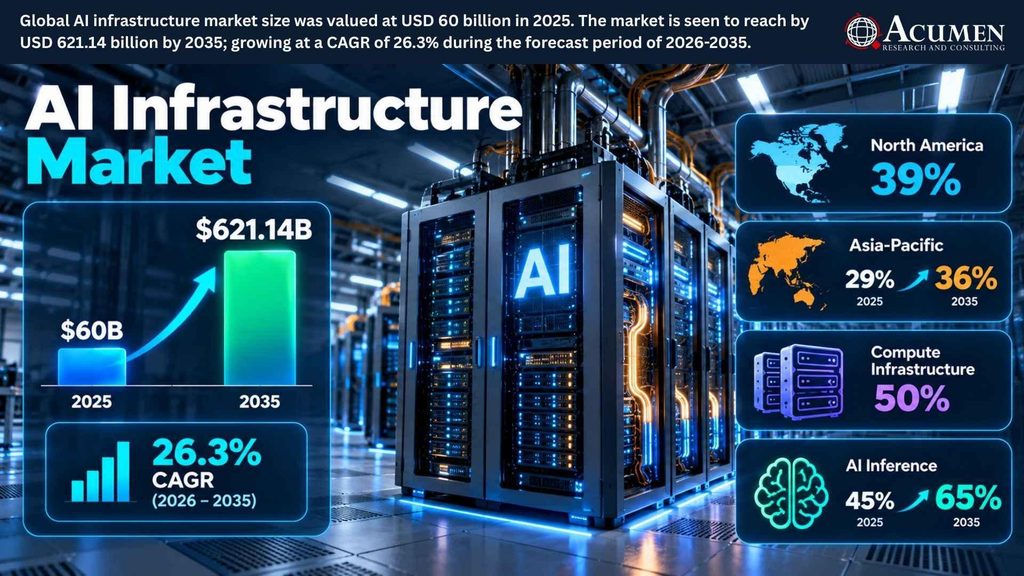
AI Infrastructure Market Statistics
| Market indicator | Statistics |
| Global market size, 2025 | USD 60 billion |
| Global market forecast, 2035 | USD 621.14 billion |
| CAGR, 2026–2035 | 26.3% |
| North America market share, 2025 | 39% |
| Asia-Pacific market share | 29% (2025) → 36% (2035) |
| Asia-Pacific CAGR | 29.3% |
| Compute infrastructure share, 2025 | 50% |
| Networking share, 2025 | 12% |
| Networking CAGR | 28.4% |
| Infrastructure software CAGR | 29.4% |
| AI model training share | 55% (2025) → 35% (2035) |
| AI model inference share | 45% (2025) → 65% (2035) |
| AI inference CAGR | 31.5% |
| Cloud deployment share | 52% (2025) → 60% (2035) |
| Hybrid deployment share | 20% (2025) → 22% (2035) |
| Machine learning share, 2025 | 38% |
| Deep learning share, 2025 | 30% |
| Generative AI share, 2025 | 22% |
| Enterprises share, 2025 | 50% |
| Cloud service providers share, 2025 | 30% |
Source: Acumen Research and Consulting, AI Infrastructure Market, September 2026. Figures represent market estimates and forecasts.
The forecast reflects growing investment in AI computing, networking, memory, storage, infrastructure software and cloud-based AI services.
However, the opportunity is no longer limited to semiconductor manufacturers.
Power generation, liquid cooling, optical networking, data-center construction and intelligent workload management are becoming increasingly important parts of the AI infrastructure economy.
AI Infrastructure Market Could Exceed USD 621 Billion by 2035
The projected expansion of the AI Infrastructure Market reflects a structural change in global computing requirements.
Traditional enterprise data centers were primarily designed to support applications, databases, virtualization and business workloads.
AI infrastructure must support far more demanding computational processes.
Training large models requires massive parallel processing, high-bandwidth memory and rapid communication between computing nodes.
Inference introduces another challenge: delivering AI-generated outputs at scale, often with low latency and predictable cost.
Acumen Research and Consulting estimates that the AI infrastructure market will increase from USD 60 billion in 2025 to USD 621.14 billion by 2035.
Three factors are driving this transformation.
First, generative AI is becoming embedded in enterprise software, consumer applications and digital services.
Second, organizations are moving beyond experimental AI projects toward production deployments.
Third, governments and technology companies are treating AI computing capacity as strategic infrastructure.
Together, these developments are creating demand for increasingly integrated computing systems.
The competitive advantage is shifting from access to individual AI chips toward the ability to operate complete AI infrastructure platforms efficiently.
AI Inference Could Become the Largest Infrastructure Investment Opportunity
One of the most important developments in the AI Infrastructure Market is the changing relationship between model training and inference.
AI model training accounted for approximately 55% of market revenue in 2025, while inference represented the remaining 45%.
By 2035, Acumen projects that AI inference will account for 65% of the market, compared with 35% for training.
The inference segment is expected to expand at a 31.5% CAGR during 2026–2035.
This represents a significant shift in infrastructure spending.
Training involves teaching models to recognize patterns and perform tasks.
Inference occurs whenever a trained model processes a new request.
Every AI-generated answer, recommendation, image analysis or automated decision requires inference computing.
As AI adoption expands, inference demand can grow through both the number of users and the complexity of each request.
Autonomous AI agents may create additional demand because they can execute multiple model calls while completing a single workflow.
The commercial implications are substantial.
Training infrastructure prioritizes large-scale computational performance.
Inference infrastructure must balance processing capacity with latency, throughput, memory efficiency, energy consumption and cost per request.
The next AI infrastructure investment cycle could increasingly be defined by how economically companies can deliver intelligence, rather than simply how much computing capacity they own.
Why AI Inference Economics Matter More Than Ever
The economics of AI inference are becoming a critical consideration for technology companies and enterprise customers.
A model may demonstrate impressive performance during development but still be expensive to operate commercially.
For example, an enterprise AI application serving thousands of employees must deliver reliable responses while managing computing expenses.
As usage increases, infrastructure costs can become a major determinant of profitability.
Several performance indicators are therefore becoming strategically important:
- Cost per million tokens processed
- Inference throughput per accelerator
- Average response latency
- Accelerator utilization
- Memory efficiency
- Energy consumed per inference task
- Infrastructure availability
The relationship between these metrics is complex.
Higher utilization can improve capital efficiency, but excessive workload consolidation may increase response times.
Smaller models can reduce computing costs, but they may not perform adequately for every application.
Specialized inference accelerators can offer efficiency advantages, although software compatibility and workload characteristics influence their effectiveness.
This is creating opportunities for hardware manufacturers, cloud providers and infrastructure software developers capable of improving AI performance per dollar invested.
Compute Infrastructure Leads With 50% Market Share
Compute infrastructure accounted for 50% of the global AI Infrastructure Market in 2025, making it the largest offering segment.
GPUs, AI accelerators, CPUs and specialized processing systems form the foundation of modern AI infrastructure.
Their importance reflects the computational intensity of machine learning, deep learning and generative AI.
NVIDIA remains a central supplier in accelerated computing, supported by its GPU platforms, networking technologies and software ecosystem.
However, the market is expanding beyond conventional GPU-based architectures.
Advanced Micro Devices is developing AI accelerators and computing platforms for large-scale AI workloads.
Intel continues to participate through processors, networking and infrastructure technologies.
Hyperscale cloud providers are also developing custom silicon.
Google’s Tensor Processing Units, Amazon’s Trainium and Inferentia families, and Microsoft’s Maia accelerators illustrate the growing interest in workload-specific computing architectures.
The objective is not simply to maximize peak processing performance.
Companies increasingly want to improve performance, power efficiency, deployment flexibility and total infrastructure cost.
As inference expands, the balance between general-purpose accelerators and specialized AI chips could become an important competitive factor.
AI Networking Is Emerging as a Critical Growth Market
GPUs often receive the greatest attention in discussions about AI infrastructure.
However, computing performance increasingly depends on how effectively processors communicate.
Large AI training clusters may contain thousands of interconnected accelerators.
Data must move continuously between computing nodes, memory systems and storage infrastructure.
If communication is inefficient, expensive processors can remain underutilized.
This makes networking an increasingly important component of AI system architecture.
Networking accounted for approximately 12% of the AI Infrastructure Market in 2025 and is projected to expand at a 28.4% CAGR through 2035.
Demand is increasing for high-speed Ethernet, InfiniBand, advanced switches, network interface technologies and optical interconnects.
Companies such as NVIDIA, Broadcom, Arista Networks and Cisco participate in different parts of this ecosystem.
Optical networking is particularly important as data-center operators seek higher bandwidth and improved energy efficiency.
The growth of AI clusters is also encouraging investment in next-generation optical transceivers and interconnect technologies.
For infrastructure suppliers, this creates opportunities beyond the processor itself.
The performance of an AI data center increasingly depends on the efficiency of the entire computing network.
Infrastructure Software Could Be the Fastest-Growing Offering Segment
Infrastructure software is projected to register a 29.4% CAGR during 2026–2035, making it the fastest-growing offering category in Acumen’s forecast.
This reflects a fundamental challenge facing AI infrastructure operators.
Building GPU clusters is expensive.
Operating them efficiently can be equally difficult.
Organizations must allocate computing resources, schedule workloads, manage memory, monitor system health and maintain infrastructure availability.
Poor resource allocation can leave valuable computing capacity unused.
Infrastructure software helps address these challenges through orchestration, scheduling, monitoring and automated resource management.
As AI environments become larger and more heterogeneous, software will play an increasingly important role in optimizing performance.
The growth of AI inference also creates demand for intelligent workload routing.
Applications may need to select different models or accelerators depending on performance requirements, cost and available capacity.
Software platforms capable of managing these decisions could become important components of the AI infrastructure value chain.
AI Data Centers Are Becoming Integrated Computing Systems
The rapid expansion of AI workloads is changing conventional data-center architecture.
Traditional facilities were designed primarily around general-purpose servers and relatively predictable power densities.
AI clusters introduce different requirements.
High-performance accelerators generate substantial heat and require reliable electrical power.
Advanced networking systems must connect large numbers of computing devices.
Storage infrastructure must deliver data at high throughput.
These requirements encourage a more integrated approach to infrastructure design.
Instead of treating servers, networking, cooling and power as separate procurement categories, operators increasingly evaluate their combined performance.
This creates opportunities for companies supplying complete infrastructure platforms.
It also changes investment decisions.
A data center equipped with powerful accelerators may still underperform if networking bandwidth, cooling capacity or electricity availability becomes a constraint.
The effective capacity of an AI facility therefore depends on its entire infrastructure architecture.
Power Availability Is Becoming a Strategic AI Infrastructure Constraint
Electricity supply is emerging as one of the most important limitations on AI infrastructure expansion.
Advanced AI data centers require substantial electrical capacity to support computing systems, networking equipment and cooling infrastructure.
In some regions, access to suitable land and computing hardware may be easier than obtaining timely grid connections.
This is encouraging closer collaboration between technology companies, utilities and energy developers.
In October 2026, Google announced a major power agreement with Constellation Energy covering approximately 3.59 gigawatts of electricity capacity, including a nuclear-power component.
The agreement illustrates how securing long-term electricity supply is becoming part of AI infrastructure strategy.
Data-center operators are also exploring demand response, energy storage and alternative power arrangements.
The investment opportunity therefore extends into electrical infrastructure, substations, transformers, grid modernization and energy management.
However, these projects carry risks.
Power availability, construction delays, financing costs and long-term demand assumptions can significantly influence project economics.
For investors, the ability to deliver reliable power may become as important as access to advanced AI processors.
Liquid Cooling Is Becoming Essential for High-Density AI Computing
As AI accelerators become more powerful, thermal management is becoming increasingly challenging.
High-density computing systems generate significant amounts of heat within relatively small spaces.
Conventional air cooling may become inefficient or impractical for some advanced configurations.
This is increasing demand for liquid cooling technologies.
Direct-to-chip liquid cooling, coolant distribution units, heat exchangers and advanced thermal-management systems are becoming important components of AI-ready data centers.
Liquid cooling can improve heat removal and support higher equipment densities.
However, adoption also requires changes to facility design, maintenance procedures and supporting infrastructure.
Companies such as Vertiv, Schneider Electric, Eaton and other thermal-management specialists are positioned within this expanding ecosystem.
The growing importance of cooling demonstrates that AI infrastructure is not simply a semiconductor market.
It is also a market for electrical engineering, mechanical systems and specialized data-center equipment.
Cloud Deployment Could Reach 60% Market Share by 2035
Cloud infrastructure accounted for 52% of the AI Infrastructure Market in 2025.
Acumen projects that its share will increase to 60% by 2035.
Cloud deployment provides organizations with access to AI computing resources without requiring them to build and maintain their own large-scale infrastructure.
This model is particularly attractive for businesses with fluctuating workloads or limited capital budgets.
Cloud providers can pool demand across customers and allocate computing resources dynamically.
Major participants include Amazon Web Services, Microsoft Azure, Google Cloud and Oracle Cloud Infrastructure.
The growth of GPU-as-a-Service and managed AI infrastructure offerings is also expanding access to accelerated computing.
However, cloud deployment is not appropriate for every workload.
Organizations handling sensitive information may prefer greater control over infrastructure location and security.
Others may find that dedicated infrastructure becomes more economical for predictable, high-volume workloads.
As a result, AI infrastructure deployment decisions will increasingly depend on workload economics rather than a single preferred architecture.
Hybrid AI Infrastructure Supports Enterprise Flexibility
Hybrid deployment accounted for approximately 20% of the market in 2025 and is projected to increase to 22% by 2035.
Hybrid architectures combine private infrastructure with cloud computing resources.
This allows organizations to maintain control over selected workloads while accessing additional computing capacity when required.
For example, an enterprise may run sensitive inference applications on private infrastructure while using cloud resources for large-scale model development.
Hybrid systems can also support geographic requirements, data sovereignty and operational resilience.
However, they introduce additional management complexity.
Organizations must coordinate security, networking, workload placement and resource monitoring across different environments.
This creates demand for infrastructure software capable of managing heterogeneous computing systems.
The long-term opportunity is therefore not limited to the physical infrastructure.
It also includes the platforms required to operate AI workloads consistently across multiple deployment environments.
Sovereign AI Is Creating a New Infrastructure Investment Cycle
Governments increasingly view AI computing capacity as a strategic national resource.
Access to advanced infrastructure can influence scientific research, public-sector digitalization, economic competitiveness and technological independence.
This is encouraging investment in sovereign AI infrastructure.
Sovereign AI generally involves developing domestic or regionally controlled computing capabilities, data systems and AI ecosystems.
Countries are pursuing different approaches depending on their technological capabilities, regulatory priorities and available resources.
Some are investing in national computing facilities.
Others are partnering with technology companies to establish regional AI data centers.
Sovereign infrastructure can create demand for GPUs, networking, storage, cloud platforms and cybersecurity technologies.
However, sovereignty does not necessarily require every component to be manufactured domestically.
Many projects depend on international technology partnerships.
The commercial opportunity lies in providing secure, reliable infrastructure that meets local requirements while remaining economically competitive.
North America Leads the AI Infrastructure Market With 39% Share
North America accounted for 39% of global AI Infrastructure Market revenue in 2025, making it the largest regional market.
The region benefits from a concentration of hyperscale cloud providers, semiconductor companies, AI developers and advanced data-center operators.
The United States remains central to global AI infrastructure investment.
Major technology companies are expanding accelerated computing capacity to support generative AI, enterprise applications and increasingly sophisticated AI models.
North America also benefits from a mature technology ecosystem involving chip designers, networking suppliers, infrastructure software developers and specialized data-center companies.
However, the region faces growing challenges involving electricity supply, construction timelines and equipment availability.
These constraints could influence where new computing facilities are developed.
Future growth may increasingly depend on regions capable of offering reliable power, suitable infrastructure and efficient project execution.
Asia-Pacific Could Capture 36% of the Market by 2035
Asia-Pacific accounted for approximately 29% of the global AI Infrastructure Market in 2025.
Its share is projected to increase to 36% by 2035, supported by a 29.3% regional CAGR during 2026–2035.
The region’s growth reflects expanding AI adoption, digital infrastructure investment and semiconductor development.
China is investing in domestic computing capacity and data-center infrastructure.
Japan and South Korea benefit from advanced semiconductor and electronics ecosystems.
Singapore remains an important regional hub for cloud computing and data-center services.
India is also emerging as a significant AI infrastructure opportunity.
Demand is increasing for AI-ready data centers, cloud services, enterprise computing and domestic AI capabilities.
However, regional expansion depends on access to power, advanced hardware, reliable networking and sufficient technical expertise.
For international infrastructure suppliers, Asia-Pacific offers opportunities across computing hardware, optical networking, data-center systems and software.
India’s AI Infrastructure Opportunity Extends Beyond Data Centers
India’s growing AI ecosystem is creating demand for computing infrastructure across several industries.
Enterprise adoption of generative AI, digital public services, financial technology, healthcare and industrial automation is increasing the need for reliable computing resources.
The country’s AI infrastructure opportunity includes cloud platforms, GPU computing, networking, storage and data-center development.
Domestic AI initiatives and demand for Indian-language AI applications could further encourage investment.
However, India’s long-term competitiveness will depend on infrastructure economics.
Electricity reliability, cooling efficiency, connectivity and access to advanced processors are important considerations.
Local infrastructure providers may find opportunities in AI server integration, data-center construction, electrical systems and managed computing services.
The market could also support partnerships between international semiconductor companies and domestic technology providers.
Rather than focusing exclusively on building large computing facilities, India may benefit from developing an integrated ecosystem that combines infrastructure, software capabilities and commercial AI applications.
Enterprise Customers Account for 50% of AI Infrastructure Demand
Enterprises represented approximately 50% of the global AI Infrastructure Market in 2025.
Cloud service providers accounted for 30%, while government and research organizations represented 15%.
The leading enterprise share reflects the growing importance of AI across business operations.
Organizations are deploying AI for customer service, software development, financial analysis, cybersecurity, predictive maintenance and operational decision-making.
However, moving from experimentation to production requires substantial infrastructure capabilities.
Enterprise AI systems must provide dependable performance, appropriate security, integration with existing applications and predictable operating costs.
This creates demand for both cloud-based AI services and dedicated enterprise infrastructure.
Companies that simplify deployment and reduce operational complexity could benefit from this transition.
Generative AI Is Reshaping Infrastructure Requirements
Machine learning accounted for 38% of the AI Infrastructure Market in 2025, followed by deep learning at 30%.
Generative AI represented approximately 22%.
The growth of generative AI is increasing demand for specialized computing architectures.
Large language models require significant memory bandwidth and processing capacity.
Multimodal systems introduce additional requirements involving images, audio, video and other data types.
Autonomous AI agents may generate multiple inference requests while completing complex tasks.
These developments could increase infrastructure utilization and create demand for more sophisticated workload-management systems.
However, improvements in model efficiency may also reduce the computing resources required for individual tasks.
Quantization, model compression, optimized inference engines and smaller specialized models can improve performance per unit of computing capacity.
This creates an important distinction.
AI infrastructure demand will depend on both the efficiency of individual models and the total volume of AI workloads.
More efficient computing does not necessarily mean lower overall infrastructure demand if AI usage expands substantially.
Leading Companies in the AI Infrastructure Ecosystem
The AI Infrastructure Market includes several interconnected groups of suppliers.
AI computing and semiconductor companies: NVIDIA, AMD, Intel and suppliers of custom AI accelerators provide core processing technologies.
Hyperscale cloud providers: Amazon Web Services, Microsoft Azure, Google Cloud and Oracle Cloud Infrastructure operate large-scale computing environments.
Networking and connectivity companies: Broadcom, Arista Networks, Cisco and NVIDIA supply technologies used to connect AI computing systems.
Data-center infrastructure providers: Vertiv, Schneider Electric and Eaton participate in electrical, power-management and thermal-management systems.
Enterprise infrastructure companies: Dell Technologies, Hewlett Packard Enterprise and other server manufacturers support AI infrastructure deployment.
Competition increasingly involves partnerships across these categories.
A high-performance AI system requires compatible processors, networking, software, storage, power and cooling.
This encourages collaboration between suppliers while creating opportunities for companies capable of delivering integrated solutions.
Where Are the Most Attractive AI Infrastructure Investment Opportunities?
The next phase of AI infrastructure growth could create opportunities across five areas.
1. Specialized AI inference computing
As inference becomes the largest infrastructure function, demand could increase for accelerators optimized for low latency, throughput and energy efficiency.
2. High-speed networking and optical interconnects
Larger computing clusters require faster data movement, creating opportunities for advanced networking hardware and optical connectivity.
3. Power and thermal infrastructure
Data-center expansion is increasing demand for electrical equipment, grid connectivity, liquid cooling and energy-management systems.
4. Infrastructure orchestration software
Organizations need better tools to schedule workloads, monitor resources and improve accelerator utilization.
5. Sovereign and regional AI infrastructure
Government initiatives and enterprise requirements could support investment in geographically distributed computing facilities.
These opportunities have different economic characteristics.
Semiconductor suppliers may benefit from technological differentiation but face rapid product cycles.
Data-center operators require substantial capital investment and dependable utilization.
Infrastructure software providers may offer recurring revenue models but operate in competitive markets.
Investors and industry participants must therefore evaluate each segment independently.
AI Infrastructure Growth Comes With Significant Risks
Despite the market’s projected expansion, several risks could influence investment returns.
Capital intensity: AI infrastructure requires substantial upfront investment in computing equipment, facilities and supporting systems.
Technology obsolescence: Rapid semiconductor innovation can shorten the economic life of computing assets.
Power constraints: Delays in grid connections and energy infrastructure can postpone data-center deployment.
Utilization uncertainty: Infrastructure profitability depends on sustained demand and effective capacity management.
Supply-chain concentration: Advanced semiconductors and supporting components depend on complex international supply chains.
Regulatory requirements: Data protection, export restrictions and national security considerations can affect infrastructure deployment.
Pricing pressure: Improvements in computing efficiency and increased competition may reduce the price customers pay for AI processing.
These risks highlight why revenue growth across the AI economy does not automatically translate into attractive returns for every infrastructure provider.
Successful investment strategies will require careful consideration of demand, financing, technology and operating efficiency.
The AI Infrastructure Market Is Moving From Capacity Expansion to Infrastructure Efficiency
The first major phase of the AI infrastructure boom was characterized by competition to acquire advanced computing hardware.
The next phase is likely to place greater emphasis on utilization, operating efficiency and commercial performance.
Several transitions are becoming increasingly important.
Training to inference: AI infrastructure spending is shifting toward systems that support production applications and continuous AI services.
Individual accelerators to integrated computing systems: Networking, memory, storage and infrastructure software are becoming essential determinants of performance.
Conventional data centers to AI-optimized facilities: High-density computing requires new approaches to electrical power, cooling and facility design.
Centralized computing to distributed AI infrastructure: Cloud, hybrid and sovereign architectures are expanding the range of deployment models.
Computing capacity to computing economics: Cost per inference, energy efficiency and infrastructure utilization are becoming important commercial metrics.
These developments suggest that AI infrastructure will increasingly be evaluated as a complete operating system rather than a collection of computing components.
AI Infrastructure Market Outlook: The Next Decade of the AI Economy
The AI Infrastructure Market is projected to expand from USD 60 billion in 2025 to USD 621.14 billion by 2035, reflecting a 26.3% CAGR.
This growth is being driven by the commercialization of generative AI, expansion of inference workloads, hyperscale computing investment and increasing demand for sovereign AI capabilities.
However, the market’s most important transformation may be structural.
AI infrastructure is evolving from a hardware-intensive technology investment into a broader ecosystem involving semiconductors, networking, software, electricity and physical data-center infrastructure.
As AI becomes embedded in everyday business operations, the infrastructure supporting it must deliver reliable performance at commercially sustainable costs.
For technology companies, this means optimizing entire computing systems.
For enterprises, it means selecting infrastructure architectures that balance performance, security and cost.
For infrastructure suppliers and investors, it means identifying the components and services that become increasingly valuable as AI adoption expands.
The next generation of AI infrastructure leaders may not simply be the companies supplying the most computing power. They may be the companies enabling the greatest amount of useful AI computing at the lowest sustainable cost.
Frequently Asked Questions
What is the AI Infrastructure Market?
The AI Infrastructure Market includes computing hardware, AI accelerators, memory, storage, networking, infrastructure software and computing services used to develop, train and deploy artificial intelligence applications.
How big is the global AI Infrastructure Market?
According to Acumen Research and Consulting, the market was valued at USD 60 billion in 2025 and is projected to reach USD 621.14 billion by 2035, expanding at a 26.3% CAGR.
What is driving AI infrastructure market growth?
Major growth drivers include generative AI adoption, rising inference demand, hyperscale data-center investment, specialized AI accelerators, cloud computing and sovereign AI initiatives.
Why is AI inference becoming more important?
AI inference supports the continuous operation of deployed AI applications. As AI services reach more users and businesses, demand increases for reliable, low-latency and cost-efficient inference computing.
Which region leads the AI Infrastructure Market?
North America led the market with approximately 39% share in 2025, while Asia-Pacific is projected to be the fastest-growing region.
Which AI infrastructure segment has the largest market share?
Compute infrastructure accounted for approximately 50% of market revenue in 2025.
What role does liquid cooling play in AI infrastructure?
Liquid cooling helps manage the heat generated by high-density AI computing systems, supporting advanced accelerator deployments and more efficient thermal management.
What are the main investment opportunities in AI infrastructure?
Important opportunities include AI accelerators, high-speed networking, optical interconnects, infrastructure software, liquid cooling, electrical equipment and sovereign AI computing facilities.