

Supercapacitors are seeing increasing interest as energy storage devices within AI data center power architectures. However, the application is still emerging, and case studies and deployments remain limited. IDTechex’s recent report “Supercapacitors for Data Centers 2027-2037: Technologies, Applications, Players and Forecasts“, predicts more than 70 GW of cumulative supercapacitor power supply will be installed in data centers across the world. This article provides an overview of early developers of the technology and potential partnerships.

Player announcements: who is targeting the market?
A number of supercapacitor players have already pivoted to better target the AI data center market, developing products aimed specifically at installation in racks or in UPS facilities, or exploring deployment of supercapacitor cells within backup units and data center power infrastructure. These include:
- Skeleton Technologies: developed hybrid and electric double-layer capacitors (EDLCs), including Graphene battery backup unit (BBU) and SuperBattery container.
- Eaton: developed uninterruptible power supply (UPS) modules and racks to complement BBUs. Developed 800V data center power architecture reference example including supercapacitors.
- VinaTech: scaling up cell and module production to target AI data centers, including partnerships with Bloom Energy, a fuel cell developer.
- LiCAP: developing modules for UPS and power stabilization at rack-scale. Quotes need for supercapacitors at 1:10 ratio compared to batteries in BBUs for AI data centers.
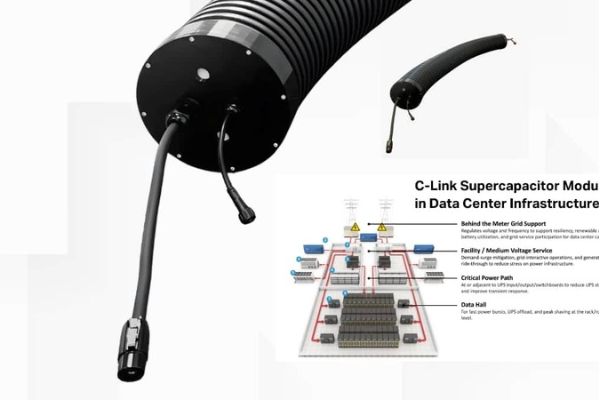
- Capacitech: developing systems and module designs rather than cells, with cable-form factor aimed at data center retrofitting.
- Panasonic: recently announced development of capacitor-based battery backup units aimed at data centers, with plans to begin production in 2027.
Types of partnerships and varying disclosure
As of 2026, there is minimal publicly available information regarding supply agreements between supercapacitor product developers and data center players directly. This may be due to limited commercial deployment at scale, with data center players currently validating and testing supercapacitor options within data center power architectures, or it may be due to the current focus of hyperscale data centers on data center construction rather than optimization of power architecture, with optimization becoming more of a priority over the next 1-3 years.
Despite this, there are several partnerships/collaborations of interest announced by supercapacitor players developing products for the AI data center industry. These generally take two forms:
- Partnerships between supercapacitor developers and power infrastructure developers to produce more complete, easily integrated products.
- Partnerships/project collaborations to validate and show proof-of-concept of supercapacitor integration.
Specific examples of both of these partnerships are explored in detail in IDTechEx’s recent report: “Supercapacitors for Data Centers 2027-2037: Technologies, Applications, Players and Forecasts”.
Development partnerships
Examples of development partnerships combine supercapacitor cell or technology developers with power architecture developers or systems developers. Musashi Energy Solutions’ partnerships Flex and DG Matrix are good examples. Musashi Energy Solutions is a developer of hybrid supercapacitor cells, based in Michigan. The company partnered with Flex in 2024 to develop capacitor-based energy storage systems (CESS). These systems, taking the form of 18.3” x 31” x 1.73 ” trays were released in 2025 and explicitly developed to target AI data centers. Musashi Energy Solutions also announced another collaboration in March 2026 with DG Matrix, integrating Musashi Energy Solutions’ ESS400 Energy Storage System and DG Matrix’s Interport, a multi-port solid-state transformer. The purpose of this collaboration was to target large AI power fluctuations, preventing equipment damage and degradation and reducing grid instability, which IDTechEx identifies as a major challenge for AI data centers.
IDTechEx conclusions
In IDTechEx’s assessment, small-scale supercapacitor deployments in data centers have already occurred, and it is likely that the market will shift from the validation stage to wider scale commercial deployment in the next 1-2 years, with 2026 marking a pivot point in the industry. Refocusing efforts by supercapacitor players to better target AI data centers, as well as direct statements by supercapacitor and power infrastructure players have shown healthy optimism for supercapacitor potential, though it remains to be seen at what scale this will be realised. For more detailed analysis of the role of supercapacitors in AI data centers and the emerging market, see IDTechEx’s recent report: “Supercapacitors for Data Centers 2027-2037: Technologies, Applications, Players and Forecasts”.