

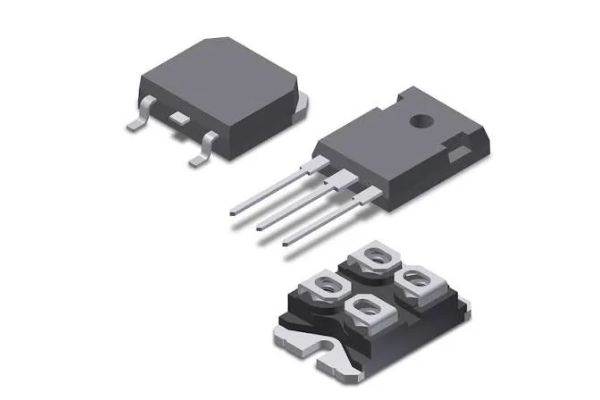
Polar MOSFETs have been used across a broad range of applications for many years and continue to provide a compelling solution for both established and newer designs where straightforward implementation, reliability and proven performance are important. Littelfuse Polar MOSFETs are characterised by strong avalanche capability, a wide safe operating area (SOA) and ease of integration. The breadth of the portfolio allows designers to support legacy platforms as well as new system developments, particularly where long-term reliability remains a key design requirement.
Balancing Performance and Reliability in Power Electronics
Power electronic applications, including power supplies, process power systems, and test and measurement equipment, must combine electrical performance with dependable operation. Fundamental device requirements include appropriate voltage and current ratings, low on-state resistance to limit conduction losses, and switching performance that supports overall system efficiency.
In practice, operating conditions can introduce additional stresses. Inductive switching may generate voltage transients, sudden line or load changes can cause overvoltage and overcurrent events, and repeated pulsed power cycling can place further demands on the devices. To maintain fault tolerance and long-term reliability, designers therefore also need characteristics such as overvoltage ruggedness, a wide safe operating area (SOA), low thermal resistance, and robust pulsed power cycling capability.
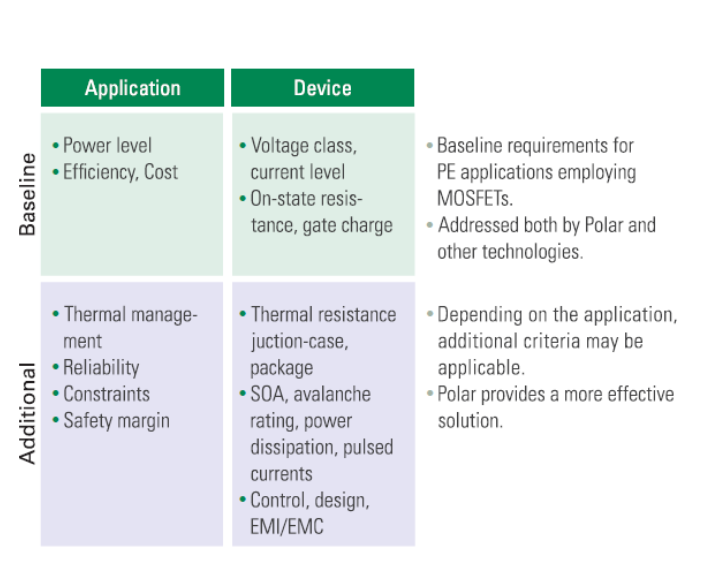
Figure 1 links typical power electronics system requirements with the device characteristics needed to address them. The relative importance of each parameter varies by application, helping identify where Polar MOSFETs can offer particular advantages.
Technologies such as Silicon Superjunction (SJ) and SiC can provide strong performance in areas including efficiency and high-speed switching. However, demanding operating conditions may also place greater emphasis on device ruggedness. Littelfuse Polar MOSFETs combine the fundamental electrical requirements with strong overvoltage ruggedness, a robust safe operating area (SOA), low thermal resistance, and enhanced pulsed power cycling capability. This combination makes them well suited to applications where straightforward implementation and reliable operation under harsh conditions are important.
Inside the Polar MOSFET Portfolio
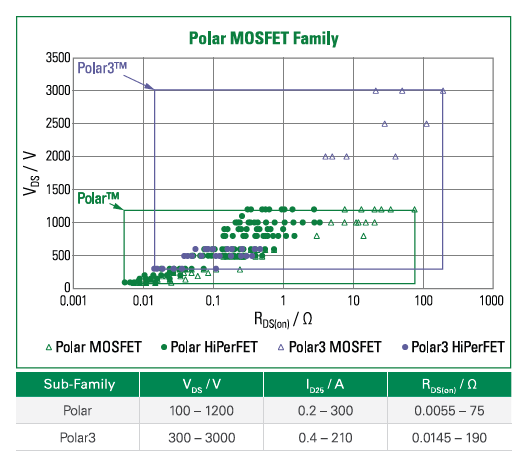
The Littelfuse Polar MOSFET portfolio shown in Figure 2 is divided into two main groups, Polar and Polar3. Both families include standard MOSFETs as well as HiPerFET devices featuring a fast body diode to support improved switching behaviour.
Across the Polar series, voltage ratings extend from 100 V to 1200 V, with current ratings from 0.2 A to 300 A and on-state resistance values ranging from 0.0055 Ω to 75 Ω. Polar3 broadens the voltage range to 300 V through 3000 V, while offering current ratings from 0.4 A to 210 A and on-state resistance values between 0.0145 Ω and 190 Ω.
Based on Littelfuse proprietary planar gate designs, these devices combine key performance characteristics with the ruggedness and reliability required for demanding applications. The portfolio is available in numerous standard discrete packages, together with specialised options including isolated ISOPLUS and high-voltage (HV) packages.
Several characteristics of Polar MOSFETs can also help simplify design and integration compared with competing MOSFET technologies
- Enhanced ruggedness: Strong avalanche and safe operating area (SOA) capabilities support reliable operation during overvoltage, overcurrent, and abrupt line and load changes.
- Standard gate drive compatibility: Operation without the need for negative gate voltages can reduce gate-driver complexity and cost.
- Simplified design integration: Minimal tuning of layout, parasitics, and thermal paths can help make implementation easier and faster across applications.
- Reliable paralleling: Controlled switching behaviour and the positive temperature coefficient of on-state resistance support safer and easier paralleling while reducing the risk of current imbalance.
- Cleaner switching behaviour: Reduced dv/dt stress can simplify PCB layout and minimise the need for complex EMI mitigation techniques.
- Robust body diode performance: HiPerFET devices incorporate a fast body diode with lower forward voltage drop, helping improve efficiency in application.
As newer competing technologies continue moving towards smaller chip geometries, thermal management can become more challenging as heat must be dissipated from a reduced die area. Polar MOSFETs, by comparison, provide strong thermal performance that can help simplify system-level thermal design.
Avalanche Capability Under Real-World Overvoltage Stress
Power electronics systems generally use either soft-switching or hard-switching topologies. Soft-switching designs use zero-voltage switching (ZVS) and zero-current switching (ZCS) to reduce switching losses, but are more complex and can be particularly sensitive to overvoltage and overcurrent conditions. Hard-switching topologies are simpler to implement, although they typically introduce higher switching losses and expose devices to greater voltage stress.
Overvoltage ruggedness remains an important requirement irrespective of the topology. Parasitic inductances and rapid switching transitions can generate voltage spikes even in well-designed circuits. If a turn-off transient drives the MOSFET voltage beyond its breakdown level, the device can briefly enter avalanche mode and conduct the excess energy. An avalanche-rated MOSFET is specifically designed and tested to tolerate this condition within defined limits without sustaining damage.
That capability provides an additional margin against transient overvoltages in real-world systems. By surviving occasional avalanche events, the MOSFET can help prevent device failure, limit the risk of wider system damage, and reduce the possibility of costly line-down events in critical applications. This built-in robustness can therefore contribute to both system reliability and operating life without requiring a more complex protection approach.
Figures 3 and 4 compare the single-pulse avalanche capability of Littelfuse Polar MOSFETs with other MOSFET technologies. The comparison uses datasheet ratings for devices with similar voltage classes, nominal current ratings, and package types.
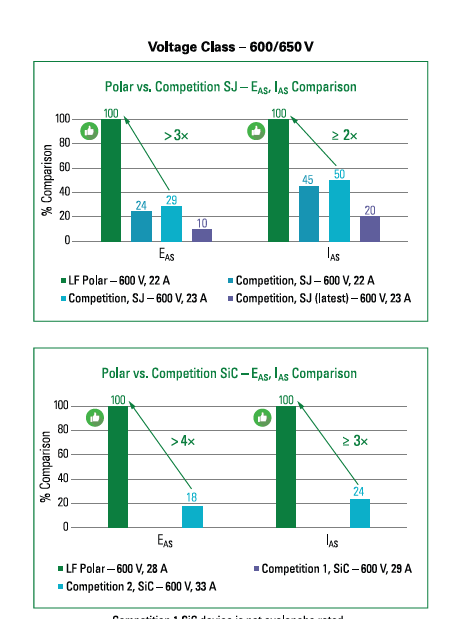
Figure 3: Single-pulse avalanche capability comparison for 600/650 V MOSFET technologies
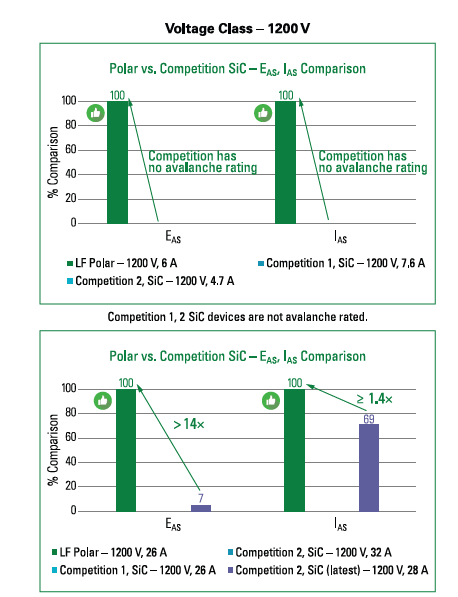
Figure 4: Single-pulse avalanche capability comparison for 1200 V MOSFET technologies
Safe Operating Area Under Demanding Conditions
A MOSFET’s safe operating area (SOA) defines the combinations of voltage and current the device can tolerate without damage. It also indicates how much power can be handled safely in the saturation or linear region under both continuous and pulsed conditions. As a measure of device robustness, SOA is particularly important when a MOSFET operates briefly in the linear region, for example during start-up, sudden load changes, or slower switching transitions.
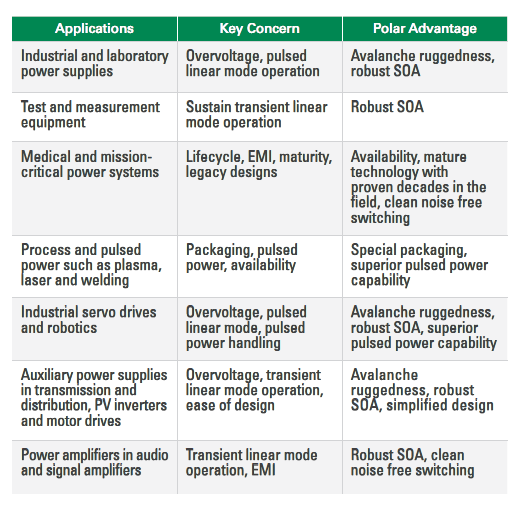
Figure 5: Pulsed safe operating area comparison across MOSFET technologies
Strong SOA performance is especially valuable in applications such as power amplifiers, push-pull topologies, auxiliary power supplies, and booster circuits in power supplies. In these environments, the ability to withstand short periods of high power dissipation can make an important contribution to system reliability and long-term durability.
Figure 5 compares the maximum current values specified in datasheet SOA ratings for pulsed operation at the maximum voltage rating for 600/650 V and 1200 V MOSFETs in comparable packages. The results show Littelfuse Polar MOSFETs providing greater safety margins than the competing technologies included in the comparison.
Where Ruggedness Becomes Critical
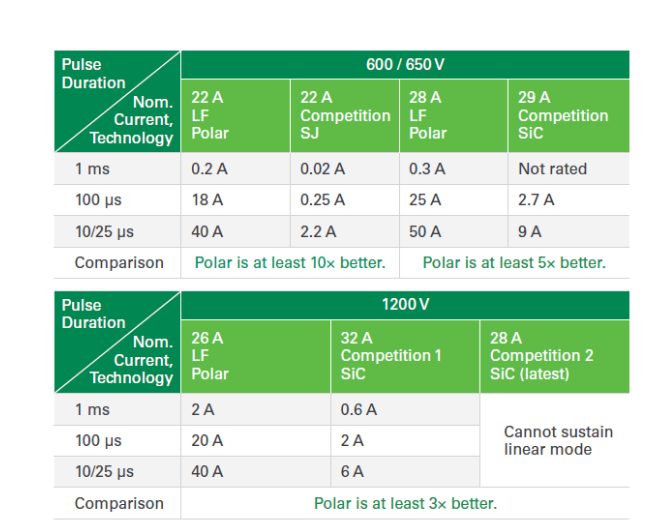
Many power electronics systems operate in conditions where dependable performance under electrical and thermal stress is essential. Table 1 highlights applications where the ruggedness of Polar MOSFETs can provide a particular advantage.
Table 1: Representative applications with demanding reliability requirements
Conclusion
Littelfuse Polar MOSFETs continue to provide a strong combination of electrical performance, ruggedness, and straightforward integration for modern power electronics systems. Their ability to tolerate overvoltage events and maintain reliable operation under demanding conditions makes them well suited to a range of industrial applications.
For designers balancing newer device technologies against proven solutions, Polar MOSFETs remain a practical option for both established platforms and new system development, particularly where long-term reliability and predictable behaviour are key priorities.
By Sachin Shridhar Paradkar, Product Marketing, Littelfuse