

The anti-drone market is experiencing rapid growth, fueled by increasing concerns over airspace security and the unauthorized use of drones. Valued at $3.14 billion in 2024, the market is projected to reach over $30.97 billion by 2034, with a compound annual growth rate (CAGR) of 25.8%.
This growth is being driven by innovations in artificial intelligence, sensor fusion, and signal processing, which are enhancing the ability of anti-drone systems—including radar, jamming, and directed energy weapons—to detect and neutralize threats. These technologies are becoming essential for military, public safety, and critical infrastructure applications.
Key Market Highlights
- By Region: North America led the market with a 41.2% revenue share in 2024. This is a result of significant military investment, a robust defense infrastructure, and the widespread adoption of anti-drone technology across government and private sectors.
- By Component: Hardware accounted for a 69.2% revenue share in 2024. Components like radars, jammers, and sensors are crucial for physically detecting and neutralizing drones, making them an indispensable part of any anti-drone system.
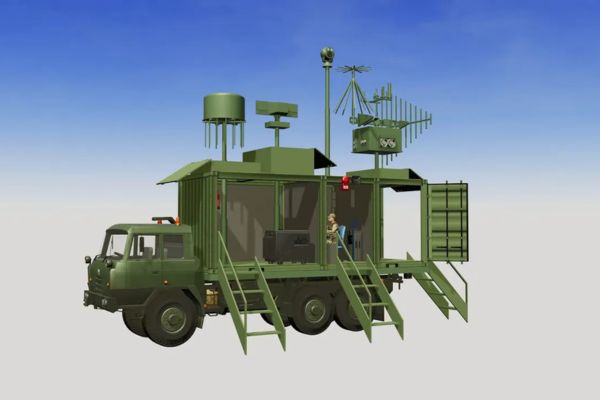
- By Type: The ground-based segment held a 76.8% revenue share in 2024. These systems, which include towers and vehicle-mounted units, are easy to deploy and ideal for protecting fixed locations like airports, borders, and other critical infrastructure.
- By Range: Systems with a range of less than 5 km captured an 83.7% revenue share in 2024. Short-range systems are best suited for urban and perimeter defense, offering effective coverage in densely populated areas where long-range detection isn’t practical.
- By Technology: Anti-drone radar was the leading technology with a 56.1% revenue share in 2024. Radar is vital for early and accurate drone detection in various weather and terrain conditions, making it a core technology in modern anti-drone solutions.
- By Defense: The detection and disruption segment dominated with a 78.4% revenue share in 2024. Integrated systems that can both detect and immediately respond to threats provide a comprehensive defense, eliminating the need for separate systems.
- By End Use: The military and defense sector recorded a 61.8% revenue share in 2024. Armed forces are the primary adopters of this technology due to the increasing threat from hostile drones, driving demand for advanced solutions to secure battlefields and sensitive installations.
The Anti-Drone Market: A Segmental Analysis
The anti-drone market is defined by a wide array of specialized technologies and applications. The following analysis breaks down the key segments driving market growth.
Component Analysis
- Hardware dominates the market’s revenue share, providing the physical means to counter drones. This includes radars, jammers, and kinetic systems that detect and physically disable unmanned aerial vehicles (UAVs). In March 2024, a European defense company introduced a hand-carried jammer designed for ground troops, highlighting the demand for durable and mobile anti-drone hardware for frontline use.
- Software is a crucial component that integrates sensor data to enable automated responses. It includes AI-based tracking and signal classification algorithms that are vital for speed and accuracy. In June 2025, an American company released an AI firmware update that reduced false positives in urban environments by 30%, underscoring the shift toward more intelligent, software-driven anti-drone operations.
Type Analysis
- Ground-Based systems hold the highest revenue share. These fixed or vehicle-mounted systems, such as towers, are designed to protect fixed locations like military bases and airports. Their sustained power and sensor capabilities are essential for long-term surveillance. For example, in October 2023, an Asian country deployed a ground-based laser defense tower at a major airport that could automatically neutralize invading drones within a 3km range.
- Handheld systems are portable jammers or detectors used by personnel for short-range drone detection, such as during patrols or VIP security. In September 2022, a security startup launched a glove-mountable RF jammer, showcasing a trend toward on-person, individual-led counter-drone solutions.
- UAV-Based systems use interceptor drones to track and disable rogue UAVs in mid-air with nets, jamming, or kinetic force. A North American military contractor unveiled a drone-to-drone interceptor in May 2025 that could autonomously track and destroy small UAVs, representing a major step toward mobile, airborne protection.
Range Analysis
- Less than 5km systems hold the largest market share. These short-range solutions are ideal for urban and perimeter defense. Their localized coverage and often portable design make them suitable for protecting crowds and built-up areas.
- Over 5km systems are used for wide-area surveillance of strategic locations. Their powerful sensors enable early threat detection. In January 2025, a European consortium launched a long-range radar tower that could detect micro-UAVs from up to 8km away, demonstrating the importance of broad-area aerial surveillance.
Technology Analysis
- Anti-Drone Radar leads the technology segment. These systems use advanced radar to detect low-signature drones, even in challenging conditions. An Israeli company’s X-band radar, introduced in August 2023, can track nano-drones in complex urban settings, making it a central component of city-wide drone defense.
- RF Scan systems provide early warnings by detecting and identifying drone communication frequencies, even encrypted ones. In November 2024, a U.S. vendor deployed a multi-channel RF scanner that could decipher encrypted drone communications, elevating the level of signal detection.
- Thermal Imaging is a crucial technology for all-weather detection. These systems identify drones by their heat signatures. In April 2022, a fused thermal/EO camera system debuted, allowing operators to differentiate between types of UAVs based on their heat signatures in low-visibility conditions.
- Other technologies include acoustic sensors, hybrid fusion platforms, and AI fusion modules. These systems complement core detection technologies. A startup’s hybrid acoustic-optical sensor array, released in February 2025, uses AI to classify drones by their sound profile, demonstrating the industry’s move toward enhanced sensor fusion and adaptive detection.
Defense Analysis
- Drone Detection & Disruption Systems generated the highest revenue share by providing comprehensive, end-to-end defense. These integrated packages combine detection, tracking, and proactive countermeasures like jamming or lasers. In May 2025, a NATO task force successfully field-tested a vehicle-mounted system with integrated radar, RF, and laser capabilities, highlighting the growing popularity of multi-tiered, fully integrated architectures.
- Drone Detection Systems only identify and track incoming UAVs without neutralizing them. They are typically used for early warning in areas where disruption is not required. In July 2023, several North American airports adopted dual radar-RF detection systems to alert security staff of drone incursions.
End-Use Analysis
- Military & Defense is the leading end-use segment. Military applications require rugged and mobile systems for battlefield use and border protection. In August 2024, a Middle Eastern military commissioned an armored anti-UAS vehicle with integrated jamming and kinetic interceptors to protect convoys, showcasing the demand for portable, multi-modal platforms.
- Commercial users, such as airports and stadiums, are increasingly using anti-drone systems to secure their operations. In November 2022, a port in Southeast Asia installed RF detection sensors to mitigate unauthorized drone inspections, indicating the expansion of this technology into civilian critical infrastructure.
- Government agencies, including law enforcement and intelligence, prefer deployable and stealthy systems for municipal security and VIP protection. A European police force used portable jammers during a G-7 summit in July 2025, demonstrating the government’s growing reliance on preemptive counter-UAS measures.
- Other end users, such as private security firms and utility operators, are implementing customized anti-drone solutions to protect their assets. An oil refinery in South America piloted an acoustic- and thermal-based perimeter detection system in March 2024, highlighting the expansion of counter-UAS solutions into industrial-specific applications.
Anti-Drone Market Regional Scope
North America Leads the Anti-Drone Market
- North America dominates the global anti-drone market, with a market size of $1.29 billion in 2024, projected to reach $12.76 billion by 2034. The region’s leadership is driven by its advanced military infrastructure, commercial interests, and significant border security needs.
- The U.S. is a key player, often pioneering integrated anti-drone systems. For example, in April 2025, the U.S. Department of Defense deployed advanced counter-drone measures on its border with Mexico to combat cartel-operated UAVs. This highlights the region’s proactive approach to security. Elsewhere, Canada is focused on protecting critical infrastructure, while Mexico is increasingly using portable jamming solutions for law enforcement.
Driving Factors in the European Market
- The European anti-drone market was valued at $0.83 billion in 2024 and is expected to grow to $8.18 billion by 2034. The market’s growth is fueled by a sharp rise in airspace violations and drone-related threats in urban centers.
- European nations are investing heavily in multi-sensor, AI-based systems. France, for example, dedicated $5.3 billion of its Military Program Law in November 2024 to anti-air systems, with a specific focus on drone defense for major public gatherings. Countries like Germany and the UK are also showcasing advanced AI-driven radar systems at major defense expos, demonstrating a collective commitment to enhancing airspace security.
Asia-Pacific’s Rapid Growth
- The Asia-Pacific region is experiencing the fastest growth in the anti-drone market, with a valuation of $0.74 billion in 2024, expected to reach $7.28 billion by 2034. This growth is driven by heightened border tensions, espionage concerns, and aviation security requirements.
- The region is also seeing a push toward indigenization, with local manufacturing playing a larger role. India successfully tested its locally developed Bhargavastra rocket-based anti-drone system in June 2025 for both military and urban use. Meanwhile, nations like China and Japan are strengthening their cross-domain readiness by deploying advanced UAV detection systems around sensitive installations.
Trends in the LAMEA Market
- The LAMEA (Latin America, Middle East, and Africa) anti-drone market was valued at $0.28 billion in 2024 and is projected to grow to $2.76 billion by 2034. The demand in this region is primarily driven by cross-border threats, risks to oil infrastructure, and urban security concerns.
- Countries here are seeking cost-effective, rugged systems that can perform in harsh conditions. In May 2025, the first Counter-UAS MEA Conference was held in Jordan, where international companies showcased deployable systems to regional militaries. Additionally, Brazil and Nigeria are testing AI-enhanced drone detection towers, while Gulf countries are focused on integrating radar-jamming platforms along their borders, reflecting a strong focus on practical, region-specific solutions.