


Artificial Intelligence Robots Market: AI-Powered Robotics is Reshaping the Future of Global Industries
Artificial intelligence (AI) is revolutionizing the robotics industry by enabling machines to perceive their surroundings, learn from data, make autonomous decisions, and continuously improve their performance. Unlike traditional robots programmed to execute repetitive tasks, AI-powered robots combine machine learning, computer vision, natural language processing (NLP), and advanced sensors to perform complex operations with minimal human intervention.
From manufacturing plants and logistics warehouses to hospitals, retail stores, agricultural fields, and smart cities, intelligent robots are transforming business operations by increasing productivity, improving precision, reducing costs, and enhancing workplace safety. The rapid convergence of AI, robotics, cloud computing, edge computing, and the Internet of Things (IoT) is enabling organizations to automate increasingly sophisticated processes while addressing labor shortages and improving operational efficiency.
Growing investments in Industry 4.0, smart manufacturing, autonomous mobility, warehouse automation, healthcare robotics, and intelligent service robots are creating significant opportunities for the global Artificial Intelligence Robots Market. As enterprises continue their digital transformation initiatives, AI-enabled robots are becoming a strategic investment across multiple industries.
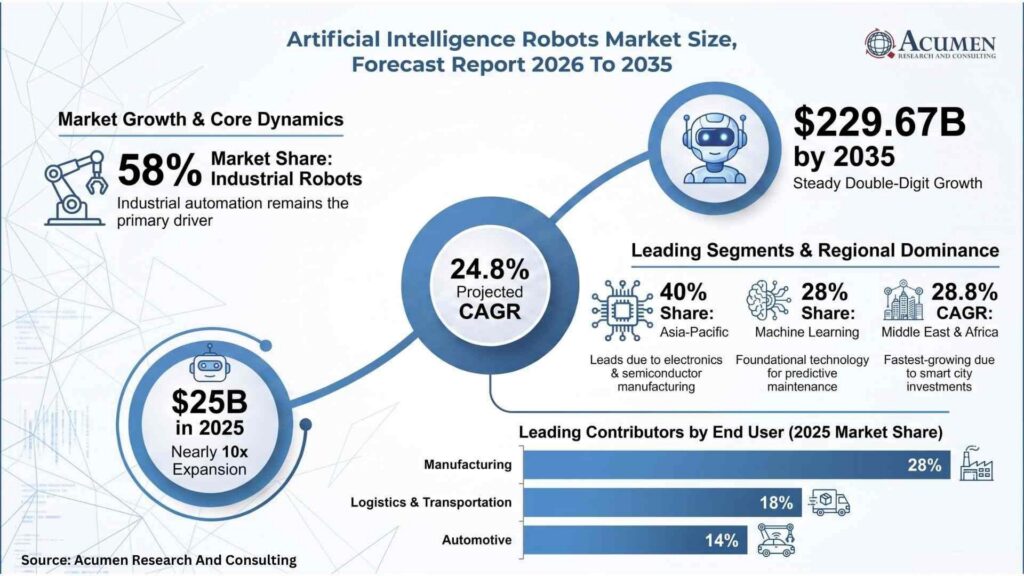
According to Acumen Research and Consulting, the Global Artificial Intelligence Robots Market was valued at USD 25 Billion in 2025 and is projected to reach USD 229.67 Billion by 2035, expanding at a robust CAGR of 24.8% during the forecast period from 2026 to 2035. The remarkable growth reflects the increasing demand for intelligent automation, autonomous systems, and AI-powered robotics across industrial and commercial applications.
Artificial Intelligence Robots Market Snapshot
| Market Attribute | Details |
| Artificial Intelligence Robots Market Size (2025) | USD 25 Billion |
| Artificial Intelligence Robots Market Forecast (2035) | USD 229.67 Billion |
| Artificial Intelligence Robots Market CAGR (2026–2035) | 24.8% |
| Largest Regional Market | Asia-Pacific (40% Market Share) |
| Fastest Growing Region | Middle East & Africa (28.8% CAGR) |
| Largest Robot Type | Industrial Robots (58% Share) |
| Fastest Growing Robot Type | Service Robots (28.3% CAGR) |
| Leading Mobility Type | Stationary Robots (62% Share) |
| Leading Technology | Machine Learning (28% Share) |
| Largest End-use Industry | Manufacturing (28% Share) |
Key Market Highlights
- The global Artificial Intelligence Robots Market is expected to increase from USD 25 Billion in 2025 to USD 229.67 Billion by 2035, registering a 24.8% CAGR.
- Asia-Pacific dominated the global market with a 40% revenue share in 2025, supported by its strong manufacturing ecosystem and rapid robotics adoption.
- Industrial robots accounted for the largest 58% market share owing to widespread deployment across manufacturing and industrial automation.
- Service robots are anticipated to witness the fastest growth at a CAGR of 28.3% through 2035 due to expanding applications in healthcare, logistics, hospitality, retail, and defense.
- Stationary robots represented 62% of the market in 2025, reflecting their extensive use in precision manufacturing and industrial production.
- Machine learning emerged as the leading AI technology with a 28% market share, enabling predictive analytics, adaptive automation, and autonomous decision-making.
- Manufacturing remained the largest end-use industry, accounting for 28% of total market revenue, while logistics & transportation held an 18% share due to rapid warehouse automation and e-commerce expansion.
What Are Artificial Intelligence Robots?
Artificial Intelligence (AI) robots are intelligent robotic systems equipped with advanced algorithms that enable them to perceive, analyze, learn, and make decisions in real time. Unlike conventional robots that perform fixed, pre-programmed tasks, AI robots can adapt to changing environments, recognize patterns, process visual and voice inputs, and continuously improve their performance through machine learning.
Modern AI robots integrate multiple technologies, including computer vision, deep learning, natural language processing, edge AI, sensor fusion, and cloud connectivity to perform increasingly sophisticated tasks across industrial, commercial, and consumer environments.
Today, AI-powered robots are widely used in manufacturing, healthcare, logistics, agriculture, retail, defense, construction, hospitality, and smart city infrastructure. Their ability to operate autonomously while improving efficiency and reducing operational costs is making them indispensable in the era of digital transformation.
Artificial Intelligence Robots Market Size and Growth Outlook
The Artificial Intelligence Robots Market is entering a period of exceptional expansion as businesses worldwide accelerate investments in intelligent automation technologies. According to Acumen Research and Consulting, the market is forecast to grow nearly nine-fold, reaching USD 229.67 Billion by 2035 from USD 25 Billion in 2025.
Several factors are driving this remarkable growth, including increasing demand for industrial automation, rapid adoption of collaborative robots (cobots), advancements in AI processors, growing deployment of autonomous mobile robots (AMRs), and rising investments in healthcare robotics and intelligent warehouse automation.
The increasing availability of high-performance computing platforms, AI-optimized semiconductor chips, cloud-based robotics platforms, and edge computing technologies is enabling robots to process data faster, respond intelligently to dynamic environments, and perform complex tasks with greater precision than ever before.
As governments and enterprises continue investing in smart factories, digital infrastructure, and AI innovation, intelligent robotics is expected to become a fundamental component of next-generation industrial operations.
Key Trends Driving the Artificial Intelligence Robots Market
1. Industrial Automation Continues to Drive Market Growth
Industrial automation remains the primary growth engine of the Artificial Intelligence Robots Market. Manufacturers are increasingly deploying AI-powered robots across production facilities to improve efficiency, reduce operational costs, and maintain consistent product quality.
AI-enabled industrial robots are widely used for welding, assembly, painting, inspection, packaging, palletizing, and material handling. By combining machine learning with advanced vision systems, these robots can detect defects, optimize workflows, and adapt to changing production requirements with minimal human intervention.
The continued adoption of Industry 4.0, digital manufacturing, and smart factories is expected to further accelerate demand for intelligent industrial robots over the coming decade.
2. Service Robots Are Expanding Across Multiple Industries
While industrial robots currently dominate the market, service robots are emerging as one of the fastest-growing segments. According to Acumen Research and Consulting, the service robot segment is projected to register the highest CAGR of 28.3% during the forecast period.
Healthcare providers are deploying AI-powered robots for robotic-assisted surgeries, patient monitoring, rehabilitation, and medication delivery. Logistics companies are investing in autonomous warehouse robots to improve order fulfillment and inventory management, while retailers and hospitality providers are adopting intelligent service robots to enhance customer engagement and operational efficiency.
The expanding role of service robots across commercial applications is expected to create significant growth opportunities throughout the forecast period.
3. Machine Learning Becomes the Foundation of Intelligent Robotics
Machine learning accounted for the largest technology share of 28% in 2025, making it the backbone of modern AI-powered robotic systems.
Machine learning algorithms enable robots to analyze operational data, recognize patterns, improve task execution, and make autonomous decisions based on real-time environmental inputs. Applications include predictive maintenance, intelligent navigation, object recognition, process optimization, and adaptive manufacturing.
As AI models become increasingly sophisticated, machine learning will continue driving innovation across industrial, commercial, and consumer robotics.
4. Autonomous Mobile Robots Are Transforming Logistics Operations
The rapid growth of e-commerce and global supply chains has significantly increased demand for autonomous mobile robots (AMRs). These AI-powered robots navigate warehouses, distribution centers, and manufacturing facilities using computer vision, LiDAR, sensors, and machine learning algorithms.
AMRs help businesses automate inventory movement, order picking, package transportation, and warehouse optimization while improving operational efficiency and reducing labor dependency.
The continued expansion of warehouse automation and intelligent logistics networks is expected to remain a major catalyst for the Artificial Intelligence Robots Market over the next decade.
Artificial Intelligence Robots Market Dynamics
Market Driver: Rising Demand for Intelligent Automation
Organizations across manufacturing, healthcare, logistics, retail, agriculture, and defense are increasingly adopting AI-powered robots to improve productivity, reduce operational costs, and enhance workplace safety.
Unlike traditional automation systems, AI robots can learn from experience, adapt to changing environments, process complex data, and make autonomous decisions in real time. These capabilities enable businesses to optimize operations while addressing labor shortages and increasing production efficiency.
The growing need for flexible, scalable, and intelligent automation solutions is expected to remain the primary driver of market growth throughout the forecast period.
Market Challenge: High Initial Investment and Technical Complexity
Despite their significant advantages, AI-powered robotic systems require substantial investments in hardware, software, system integration, and employee training. Deploying intelligent robots also involves addressing cybersecurity risks, data privacy concerns, interoperability challenges, and compliance with industry regulations.
However, continued advancements in cloud robotics, Robotics-as-a-Service (RaaS), AI software platforms, and declining technology costs are expected to improve accessibility and encourage broader adoption among small and medium-sized enterprises.
Artificial Intelligence Robots Market Segmentation Analysis
The Artificial Intelligence Robots Market is expanding rapidly as organizations across industries deploy intelligent robotic systems to automate complex processes, improve operational efficiency, and enhance decision-making. Advances in machine learning, computer vision, natural language processing (NLP), and edge AI are enabling robots to perform tasks that were once considered exclusive to human workers.
The market can be analyzed across robot type, mobility, technology, and end-user industries, each playing a critical role in shaping future demand.
By Robot Type: Industrial Robots Continue to Lead Global Adoption
Industrial Robots Dominate the Market
Industrial robots accounted for 58% of the global Artificial Intelligence Robots Market in 2025, making them the largest robot type. Their dominance is driven by increasing deployment across manufacturing facilities for welding, assembly, inspection, painting, packaging, and material handling.
Unlike conventional industrial robots, AI-powered industrial robots continuously learn from operational data, enabling predictive maintenance, adaptive production, and real-time quality control. Manufacturers are increasingly integrating AI with robotics to improve productivity, reduce downtime, and optimize resource utilization.
The adoption of Industry 4.0, digital twins, industrial IoT (IIoT), and smart factories is further strengthening demand for intelligent industrial robots. These technologies enable seamless communication between machines, sensors, and enterprise systems, creating highly efficient production environments.
Service Robots Witness Rapid Growth
Service robots are projected to register the fastest CAGR of 28.3% through 2035, reflecting their growing adoption across commercial and public service applications.
Healthcare providers are using AI-powered service robots for robotic-assisted surgeries, patient monitoring, rehabilitation support, and medication delivery. In logistics, autonomous robots optimize warehouse operations and last-mile delivery, while retailers and hospitality providers are deploying robots for customer assistance, inventory management, and cleaning services.
As AI capabilities improve, service robots are expected to become increasingly autonomous, interactive, and capable of operating safely alongside humans.
By Mobility Type: Stationary Robots Maintain Market Leadership
Stationary Robots Hold the Largest Market Share
Stationary robots represented 62% of the Artificial Intelligence Robots Market in 2025, reflecting their extensive use in fixed industrial environments where speed, precision, and repeatability are essential.
These robots are commonly deployed for:
- Precision assembly
- Welding and fabrication
- Automated inspection
- Packaging and palletizing
- Material handling
- Quality assurance
Their ability to perform repetitive tasks with exceptional accuracy makes them indispensable in automotive, electronics, aerospace, and heavy manufacturing industries.
Mobile Robots Expand Across Logistics and Healthcare
Mobile robots accounted for 38% of the market in 2025, driven by increasing adoption in warehouse automation, hospital logistics, agriculture, and autonomous delivery systems.
Autonomous Mobile Robots (AMRs) use AI, LiDAR, cameras, GPS, and sensor fusion to navigate dynamic environments without fixed guidance systems.
Their growing deployment is helping organizations:
- Improve warehouse productivity
- Reduce manual material handling
- Optimize inventory movement
- Enhance hospital logistics
- Support precision agriculture
As e-commerce continues expanding worldwide, mobile robots are expected to become a cornerstone of intelligent logistics operations.
By Technology: Machine Learning Drives Intelligent Robotics
Machine Learning Dominates AI Robotics
Machine learning accounted for 28% of the global market in 2025, making it the leading technology powering AI robots.
Machine learning enables robotic systems to learn from operational data, identify patterns, improve accuracy, and make autonomous decisions without requiring constant human programming.
Major applications include:
- Predictive maintenance
- Intelligent navigation
- Adaptive manufacturing
- Process optimization
- Object recognition
- Autonomous decision-making
As AI models continue evolving, machine learning will remain the foundation of intelligent robotics innovation.
Natural Language Processing Emerges as the Fastest-Growing Technology
Natural Language Processing (NLP) is expected to register the highest CAGR of 27.3% through 2035.
NLP enables robots to understand, interpret, and respond to human language, making interactions more natural and intuitive.
Key applications include:
- Voice-controlled robots
- Customer service robots
- Healthcare assistants
- Hospitality automation
- Educational robots
- Smart home robotics
The increasing demand for conversational AI and human-machine collaboration is expected to accelerate NLP adoption across service robotics.
End-User Analysis
Manufacturing Remains the Largest End-Use Industry
Manufacturing accounted for 28% of total market revenue in 2025, making it the largest end-user segment.
AI-powered robots are transforming manufacturing through:
- Automated assembly lines
- Intelligent inspection systems
- Predictive equipment maintenance
- AI-based quality control
- Smart material handling
- Digital production optimization
Manufacturers are increasingly integrating AI robotics into smart factories to improve operational efficiency, reduce defects, and respond more quickly to changing customer demands.
Logistics & Transportation Continue Strong Expansion
Logistics and transportation represented 18% of the market in 2025, making it the second-largest end-user segment.
The rapid growth of e-commerce, same-day delivery expectations, and warehouse automation has significantly increased demand for intelligent robotic solutions.
AI robots support logistics operations through:
- Autonomous warehouse navigation
- Inventory management
- Robotic picking and sorting
- Package handling
- Route optimization
- Autonomous delivery systems
As supply chains become increasingly digital, AI-powered robotics will play an even greater role in improving speed, accuracy, and operational resilience.
Artificial Intelligence Robots Market Regional Analysis
Asia-Pacific Leads the Artificial Intelligence Robots Market
Asia-Pacific accounted for 40% of global revenue in 2025, making it the largest regional market.
The region’s leadership is supported by:
- Strong industrial manufacturing capabilities
- Large-scale electronics production
- Advanced semiconductor fabrication
- Rapid robotics adoption
- Government support for AI innovation
- Expansion of smart manufacturing initiatives
China, Japan, South Korea, and India continue investing heavily in robotics, automation, semiconductor technologies, and AI research, strengthening the region’s competitive position.
Middle East & Africa Emerges as the Fastest-Growing Region
The Middle East & Africa is projected to expand at the fastest CAGR of 28.8% through 2035.
Growth is driven by:
- Smart city development
- Industrial automation investments
- Oil & gas robotics deployment
- National AI strategies
- Infrastructure modernization
- Increasing public and private sector investment in intelligent technologies
Countries across the region are prioritizing AI adoption as part of broader economic diversification initiatives.
Competitive Landscape
Competition within the Artificial Intelligence Robots Market is intensifying as robotics manufacturers, AI software developers, semiconductor companies, and automation providers continue investing in innovation.
Key competitive strategies include:
- Development of AI-powered collaborative robots
- Expansion of autonomous mobile robot portfolios
- Integration of generative AI into robotic systems
- Investments in edge AI computing
- Strategic mergers, acquisitions, and partnerships
- Robotics-as-a-Service (RaaS) business models
Leading companies are focusing on improving robot intelligence, reducing deployment complexity, enhancing safety, and enabling seamless collaboration between humans and machines.
Emerging Trends Shaping the Market
Several technological trends are expected to redefine the Artificial Intelligence Robots Market over the next decade:
Humanoid Robots
Advancements in AI, motion control, and computer vision are accelerating the commercialization of humanoid robots for industrial, healthcare, and service applications.
Physical AI
The convergence of AI software with robotics hardware is enabling machines to understand, reason, and interact with the physical world more effectively.
Edge AI Robotics
Processing AI workloads directly on robotic devices reduces latency, improves reliability, and enables faster real-time decision-making.
Robotics-as-a-Service (RaaS)
Subscription-based robotics solutions are lowering adoption barriers by reducing upfront investment costs and making advanced automation accessible to a broader range of organizations.
Generative AI Integration
Generative AI is enhancing robotic capabilities by improving task planning, natural language interaction, autonomous learning, and adaptive decision-making, opening new possibilities for intelligent automation across industries.
Future Outlook: Artificial Intelligence Robots Will Transform the Next Generation of Automation
The Artificial Intelligence Robots Market is entering a new phase of innovation where robots are evolving from programmable machines into intelligent, autonomous systems capable of learning, reasoning, and collaborating with humans. Over the next decade, AI-powered robots are expected to become an integral part of manufacturing, healthcare, logistics, agriculture, retail, construction, defense, and smart city infrastructure.
The integration of artificial intelligence with robotics is enabling machines to perform increasingly complex tasks that require perception, adaptability, and real-time decision-making. Future robots will leverage multimodal AI, computer vision, edge computing, digital twins, and advanced sensors to operate more efficiently in dynamic environments while minimizing the need for human intervention.
According to Acumen Research and Consulting, the global Artificial Intelligence Robots Market is projected to grow from USD 25 Billion in 2025 to USD 229.67 Billion by 2035, registering a CAGR of 24.8%. This exceptional growth highlights the increasing importance of intelligent robotics in driving productivity, operational efficiency, and digital transformation across industries.
The next generation of AI robots will be increasingly connected, collaborative, and autonomous, enabling organizations to address labor shortages, optimize workflows, improve workplace safety, and unlock new business models through intelligent automation.
Investment Opportunities Across the AI Robotics Ecosystem
Rapid advancements in AI and robotics are creating significant investment opportunities across the technology value chain.
Smart Manufacturing
Manufacturers continue to invest heavily in AI-driven robotic automation to improve production efficiency, reduce downtime, enhance quality control, and enable flexible manufacturing environments.
Healthcare Robotics
Growing demand for robotic-assisted surgery, rehabilitation systems, patient monitoring, and elderly care solutions is expected to create substantial growth opportunities for AI robotics developers.
Warehouse and Supply Chain Automation
The expansion of e-commerce and omnichannel retail is accelerating investments in autonomous mobile robots (AMRs), robotic picking systems, automated storage solutions, and AI-powered logistics platforms.
Agriculture and Precision Farming
AI-powered agricultural robots are helping farmers improve crop monitoring, automate harvesting, optimize irrigation, and reduce labor dependency through intelligent farming practices.
Defense and Public Safety
Governments worldwide are increasing investments in autonomous surveillance systems, unmanned ground vehicles, bomb disposal robots, and disaster response technologies powered by artificial intelligence.
Challenges That Could Influence Market Growth
Despite the strong growth outlook, the Artificial Intelligence Robots Market faces several challenges that industry stakeholders must address.
High Capital Investment
Deploying AI-powered robotic systems requires significant investment in robotics hardware, AI software, sensors, integration services, and workforce training. While costs are gradually declining, affordability remains a concern for many small and medium-sized enterprises.
Cybersecurity and Data Privacy
As robots become increasingly connected through cloud platforms and industrial IoT networks, protecting operational data and preventing cyberattacks are becoming critical priorities. Organizations must invest in robust cybersecurity frameworks to ensure secure deployment of AI-enabled robotics.
Regulatory and Ethical Considerations
The widespread adoption of intelligent robots raises important questions regarding safety standards, accountability, privacy, and ethical use of autonomous systems. Governments and industry bodies are working to establish regulations that encourage innovation while ensuring responsible AI deployment.
Analyst Perspective
Artificial intelligence is fundamentally changing the role of robotics across the global economy. Rather than simply replacing repetitive manual tasks, AI-powered robots are becoming intelligent collaborators capable of learning, adapting, and making informed decisions in real time.
Industrial robots continue to dominate current market revenue due to their widespread adoption in manufacturing, while service robots are emerging as the fastest-growing segment as organizations increasingly deploy intelligent automation across healthcare, logistics, hospitality, retail, and public services.
Asia-Pacific’s leadership reflects the region’s strong manufacturing ecosystem, advanced electronics industry, and sustained investments in AI and robotics. At the same time, the Middle East & Africa is expected to emerge as one of the most dynamic growth regions as governments accelerate smart city initiatives and industrial automation programs.
The convergence of machine learning, edge AI, natural language processing, computer vision, and robotics hardware will define the next generation of intelligent machines. Organizations that invest early in scalable AI robotics platforms, workforce upskilling, and digital transformation strategies are likely to gain significant competitive advantages over the coming decade.
Artificial intelligence is transforming robotics from task-specific automation into intelligent systems capable of autonomous decision-making, adaptive learning, and human collaboration. As organizations across manufacturing, logistics, healthcare, agriculture, retail, and defense continue adopting AI-driven robotic solutions, the market is poised for sustained long-term growth.
According to Acumen Research and Consulting, the global Artificial Intelligence Robots Market is expected to increase from USD 25 Billion in 2025 to USD 229.67 Billion by 2035, expanding at a CAGR of 24.8%. Industrial robots currently dominate the market, while service robots are projected to record the fastest growth as businesses increasingly seek flexible and intelligent automation solutions.
Supported by continuous innovation in AI technologies, favorable government initiatives, expanding industrial automation, and growing investments in smart infrastructure, the Artificial Intelligence Robots Market is set to play a central role in the future of global automation and digital transformation.
Frequently Asked Questions (FAQs)
1. What is the Artificial Intelligence Robots Market?
The Artificial Intelligence Robots Market includes robotic systems equipped with AI technologies such as machine learning, computer vision, and natural language processing that enable autonomous decision-making, learning, and intelligent task execution across industrial and commercial applications.
2. How big is the Artificial Intelligence Robots Market?
According to Acumen Research and Consulting, the global Artificial Intelligence Robots Market was valued at USD 25 Billion in 2025 and is projected to reach USD 229.67 Billion by 2035, growing at a CAGR of 24.8% during the forecast period.
3. What factors are driving the Artificial Intelligence Robots Market?
Major growth drivers include increasing industrial automation, rapid adoption of smart manufacturing, advances in AI technologies, rising demand for warehouse automation, healthcare robotics, collaborative robots, and intelligent service robots.
4. Which region leads the Artificial Intelligence Robots Market?
Asia-Pacific dominated the global market in 2025 with a 40% share, supported by its strong manufacturing base, electronics production, semiconductor industry, and widespread robotics adoption across China, Japan, South Korea, and India.
5. Which region is expected to grow the fastest?
The Middle East & Africa is projected to register the fastest growth through 2035, with a CAGR of 28.8%, driven by investments in smart cities, industrial automation, oil and gas robotics, and national AI initiatives.
6. Which robot type dominates the market?
Industrial robots accounted for the largest market share of 58% in 2025, driven by extensive deployment across manufacturing processes such as welding, assembly, inspection, painting, and material handling.
7. Why are service robots growing rapidly?
Service robots are expected to grow at a CAGR of 28.3% through 2035 due to expanding use in healthcare, logistics, hospitality, retail, domestic services, and defense applications.
8. Which AI technology leads the market?
Machine learning held the largest technology share of 28% in 2025 because it enables predictive maintenance, adaptive automation, intelligent navigation, and autonomous decision-making.
9. What industries use AI-powered robots?
AI robots are widely used across manufacturing, logistics, healthcare, agriculture, retail, hospitality, defense, construction, and smart city infrastructure.
10. What is the future of the Artificial Intelligence Robots Market?
The market is expected to witness robust growth as AI-powered robots become more intelligent, autonomous, and collaborative. Advancements in edge AI, humanoid robotics, computer vision, and Robotics-as-a-Service (RaaS) will continue expanding adoption across industries worldwide.