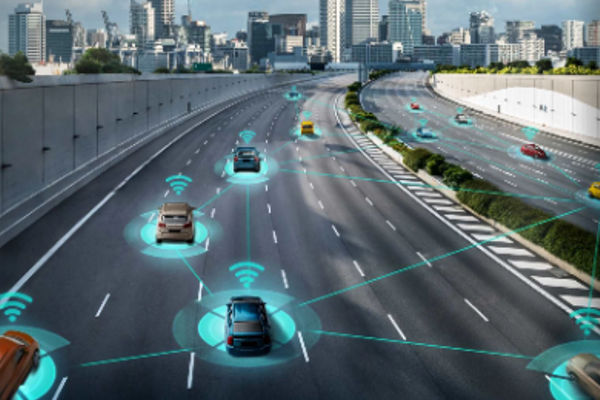
Vehicle-to-Everything (V2X) communication is a transformative wireless technology that enables automobiles to interact seamlessly with other vehicles, infrastructure, pedestrians, devices, and networks bringing next-generation intelligence and connectivity to transportation systems. By integrating V2X, the global automotive sector is advancing toward safer, more efficient, and autonomous mobility environments, driven by a convergence of sensor-based and networked technologies.
V2X Extends Awareness Even In Obstructed Or Adverse Weather Conditions

V2X stands for Vehicle-to-Everything, an overarching term for the communication systems facilitating dynamic data exchanges between a vehicle and virtually any entity in its environment, including other vehicles (V2V), roadside infrastructure (V2I), pedestrians (V2P), networks (V2N), and connected devices (V2D). These links employ wireless protocols to transmit real-time information about speed, location, hazards, and context, which supports everything from collision avoidance to route optimization. V2X augments conventional radar, camera, and lidar sensors by acting as a non-line-of-sight sensor, extending awareness even in obstructed or adverse weather conditions.
Technical Architecture and Protocols
V2X functionality is typically built around two main communication standards: Dedicated Short-Range Communication (DSRC) and Cellular Vehicle-to-Everything (C-V2X).
- DSRC leverages IEEE 802.11p, operating within the 5.9 GHz band and offering low-latency (less than 100ms) direct communications. DSRC’s architecture includes on-board units and roadside units, enabling real-time V2V and V2I links critical for scenarios like emergency braking and intersection collision warnings. Its strengths lie in established reliability, security, and interoperability. However, DSRC faces limitations in urban non-line-of-sight scenarios, fixed bandwidth, and scalability issues under dense traffic conditions.
- C-V2X, based on 3GPP LTE and 5G standards, supports two modes:
- PC5 Interface: Direct device-to-device communication for V2V and V2I, independent of cellular networks.
- Uu Interface: Vehicle-to-network connections using existing cellular infrastructure for real-time updates, traffic analytics, and cloud services.
C-V2X enhances scalability and coverage, especially as 5G deployments grow, supporting ultra-reliable low-latency communication (URLLC), massive machine-type communications (mMTC), and extended non-line-of-sight performance. However, it is network-dependent and may be constrained in regions with sparse infrastructure. Its full benefits hinge on progressing standardization and regulatory alignment.
V2X Use Cases: Safety, Efficiency, and Autonomy
The implementation of V2X technologies drives multiple high-impact use cases:
- Accident Prevention: Real-time alerts on potential collisions, unsafe driving conditions, and road hazards improve situational awareness and reduce fatalities.
- Traffic Flow Optimization: Cars interact with traffic lights, sensors, and control centers to dynamically adapt routes and speeds, enhancing fuel efficiency and lowering congestion.
- Pedestrian and Vulnerable Road User Protection: Vehicles recognize and exchange data with pedestrians or cyclists via mobile or wearable devices, providing proactive warnings.
- Connected and Autonomous Driving: V2X extends sensing capabilities beyond vehicle-mounted sensors, contributing to the safe operation of autonomous vehicles under varied visibility, weather, and traffic conditions.
- Infotainment and Over-the-Air Updates: Through V2N, vehicles receive software updates, infotainment data, weather alerts, and cloud services that personalize the driving experience and maintain operational integrity.
DSRC vs. C-V2X
| Feature | DSRC | C-V2X |
| Standard | IEEE 802.11p | 3GPP LTE, 5G |
| Communication Range | 300-1000 meters | Cellular + direct, scalable |
| Latency | < 100 ms | 1-50 ms (with 5G) |
| Coverage | Localized | Global via cellular |
| Scalability | Bandwidth-limited | Supports massive connections |
| Interference/Obstacles | Affected | Advanced NLOS capability |
| Spectrum Allocation | Dedicated (5.9 GHz) | Shared cellular bands |
| Security | Mature, tested | Evolving |
| Future Proofing | Less flexible | Forward-compatible, 5G-ready |
Security and System Validation
Security is paramount in V2X systems, given the safety-critical nature and complexity of connected mobility. Each V2X entity must possess trusted identities, and protocols must ensure data authenticity, integrity, and privacy, often using PKI (Public Key Infrastructure) solutions. Threats include data interception, spoofing, and denial-of-service attacks, necessitating advanced cryptographic and resilient architectures connected to regulatory frameworks and industry standards.
Testing and validation are challenging due to the complexity of real-world environments and the sheer variety of scenarios—ranging from urban landscapes with signal obstacles to high-density traffic and rapid mobility. To address these, manufacturers utilize lab-based simulation and emulation platforms that replicate field conditions and communications, minimizing deployment costs while verifying reliability and compliance.
Security Threats
Vehicle-to-Everything (V2X) communication faces a diverse array of security threats due to its complex wireless environment and safety-critical role in transportation. Key security threats include:
- Message Spoofing and False Information Injection: Attackers may send counterfeit messages to vehicles or infrastructure, causing misinformation about traffic conditions, hazards, or vehicle status, potentially leading to accidents or traffic disruption.
- Denial-of-Service (DoS) Attacks: Overwhelming communication channels or road-side units (RSUs) can disrupt network availability, impairing V2X message delivery and preventing timely safety alerts.
- Unauthorized Access and Data Leakage: Weak access controls can allow unauthorized entities to infiltrate V2X systems, stealing sensitive data such as vehicle location or personal information.
- Man-in-the-Middle (MitM) Attacks: Intercepting and altering the communication between vehicles and networks to manipulate or reroute data flows.
- Malware and Third-Party Application Vulnerabilities: Malicious software infiltrations via vulnerable applications or APIs can compromise system integrity and privacy.
- Replay Attacks: Re-transmission of previously captured valid messages to deceive V2X systems, causing erroneous responses or confusion.
Mitigation strategies to counter these threats are centered around a multi-layered security framework:
- Strong Authentication and Public Key Infrastructure (PKI): Ensuring that all V2X entities (vehicles, RSUs, network elements) use cryptographically secure identities with PKI certificates, enabling trustworthy communication and message verification in real time.
- End-to-End Encryption: Employing encryption protocols such as TLS/SSL for V2X messages to protect data integrity and confidentiality, including securing the in-vehicle CAN (Controller Area Network) communications.
- Robust Access Control and API Security: Implementing multi-factor authentication, real-time access monitoring, and secure API gateways to prevent unauthorized access and control abnormal interactions.
- Anomaly and Intrusion Detection Systems: Utilizing machine learning and extended detection and response (XDR) platforms to identify and respond to suspicious activities or attacks promptly.
- Hardware Security Modules (HSM): Secure storage of private keys and cryptographic operations to prevent tampering and unauthorized extraction.
- Regular Security Verification and Certification: Continuous testing and certification of V2X systems, protocol stacks, and applications to ensure compliance with evolving security standards and operational safety.
- Post-Quantum Cryptography Exploration: Preparing for future threats posed by quantum computing by researching and potentially deploying quantum-resistant cryptographic methods.
V2X and the Future of Mobility
V2X is a foundational technology for smart mobility, poised to dramatically improve safety, efficiency, and automation in automotive environments. Its evolution depends on harmonized global standards, growing 5G infrastructure, and robust cybersecurity. As the industry moves forward, V2X will enable cars to traverse interconnected digital landscapes, making driving predictively intelligent and cities significantly safer and more responsive.