
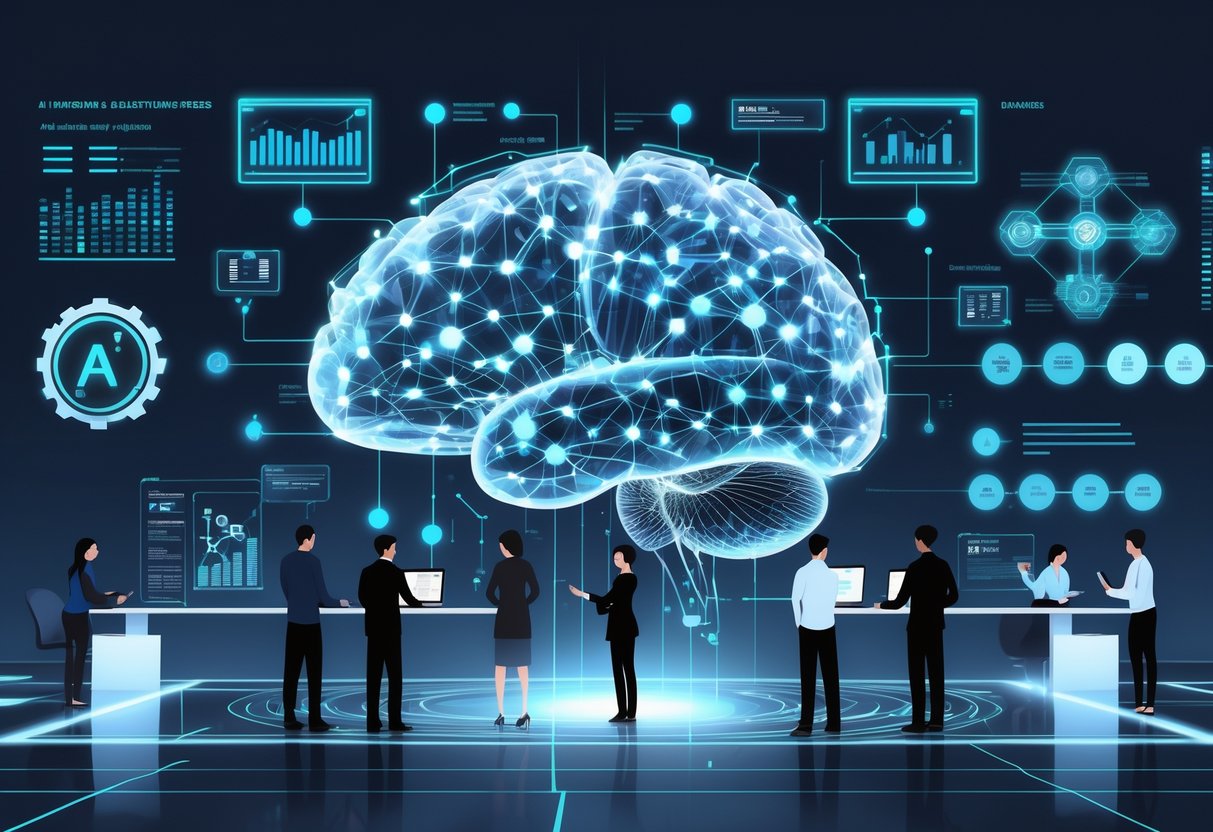
A student can now generate an essay in seconds. A teacher can create a lesson plan in minutes. Smart Tech A complex concept can be explained instantly, simplified, and summarised at the click of a button. Each of these scenarios reflects a broader transformation one that raises urgent questions about the role of effort, understanding, and human judgment in learning. These are not distant possibilities; they are the everyday realities of a classroom already transformed by Artificial Intelligence.
The real question is: will AI strengthen learning, or will it replace it?
This is the evolving reality of education in the age of AI where possibility expands, and purpose must lead.
Artificial Intelligence has rapidly moved from being a specialised tool used in technical industries to becoming a mainstream companion in classrooms. It is accessible, intuitive, and increasingly embedded in how students learn and how teachers teach. But as AI becomes more powerful and widespread, the real question is not whether education will adopt AI—it already has.
AI Must Be a Learning Partner, not a Replacement
The most important responsibility for educators today is to ensure that AI does not become a shortcut to thinking. While AI can produce quick outputs, learning has never been about speed. Learning is about the ability to question, explore, reflect, and build understanding through effort.
AI can support this process, but it cannot substitute it. A teacher is not simply a provider of content. Teachers build context, mentor students, recognise emotional and academic needs, and guide values. Similarly, students do not grow by consuming answers—they grow by developing curiosity, reasoning, and resilience.
AI should enhance the classroom, but the classroom must remain human at its core.
From Answer Machines to Learning Companions
The evolution of AI tools has been swift. In their early iterations’, AI platforms functioned like search engines on steroids, students gave prompts and received ready-made answers. That made them useful, but also risky, because it encouraged passive learning
However, the most promising shift in AI is that it is increasingly becoming tutorial-driven. Many AI tools now support step-by-step explanations, customised difficulty levels, and guided learning pathways. Instead of simply giving the final answer, AI can help students understand the process behind it. Like the Khan Academy’s Khanmigo, rather than giving answers directly, Khanmigo asks students guiding questions like “What do you think the next step is?” making it one of the closest real-world examples of the Socratic AI tutor. Used responsibly, this can help learners move from asking “What is the answer?” to asking “How do I get there?”
Supporting Teachers by Reducing the Administrative Burden
One of the most powerful benefits of AI lies in how it can support educators behind the scenes.
Teachers’ are expected to do far more than teach. They manage lesson planning, assessment frameworks, student progress tracking, report writing, data documentation, and learning gap analysis. Much of this work is repetitive and time-consuming, leaving educators with less time for meaningful engagement.
Automating the Routine to Reclaim the Meaningful
AI can change that.
With the right systems in place, AI can help organise student data, highlight learning gaps, support differentiated lesson planning, and reduce the manual effort required for documentation. This frees educators to focus on what matters most—mentoring, discussion-based learning, and deeper classroom interaction.
In many ways, AI can give teachers back their most valuable resource: time.
The Biggest Risk: Dependency Over Development
Despite its benefits, AI also introduces a clear risk overdependence.
Students are increasingly using AI tools for everything: homework answers, writing assignments, project ideas, even personal queries. The convenience is undeniable, but the long-term consequence can be serious. If learners begin to outsource thinking, they may stop building essential skills such as critical reasoning, writing clarity, originality, and problem-solving.
Education cannot afford to create students who can generate content quickly but cannot think independently. “A 2025 study of 666 students found a significant negative correlation between AI tool usage and critical thinking scores with 17–25-year-olds showing the highest dependence and the weakest independent reasoning (Gerlich, 2025).”
A study of 666 participants across diverse age groups found a significant negative correlation between AI tool usage and critical thinking scores. Notably, younger individuals aged 17–25 showed the highest AI dependence and the lowest critical thinking scores ANSI exactly the demographic the article is speaking to.
In the AI era, the ability to think deeply will become the biggest competitive advantage.
AI Literacy Must Become a Core Skill
The conversation around AI in education cannot stop at adoption. It must move toward awareness and responsibility.
AI literacy is no longer optional it is a foundational life skill. Students, educators, and parents must understand how AI works, what its limitations are, and where the risks lie.
This includes understanding:
- that AI can hallucinate but factually incorrect information and must always be verified against credible sources
- that AI outputs may reflect the biases embedded in their training data, leading to skewed or unrepresentative perspectives
- that personal data privacy is a real concern
- that ethical boundaries must be maintained
Students must be taught not only how to use AI tools, but how to question them, validate them, and engage with them safely.
The Role of Parents and Shared Responsibility
AI usage does not end at school gates. Students may follow guidelines in classrooms but still experiment freely at home. This makes parental involvement critical.
Responsible AI integration demands collaboration between schools, teachers, parents, and leadership built on open dialogue and shared accountability. Open conversations, awareness workshops, and shared digital guidelines will be essential to ensure students build healthy habits around technology.
In the AI era, education must be a shared ecosystem, not a silo.
Smart Technology Must Build Deeper Minds
AI is here to stay. It will continue evolving, becoming faster, smarter, and more integrated into daily life. But education must ensure that while technology advances, thinking does not decline.
AI should not replace learning. It should elevate it. The future belongs to students who can question, imagine, create, and make ethical decisions—not just students who can generate quick outputs.
In the end, education is not about producing answers. It is about building thinkers. Educators must teach with intention. Policymakers must legislate with foresight. Parents must engage with awareness. And students must learn to question, not just to query. AI will not determine the future of education. We will.
And in this age of smart technology, the goal must remain clear AI should strengthen minds, not shortcut them.
By Komal Dabas, Program Manager-Makerspace, Heritage Xperiential Schools