


The global battery plate market size accounted for USD 3.00 billion in 2025 and is predicted to increase from USD 3.47 billion in 2026 to approximately USD 12.84 billion by 2035, expanding at a CAGR of 15.65% from 2026 to 2035. The rapid growth is due to rising electric vehicle adoption, expanding renewable energy storage, and manufacturing innovations with lower costs while improving electrochemical efficiency.
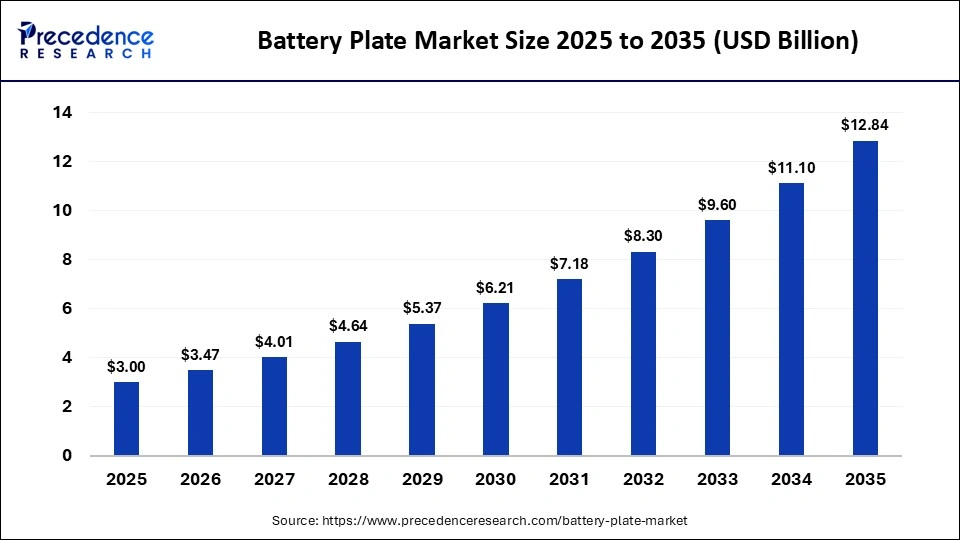
Battery Plate Market Key Insights
- Asia Pacific dominated the battery plate market with 59% in 2025.
- North America is expected to grow at the fastest CAGR in the market during the forecast period.
- By battery type, the lead-acid segment held a dominant position in the market of 57% in 2025.
- By battery type, the lithium-ion segment is expected to grow at the fastest CAGR in the market during the forecast period.
- By plate material, the lead-calcium alloys segment held a dominant position in the market with 47% in 2025.
- By plate material, the advanced composites segment is expected to grow at the fastest CAGR in the market during the forecast period.
- By manufacturing technology, the continuous pasting segment held a dominant position in the market with 43% in 2025.
- By manufacturing technology, the bipolar/3D printing segment is expected to grow at the fastest CAGR in the market during the forecast period.
- By end-user, the automotive segment held a dominant position in the battery plate market with 52% in 2025.
- By end-user, the energy storage systems segment is expected to grow at the fastest CAGR in the market during the forecast period.
- By application, the healthcare segment is expected to grow at the fastest CAGR in the AI-agent market.
- By end-user, the enterprise segment captured the major market share in 2024.
- By end-user, the industrial segment is projected to grow at the fastest CAGR in the market.
Role of AI Battery Plate Market
AI is significantly transforming the market. The overall performance optimization is achieved by enhancing material innovation and manufacturing efficiency with AI-assistance. AI-driven data analytics enable manufacturers to identify advanced materials and coatings that improve energy density, charging speed, and durability of battery plates. AI-powered systems monitor production in real time, an automation and machine vision system detects defects in real time, reducing material waste, and helps lower costs.
Machine learning algorithms predict the performance of a battery under various operating conditions, which enables the design of a battery that maintains a longer lifecycle management. Accurate demand forecasting and inventory optimization are carried out using AI by strengthening supply chain planning.
Regional Outlook for Battery Plate Market
North America battery plate market is expected to grow at a significant CAGR from 2026 to 2035. The growth is driven by strong electrification trends and advanced manufacturing capabilities. Rapid adoption of electric vehicles and renewable energy storage solutions are major demand driver.
Federal incentives, clean-energy targets, and infrastructure investments are accelerating battery production and usage. The competitive landscape in the region is dominated by key players that are investing heavily in research and development to enhance battery performance and sustainability.
The presence of strong manufacturing facilities and supply chains, expanding energy storage installations, and technological innovation is driving rapid regional market growth.
Asia-Pacific Asia Pacific dominated the global battery plate market in 2025, driven by increasing industrialization, urbanization, and rising demand for electric vehicles. Through government policies, EV incentives, and large-scale renewable energy investments, countries like China and India are leading the adoption. The region has cost-efficient labour, well-established manufacturing infrastructure, and integrated supply chains for battery production.
As the demand for energy storage systems continues to rise, the region has become a major manufacturing hub for battery plates. The government is heavily investing in recycling infrastructure. The region is recognized for its technology leadership and rapid adoption innovation technologies. The region is a hub for all heavy battery users, reinforcing consistent base demand.
Market Scope
| Report Coverage | Details |
| Market Size in 2025 | USD 3.00 Billion |
| Market Size in 2026 | USD 3.47 Billion |
| Market Size by 2035 | USD 12.84 Billion |
| Market Growth Rate from 2026 to 2035 | CAGR of 15.65% |
| Dominating Region | Asia Pacific |
| Fastest Growing Region | North America |
| Base Year | 2025 |
| Forecast Period | 2026 to 2035 |
| Segments Covered | Battery Type, Plate Material, Manufacturing Technology, End-user, and Region |
| Regions Covered | North America, Europe, Asia-Pacific, Latin America, and Middle East & Africa |
Segmental Outlook Battery Plate Market
By Battery Type Insights
How Did the Lead-Acid Segment Lead the Battery Plates Market?
The lead-acid segment led the battery plate market in 2025, due to its long-term industrial use, low cost, and high recycling rate. They account for a large market share as one of the rechargeable battery technologies, widely adopted in automotive starting, lighting, and ignition applications.
They are known for their reliability and ability to deliver high surge currents, making them ideal for automotive applications. They are highly accessible across the automotive industry and other industrial sectors due to their affordability and abundant raw materials. With high recycling rates of lead-acid batteries, it ensures sustainable material reuse and stable supply chains.
By Plate Material Insights
How did the Lead-Calcium Alloys Segment Dominate the Battery Plate Market?
The lead-calcium alloy segment dominated the market in 2025. It offers high performance and operational advantages. The calcium in the lead grid reduces water loss, corrosion, and self-discharge, resulting in longer battery life and minimal maintenance. These batteries are more reliable for automotive and industrial applications due to their durability, charge retention, and efficiency. Large-scale adoption is further supported by its lower gassing and maintenance-free operation for safe and convenient for sealed battery designs.
The advanced composites segment is expected to grow at a faster CAGR between 2026 and 2035. Compared to conventional materials, advanced composites enhance performance, durability, and efficiency. They offer high strength-to-weight ratios, improved corrosion resistance, and better electrical conductivity. They support lightweight battery designs, essential for electric vehicles and portable energy systems. They enable improved thermal stability and faster charge-discharge cycles. Advanced composites are gaining adoption across automotive, renewable energy, and industrial applications, with growing demand for high performance and a shift toward next-generation battery technologies.
By End-User Insights
What made the Automotive Segment Dominate the Battery Plate Market?
The automotive segment dominated the battery plate market in 2025. The increasing demand for electric vehicles and hybrid models is contributing to the segment dominance in the market. The automotive industry requires high-performance batteries for starting, lighting, ignition, and propulsion, creating demand for battery plates. Government initiatives promoting the shift toward electrification and consumer interest in lower operating costs are further boosting the dominance. Major automakers are rapidly expanding their electric and hybrid vehicle portfolios, increasing battery production volumes.
The energy storage systems segment is expected to grow at a higher CAGR during the forecast period due to the rapid global expansion of renewable energy. There is a need for reliable storage solutions that can balance supply and demand with intermittent solar and wind power. Battery-based energy storage helps stabilize grids, store excess electricity, and ensure an uninterrupted power supply. To support decarbonization goals and modernize aging power infrastructure, governments are investing in large-scale storage.
Recent Developments
- In April 2025, Lyten announced the U.S. first domestic production of battery-grade lithium metal foil with U.S. made lithium alloys and U.S.-sourced lithium metal. This achievement marks a pivotal step in bolstering the U.S. battery supply chain, aiming to reduce dependence on overseas sources for essential battery materials.
- In February 2025, Luminous Power Technologies launched lead production at its new industrial battery plant in northern India, boosting a revolutionary green positive plate manufacturing system that uses 100% grey oxide through a wet paste filling process.
AI Agents Market Companies
Amara Raja Batteries Limited
- Amara Raja Energy & Mobility Limited is one of India’s largest manufacturers of automotive and industrial batteries, known for its AMARON brand and strong OEM partnerships.
- The company is expanding into lithium-ion technology and EV solutions, with exports to 50+ countries and a planned gigafactory in India.
Kijo Battery Group
- KIJO Group is a Chinese battery manufacturer specializing in energy storage and lead-acid batteries for global markets.
- With 4,500+ employees and international certifications, it provides solutions for telecom, UPS, and renewable energy applications.
Crown Battery
- Crown Battery is a U.S.-based company known for manufacturing deep-cycle and industrial batteries for motive power and renewable energy sectors.
- It has a long history of producing durable batteries for forklifts, backup power, and transportation applications.
CSB Energy Technology Co. Ltd.
- CSB Energy Technology Co. Ltd. specializes in sealed lead-acid batteries used in UPS systems, telecom, and emergency backup solutions.
- The company is known for high-reliability energy storage products serving industrial and commercial applications globally.
Source: https://www.precedenceresearch.com/battery-plate-market