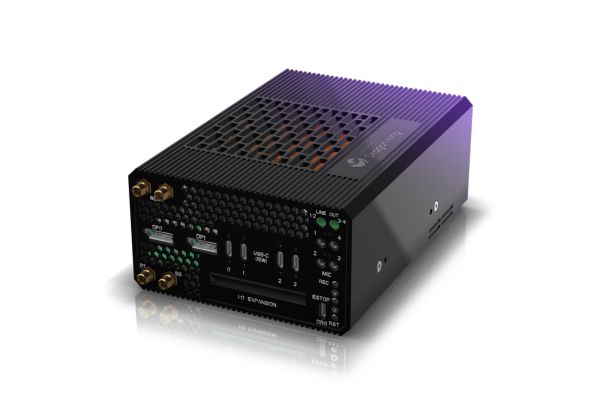
The next wave of robotics will not be defined by isolated subsystem performance alone. It will be shaped by how effectively teams can integrate compute, sensing, networking, safety, control and software into a reliable platform that is ready for real-world deployment.
The Qualcomm Dragonwing IQ10 Robotics Reference Design (RRD) is built for production level sensor-AI systems that require flexible execution, modular expansion, and
predictable deployment. By using dedicated sensor interfaces and scaling through PCIe expansion, the platform aims to reduce integration complexity and improve timing
efficiency, helping teams move from prototype to deployable systems with clearer validation boundaries and lower operational burden.
Why it matters
Robotics developers are increasingly building systems that must see, sense, reason, move, and adapt in complex environments. In practice, that means they need more than a
powerful processor; they need a coherent platform that enables a wholistic robotic features and lifecycle management without adding unnecessary integration burden.
The Dragonwing IQ10 RRD is designed to address this requirement. Built on the Qualcomm Dragonwing IQ10 processor, it packages heterogeneous compute, AI acceleration, camera and sensor interfaces, motion control, networking, and a layered robotics software stack
into a unified reference design. The platform is further supported by MLOps and DevOps tools for AI model development, deployment, validation, and lifecycle management, and
may be used to assist in building applications for perception, navigation, manipulation and autonomy. This holistic approach is designed to help reduce system integration complexity, shorten development cycles, and accelerate the transition from prototype to production
across industrial, AMR, and humanoid robotics platforms.
Key platform advantages
Integrated full-stack architecture
The Dragonwing IQ10 RRD aims to consolidate certain key building blocks of a production robot into one cohesive design. That includes compute, sensor interfaces, networking, real-time control, and software services, helping to assist in reducing integration
complexity and accelerate system bring-up.
High-performance embodied AI compute
The platform is designed to deliver up to 700 TOPS of AI performance, paired with 18
Qualcomm Oryon CPU cores, multicore NPUs, and a GPU architecture designed to support on-device perception, planning, and reasoning without external accelerators.
Built for advanced perception
In real-world environments, robots depend on fast, reliable sensor data to understand and respond to their surroundings. The Dragonwing IQ10 RRD is designed to make this easy.
It natively supports up to 12 GMSL2 cameras, along with LiDAR, Time-of-Flight (ToF), IMU, and other sensors, enabling rich, multi-modal perception. This allows robots to combine different types of data, vision, depth, and motion, which can be used to support more
accurate planning and action.
Simplified Sensor Integration
A key advantage of the Dragonwing IQ10 RRD is how it brings all this together directly to the platform. Rather than relying on separate bridging components to connect sensors and compute, the Dragonwing IQ10 RRD integrates sensor ingestion natively. This aims to help:
- Keep data streams synchronized and aligned
- Reduce delays between sensing and processing
- Simplify overall system design
- Reduce Integration cost
The result is the ability to support a cleaner, more efficient architecture that’s easier to scale from simple camera-based systems to more complex, multi-sensor robots.
Deterministic control and real-time I/O
Production robotics requires predictable behavior. The design supports high-speed deterministic interfaces including PCIe, TSN, USB, and CAN, along with Ethernet, EtherCAT, and CAN-FD, to help enable precise motion control and consistent timing across the
system.
Built for deployment realities
The enclosed system includes integrated forced-air cooling, is designed to operate from – 40 to 70 °C, and supports 12V/24V input, supporting use in deployment scenarios where thermal margins and environmental durability matter.
Robotics Software Stack
The Dragonwing IQ10 RRD stands out not only for its hardware, but also for its tightly integrated end-to-end robotics software stack.
It is designed as a full-stack platform, to support robotics development, deployment, and fleet-scale operations. At its core is a layered architecture that is designed to manage
system complexity while providing flexibility across the entire lifecycle of a robot. The Dragonwing IQ10 RRD software stack is structured across several key layers:
- On-device AI runtimes that support low-latency perception and decision-making
- ROS2 support to decouple hardware from application logic and can help simplify integration by leveraging the robotics ecosystem
- Platform services that support core robotics capabilities such as sensing, planning, and actuation
- Cloud-connected lifecycle management for deployment, monitoring, and iterative improvement through the Qualcomm AI hub
This modular approach allows teams to work at the level that best fits their needs whether optimizing models at the edge or orchestrating fleets in the cloud.
Full-Stack Robotics Capabilities
Out of the box, the platform is designed to support the core functional building blocks of modern robotics systems:
- Perception for vision, depth, and environment understanding
- Navigation and localization for autonomous movement
- Planning and control for motion execution
- Manipulation for robotic arms and end effectors
- Task planning and orchestration for higher-level autonomy
- Natural language interaction for human-robot interfaces
This breadth helps to enable developers to build everything from mobile robots to complex, multi-modal autonomous systems without stitching together fragmented toolchains.
Ready to Scale with Your System
Whether building a mobile robot, an industrial system, or a humanoid platform, the
Dragonwing IQ10 RRD is designed to provide a consistent foundation for sensor fusion and perception without the need to redesign the data pipeline as systems grow more complex.
The Dragonwing IQ10 RRD also reflects a broader shift in robotics architecture. As robots become more autonomous and sensor-rich, the key question is no longer just whether a platform can run a workload, but whether it can scale, operate safely, and support
repeatable deployment with confidence.
The Dragonwing IQ10 RRD is built with that need in mind. By combining heterogeneous compute, multi-domain networking, safety-oriented design, and a unified software stack, it is designed to provide OEMs and robotics developers with a strong foundation for
advanced AMRs, humanoids, and industrial robots. Early access partners, including NEURA Robotics, Advantech, APLUX, Booster, Innodisk, MeiG, NEXCOM, Radxa, Thundercomm, and VinMotion, are already exploring its full capabilities.
At Computex 2026, the Dragonwing IQ10 RRD will be unveiled. Get ready for the
Dragonwing IQ10 RRD. Sign up to be notified when global availability begins in September 2026 and stay updated with the latest tools, resources, and release details to support your deployment.