
The global Applied AI in Autonomous Vehicles market is undergoing a transformative shift as artificial intelligence becomes the core foundation of next-generation transportation systems. From perception and navigation to real-time decision-making, AI is enabling vehicles to move closer to fully autonomous operation.
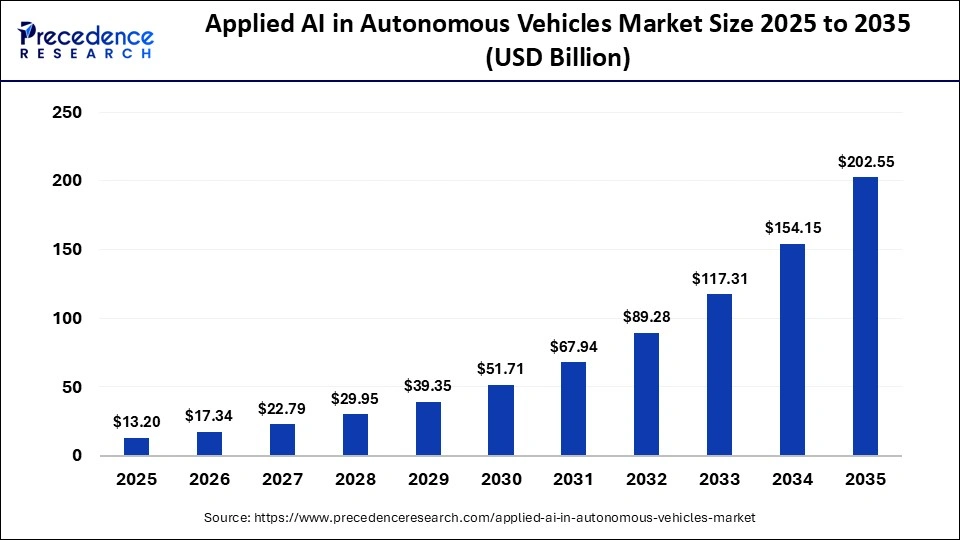
The market was valued at USD 13.20 billion in 2025 and is projected to surge from USD 17.34 billion in 2026 to approximately USD 202.55 billion by 2035, expanding at a remarkable CAGR of 31.40% during 2026–2035. This explosive growth is driven by rapid advancements in machine learning, computer vision, sensor fusion, and edge AI computing.

Why is Applied AI in Autonomous Vehicles Growing So Fast?
The automotive industry is shifting from assisted driving to fully intelligent mobility ecosystems, where AI acts as the “brain” of the vehicle.
Key growth drivers include:
- Rapid expansion of robotaxi and autonomous ride-hailing services
- Advancements in deep learning and computer vision systems
- Increasing demand for road safety and accident reduction
- Strong adoption of ADAS (Level 2 and Level 3 autonomy)
- Integration of AI with electric and connected vehicles
- Development of smart city and intelligent transport infrastructure
Companies like Waymo and Baidu are already scaling autonomous fleets, while automakers are rapidly integrating AI into production vehicles.
What is Applied AI in Autonomous Vehicles?
Applied AI in autonomous vehicles refers to the use of intelligent algorithms that allow vehicles to:
- Interpret real-time sensor data
- Detect objects, pedestrians, and road conditions
- Predict driving behavior and traffic movement
- Make autonomous navigation decisions
- Continuously learn from driving environments
It combines technologies such as machine learning, computer vision, deep learning, and sensor fusion to replicate human-like driving intelligence.
Quick Insights: Applied AI in Autonomous Vehicles Market
- Market size expected to reach USD 202.55 Billion by 2035
- Valued at USD 13.20 Billion in 2025
- Growing at a CAGR of 31.40% (2026–2035)
- North America leads global adoption
- Asia Pacific is the fastest-growing region
- Machine learning holds the largest technology share (~35%)
- Passenger vehicles dominate end-use (~55%)
- Level 3 autonomy leads vehicle type adoption (~30%)
How is AI Transforming Autonomous Driving?
Applied AI is reshaping mobility by turning vehicles into self-learning intelligent systems.
It enables:
- Real-time object detection using computer vision
- Predictive path planning in complex traffic conditions
- Adaptive cruise and lane-keeping assistance
- Driver behavior monitoring for safety
- End-to-end autonomous decision-making systems
Recent advancements in reasoning-based AI models are enabling vehicles to handle rare and complex driving scenarios with improved safety and reliability.
What Are the Key Market Drivers?
Several structural factors are fueling market expansion:
- Growth of AI-powered mobility platforms
- Increasing investment in robotaxis and autonomous fleets
- Rising demand for connected and smart vehicles
- Advancements in edge computing and real-time AI processing
- Expansion of EV + AI integration ecosystems
- Strong focus on reducing human-driven road accidents
What Trends Are Shaping the Market?
Are Robotaxis Becoming Mainstream?
Yes. Companies are scaling autonomous ride-hailing services across major cities, transitioning from pilot projects to commercial deployment.
Is Level 4 and Level 5 Autonomy Emerging?
Level 4 systems are gaining traction, while Level 5 full autonomy is still in development due to regulatory and safety challenges.
Is AI Moving Toward “Thinking Vehicles”?
Yes. New-generation AI models are enabling vehicles to reason, explain decisions, and handle rare edge cases, marking a shift toward cognitive mobility systems.