



The global Electric Commercial Vehicle Market is witnessing accelerated growth, driven by increasing pressure on fleet operators to reduce emissions, rising fuel costs, and rapid advancements in battery and charging technologies. According to industry-aligned insights, the market is projected to expand at a strong double-digit CAGR through 2032, supported by electrification across buses, trucks, and last-mile delivery vehicles.
Electric commercial vehicles (ECVs) including electric buses, trucks, vans, and pickup vehicles are emerging as a critical component of sustainable mobility. Governments worldwide are implementing strict emission norms and incentivizing fleet electrification, accelerating adoption across public transport, logistics, and industrial applications.
Quick Insights
- Market Trend: Strong double-digit CAGR through forecast period
- Key Growth Driver: Fleet electrification and emission regulations
- Dominant Segment: Battery Electric Vehicles (BEVs)
- Leading Vehicle Type: Electric Buses (largest share)
- Fastest-Growing Segment: Electric Trucks & Light Commercial Vehicles
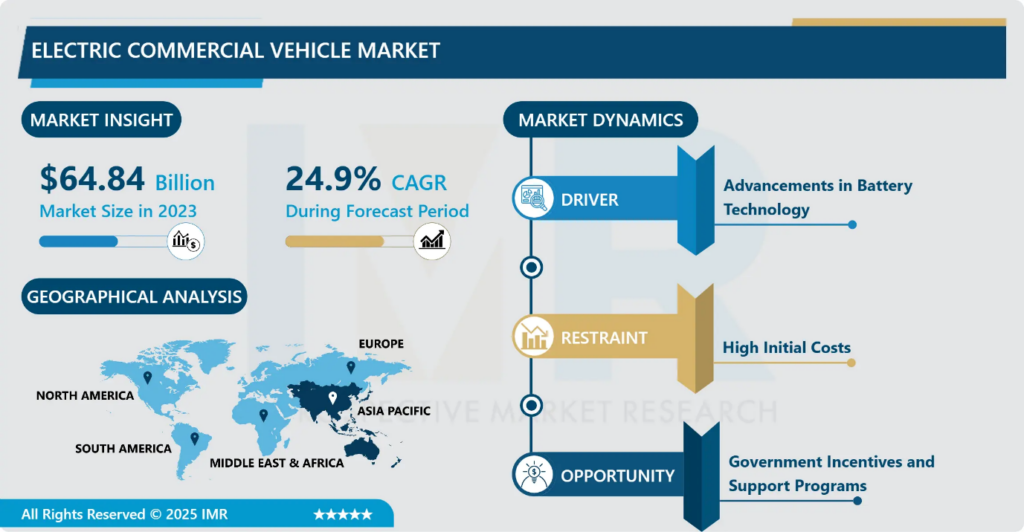
- Leading Region: Asia-Pacific (~43% market share)
- Key Players: BYD Motors, Daimler Truck AG, AB Volvo, PACCAR Inc., Traton SE
- Core Opportunity: Last-mile delivery electrification and smart logistics
- Primary Challenge: Charging infrastructure and high upfront costs
Revenue Breakdown & Market Segmentation
| Segment Category | Key Insights |
|---|---|
| By Vehicle Type | Buses, Trucks, Vans, Pick-up Trucks |
| By Propulsion | BEV, PHEV, FCEV |
| By Range | 0–150 Miles, 151–250 Miles, 251–500 Miles, 500+ Miles |
| By Component | EV Battery, Electric Motor, Hydrogen Fuel Cell |
| By Region | North America, Europe, Asia-Pacific, MEA, South America |
- Electric buses dominate due to government-led public transport electrification programs.
- Light commercial vehicles (LCVs) are the fastest-growing segment, fueled by e-commerce and last-mile delivery demand.
- BEVs lead the market due to lower maintenance costs and widespread charging infrastructure availability.
What’s Driving Growth? What Trends Are Reshaping the Market?
Why is the electric commercial vehicle market gaining unprecedented traction?
- Decarbonization mandates: Governments are enforcing stricter CO₂ emission regulations across transport sectors.
- Fleet electrification: Logistics and public transport operators are transitioning to zero-emission fleets.
- Lower total cost of ownership (TCO): EVs offer up to 60–70% fuel cost savings compared to diesel vehicles.
- Battery advancements: Improvements in energy density and cost are enhancing vehicle range and affordability.
- E-commerce boom: Rising demand for urban logistics is accelerating adoption of electric vans and trucks.
Regional & Segment Analysis
- Asia-Pacific dominates the market, led by China’s large-scale electric bus deployments and strong EV manufacturing ecosystem.
- Europe is witnessing rapid adoption due to stringent emission regulations and urban low-emission zones.
- North America is growing steadily, driven by investments in electric trucking and logistics fleets.
Segment Insights:
- Electric buses account for the largest revenue share, supported by government initiatives.
- Electric trucks are expected to register the fastest growth due to increasing freight electrification.
- Fuel cell vehicles (FCEVs) are emerging in heavy-duty applications requiring long range.
Latest Industry Developments
- BYD Motors continues to expand its global electric bus and truck portfolio.
- Daimler Truck AG and Volvo Group are investing heavily in electric heavy-duty trucks and hydrogen-powered solutions.
- Increasing adoption of megawatt charging systems and battery swapping technologies is improving operational efficiency.
- Companies are integrating telematics, AI, and fleet management systems to optimize performance and reduce downtime.
Challenges & Cost Pressures
- High upfront costs: Electric commercial vehicles remain more expensive than diesel counterparts.
- Charging infrastructure gaps: Limited fast-charging networks for heavy-duty vehicles.
- Battery limitations: Range and charging time constraints for long-haul operations.
- Supply chain dependencies: Critical reliance on battery materials and semiconductor components.
Case Study: Electric Fleet Transformation in Urban Logistics
A leading logistics company deployed electric delivery vans across urban centers, resulting in reduced operating costs and zero tailpipe emissions. The transition improved route efficiency and compliance with city-level emission regulations, demonstrating the scalability of electric commercial fleets in last-mile delivery operations.