


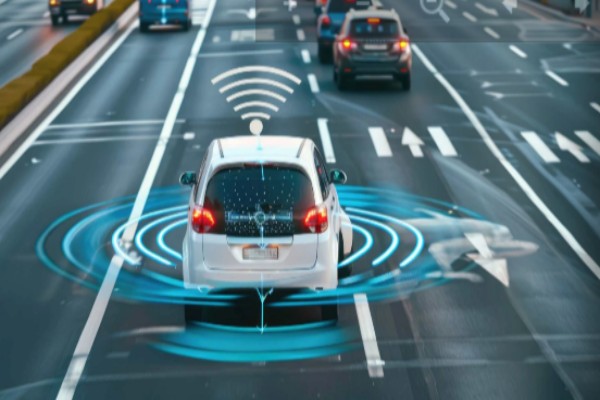
Cars are no longer just machines that help us to commute from one place to another. They have now become an intelligent companion on the road for the user, they watch, warn, assist and in some cases they even react faster than humans. Advanced Driver Assistance Systems (ADAS) is the technology that is transforming modern mobility from passive transportation into active safety.
What once seemed futuristic that I used to see in the cartoons as for example a car that can detect the obstacles and apply brakes automatically is now becoming part of everyday driving that I see it today. ADAS is no longer a luxury reserved for premium vehicles but has become a necessity for safeguarding the human life. It is quickly becoming the backbone of safer, smarter, and more connected transportation.

As these systems are evolving, one critical question always arises: How do we ensure that intelligence on wheels remains safe, reliable, and trustworthy?

When Cars Began to “Think”
The story of ADAS began with basic safety interventions for user safety and even making vehicles smarter. In traditional vehicles, systems such as Anti-Lock Braking Systems (ABS), traction control, and Electronic Stability Control (ESC) marked the first big step in helping drivers maintain control during risky situations. Now these were called the game changers in the field of automotive. They proved that doing changes in the technology of electronics it could step in at the right moment and prevent accidents before they happened.
As the electronics started becoming intelligent vehicles started using cameras, radar, and ultrasonic sensors to observe the road and surroundings. This opened the door for new features in the vehicles such as adaptive cruise control, lane departure warning, blind-spot detection, forward collision warning, and automatic emergency braking.
Now the vehicle was not understanding what is happening within it but also around it. Today, ADAS has moved far beyond any of the standalone features. It has become an intelligent network of sensors, software, control units, and algorithms working together in real time. Through sensor fusion, vehicles are now able to combine information from multiple sources that can build a more complete and reliable picture of the world around them. This helps them identify other vehicles, pedestrians, traffic signs, lane changing boundaries with growing accuracy.
In simple terms, ADAS is teaching the car how to see, interpret, and assist the user .
Why ADAS Is Becoming a Necessity, Not an Option
As we see number of accidents increasing the road safety remains one of the biggest global mobility challenges, and human error that continues to be one of the main causes of accidents. Distraction, fatigue, overconfidence and delayed reaction, by the driver can turn ordinary situations into dangerous ones within seconds.
This is where exactly ADAS makes its strongest impact. A driver may not notice a slowing vehicle ahead in time, but a forward collision warning system will. A tired or drunken driver may begin to drift out of the lane, but lane-keeping assist can help correct it and avoid collision with other vehicles. That is why ADAS is now having safety features. It improves driver awareness, reduces reaction time, and supports decision-making in ways that were previously impossible and avoid any serious accidents.
ADAS have become more valuable for crowded and unpredictable road conditions especially in developing mobility ecosystems where traffic mixes cars, bikes, pedestrians, and informal movement patterns. This also means these systems must be designed carefully, tested rigorously, and adapted to real-world conditions rather than ideal ones which can never happen.
The Big Shift: From Assistance to Anticipation
The most exciting part of ADAS evolution is that it is no longer just helping the driver after a problem appears. It is increasingly about anticipating risk before it turns into danger.
Modern ADAS systems are becoming more predictive as they are using more predictable and AI algorithms. They not only detect that a vehicle is nearby; they also estimate the speed, direction, and possible collision risk. They do not just identify lane markings; they also monitor whether the vehicle’s behavior suggests inattentive driving. Driver monitoring systems can now track eye movement, head position, and drowsiness indicators, making safety more proactive than ever.
This shift is crucial because the future of mobility will depend on how effectively vehicles can interpret any incident before it happens. The road is messy, lane markings fade, pedestrians behave unpredictably, construction zones confuse sensors all this will be handled by ADAS.
Why Safety Standards Matter More Than Ever
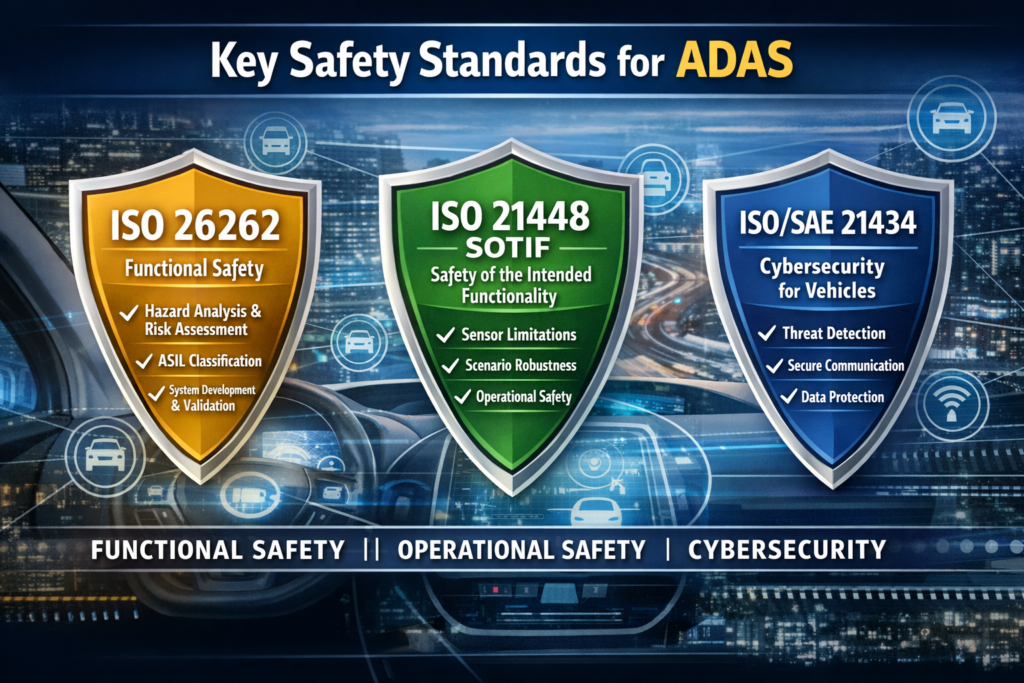
As ADAS grows to become more sensible and intelligent, it also becomes more safety-critical. When a system can control braking, steering, speed, or driver response, there is very little room for error. Any error can be fatal for human life that is why safety standards are no longer background engineering requirements they are central point for trust.
A major pillar in this area is safety standard ISO 26262, it is a global standard for functional safety in road vehicles. It helps manufacturers and developers identify hazards, assess risks, assign safety levels, and create a structured process for building reliable automotive electronic systems. For ADAS, this is essential because the consequences of a failure are not theoretical; they can play out directly on the road and if anything goes wrong it will be fatal.
Sometimes a system may work exactly as intended and can take wrong decisions. For example, a camera may function normally but fail to recognize a faded lane marking, an unusual object, or a low-contrast pedestrian in poor lighting. In such cases, the issue is not a broken system but a limitation in how the system understands reality.
This is where another standard ISO 21448, known as Safety of the Intended Functionality (SOTIF), becomes highly relevant. It addresses risks that arise not from malfunction, but from the limitations of perception and decision logic in complex environments.
These systems depends heavily on software, electronic communication, and increasingly connected architectures with sensors and other components. If these systems are vulnerable to digital compromise, safety itself is at risk. Standards such as ISO/SAE 21434 are therefore becoming important for protecting vehicle systems against cyber threats that could affect safe operation.
Trust Can Make or Break ADAS
Technology alone does not make ADAS successful. People do.
One of the biggest challenges in deploying ADAS is making sure drivers understand the system properly. If warnings are too frequent, drivers may start ignoring them as we see in vehicles without these systems. If the system appears too capable, drivers may trust it more than they should. For example if autonomous driving is given importance it can happen vehicle takes a wrong judgement. That is why the human-machine interface matters so much. Alerts must be timely, clear, and meaningful. The system must not create panic or confusion. Above all, the driver must remain aware that ADAS is an assistant, not a replacement.
This balance between human responsibility and machine intelligence will define how successfully ADAS is adopted in the coming years.
The Road Ahead
The future of ADAS is incredibly promising and breath taking . Vehicles will become more connected, more context-aware, and more predictive. Artificial intelligence will improve perception. V2X communication will allow vehicles to receive warnings from infrastructure and nearby vehicles. Centralized computing platforms will make system coordination faster and more efficient.
But the true success of ADAS will not be measured only by how advanced the features become. It will be measured by how many accidents are prevented, how much trust is built, and how responsibly the technology is developed.
ADAS is not just another automotive trend. It is a turning point. It marks the transition from vehicles that only respond to commands to vehicles that actively participate in safety.
In the years ahead, the winners in this space will not simply be those who build smarter systems — but those who build systems that drivers can rely on with confidence.Because in the end, the purpose of ADAS is not to impress the world with intelligence.
It is to save lives with it.