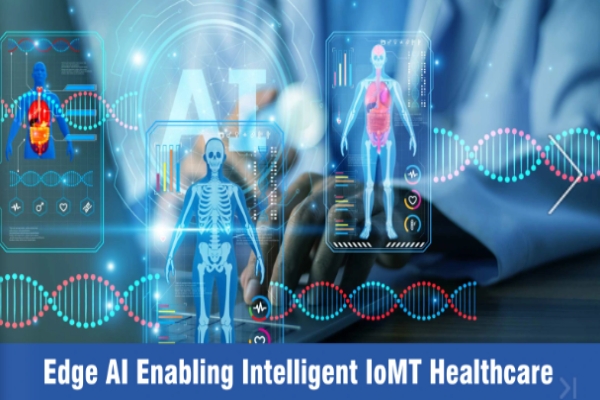
Healthcare is gradually surpassing the physical parameters of hospitals and clinics. For many years, medical care was entirely reactive; patients only visited doctors when symptoms manifested, and most treatment decisions were based on the data drawn from occasional checkups.
The approach was sufficient in the past, but did not always provide enough attention to early warning signs of health deterioration. Today, advances in AI and Digital engineering are slowly changing this model to be more connected, continuous, and proactive.
The Internet of Medical Things (IoMT) is one of the core factors behind this revolution. Healthcare providers gather data on patients remotely through specialized medical equipment: wearables, glucose monitors, and vision systems for remote supervision over medical conditions.
Rather than depending only on periodic visits, signs can be monitored continuously, and any potential concern can be detected much earlier. Moving towards real-time data allows doctors the ability to deliver more precise treatments for chronic diseases while aiding in the effective management of them for the patient.
As more hospitals, research groups, and tech firms invest in digital health solutions, there will also be a growing use of connected medical devices. This increase is due to the growing need for preventive care, data-driven diagnosis, and medicine that centre on the patient; and because of this, health care systems will work towards developing smarter and more adaptable models of care.
To understand how these connected systems work and why they are now becoming essential in modern healthcare, it is necessary to first look at the concept and structure of the Internet of Medical Things (IoMT).
Understanding the Internet of Medical Things (IoMT)
The Internet of Medical Things (IoMT) means a network of connected medical devices, healthcare systems, and applications that collect, transmit, and analyze health data via the internet. In simple terms, it links patients, medical equipment, and health care professionals via intelligent technologies that are not just a bid to transfer data at hospital visits but ensure a continuous flow of health information. The connected ecosystem that’s making up the foundation of today’s digital health care system is the backbone of our global digital health environments.
Many different types of IoMT devices are available. Some wearables measure vital signs such as heart rate, sleep patterns, and activity levels. This is evident in Remote patient monitoring systems that allow doctors to monitor patients battling chronic diseases at home using connected devices such as glucose monitors or blood pressure monitors. In hospitals, however, smart medical equipment, such as connected imaging machines, infusion pumps, and patient monitoring systems, allows healthcare teams to have real-time data to speed up clinical decisions.
The most powerful feature of IoMT is the continuous data flow between the patients, devices, and healthcare providers. For this ecosystem to work effectively, systems must smoothly communicate with one another while maintaining strong security standards to ensure safe and reliable exchange of sensitive health information.
Technology Infrastructure Powering IoMT Ecosystems
Every successful IoMT ecosystem depends on a strong, flexible, multi-layered technology infrastructure. The architecture of these systems must provide confidence that health data is collected, transmitted, processed reliably, and analyzed quickly enough so clinicians can act based on real-time insights. The following sections identify the core components of infrastructure needed to support a modern IoMT environment.
1. Smart Medical Devices as Data Sources
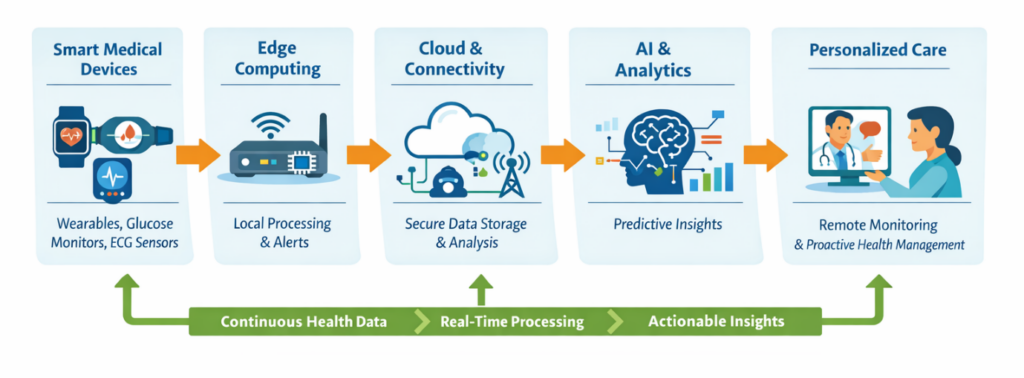
The Internet of Medical Things (IoMT) stack starts with the device layer, which is constantly generating health data from sensor-enabled medical equipment. Wearable biosensors, continuous glucose monitors (CGMs), ECG patches, pulse oximeters, and connected diagnostic devices collect physiological signals at a high frequency. These devices are usually low-power microcontrollers with minimalist firmware that transmit structured or semi-structured telemetry data like HL7 FHIR or IEEE 11073 standardized protocols.
2. Edge Computing and Cloud Computing
The Internet of Medical Things (IoMT) operates on a distributed computing framework that merges edge and cloud resources. Edge nodes, which include medical gateways and embedded systems, are responsible for local preprocessing, filtering signals, and detecting anomalies in real-time to cut down on latency. The cloud component takes care of large-scale data ingestion, long-term storage, and advanced analytics through scalable health data platforms. In practical scenarios, edge systems can spot missed medication events, while cloud platforms look at long-term adherence patterns and risk indicators.
3. Connectivity Technologies
The connections used by Edge and Cloud solutions provide the means of reliable connection between devices, Edge Systems, and Cloud Platforms. Some devices, such as wearables, utilize Bluetooth Low Energy (BLE) for short-range communication and Wi-Fi to support high-bandwidth clinical equipment located in healthcare organizations. For remote patient monitoring, the use of cellular technologies such as LTE-M and NB-IoT provides low-power wide-area connections. To provide safe transmission of sensitive medical data, secure communication protocols, encryption, and device authentication mechanisms are required.
4. Secure Data Ingestion and AI-Driven Analytics
Secure data ingestion pipelines on platforms of the Internet of Medical Things use providers such as MQTT and Kafka/Flink to handle high-throughput telemetry data collected from edge gateways. The direct incoming data is validated with either Avro or Protobuf, deduplicated from one another, normalized between HL7 FHIR and IEEE 11073 standards, and then stored in either Iceberg or InfluxDB lakes.
Kubernetes-orchestrated TensorFlow/Kubeflow pipelines leverage CNN/RNN model architectures for real-time ECG and glucose analysis, allowing for more than 100ms of real-time anomaly detection, predictive insight, and alerts scheduled with FHIR, with added HIPAA compliance through encryption and role-based access control (RBAC) to all users of the application, and with outcomes of the federated learning.
Together, these infrastructure layers create a secure and scalable technology stack that empowers IoMT platforms to process continuous data streams from devices into actionable healthcare intelligence.
Let’s look at an example of what AI-powered IoMT could look like.
Real-World IoMT in Action: The AI-Powered Smart Medication Box
MosChip recently showcased an AI-Powered Smart Medication Box that functions as an IoMT edge node that senses, decides, and dispenses the medication based on who the user is.
For the device layer, you have an on-device camera function that authenticates the user, and it can also recognize voices/keywords by the microphone. It provides voice commands, and the LEDs light up to indicate which medication needs to be consumed.
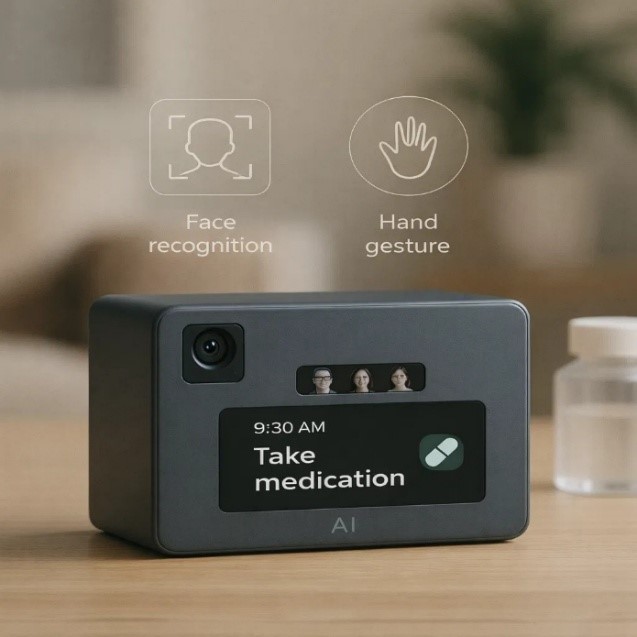
AI-Powered Smart Medication Box
All this runs on an Infineon PSoC™ Edge E84 platform locally, so decisions are fast and made right at the edge, even if there are connectivity blips.
Dose events (taken, missed, late) are detected and securely saved on the device, then synced to the caregiver app to ensure interventions are made only when necessary.
The result is a closed-loop, adherence workflow that personalizes relatively unstructured, continuous-protocol device data into safer outcomes without streaming potentially sensitive audio/visual feeds into the cloud.
How IoMT Enables Personalized and Preventive Care
A smart medication box is just one example of a much bigger shift happening across healthcare. IoMT is fundamentally moving care delivery away from periodic, reactive treatment toward continuous, personalized, and preventive models built around the patient’s actual life.
1. Continuous, Real-Time Monitoring
IoMT devices capture physiological and behavioral data around the clock, giving clinicians a far richer and more accurate picture of patient health than occasional checkups ever could.
2. Personalized Treatment Plans
The continuous stream of data allows for the development of care plans that are specifically designed to fit each person’s behaviour, history, and response patterns. This approach leads to genuinely personalized care rather than just following general clinical guidelines.
3. Proactive Intervention Over Reactive Treatment
Healthcare teams can now respond to early warning signs, identifying worsening trends, missed medications, or unusual vital signs before conditions worsen, which helps to lower hospital readmissions and enhance long-term patient outcomes.
4. Context-Aware Care Powered by Edge AI
By processing data directly on the device, as shown with the smart medication box, edge AI provides immediate, intelligent responses without needing cloud connectivity, ensuring that care remains uninterrupted, private, and consistently attuned to each patient’s real-world situation.
Future healthcare systems will be built on intelligent, interconnected IoMT devices, driven through edge AI and a secure infrastructure. Moving intelligence from people to devices promotes predictive, preventive, and personalized forms of patient care while allowing for quicker decisions and greater privacy and context awareness. From smart adherence to autonomous workflows, this offers a solution to clinical burden and enhances patient outcomes in an adaptive manner.
MosChip has expertise in designing, developing, and deploying end-to-end IoMT solutions using Digital Engineering. Their capabilities cover embedded systems, edge AI, secure connectivity, cloud integration, and Data analytics, allowing healthcare innovators to translate complex requirements into scalable production-ready platforms.
MosChip can help you support anything from the development of healthcare devices and digital enablement to developing AI-driven applications to support every phase of your product lifecycle, therefore speeding up time to market while ensuring quality, security, and regulatory compliance.