
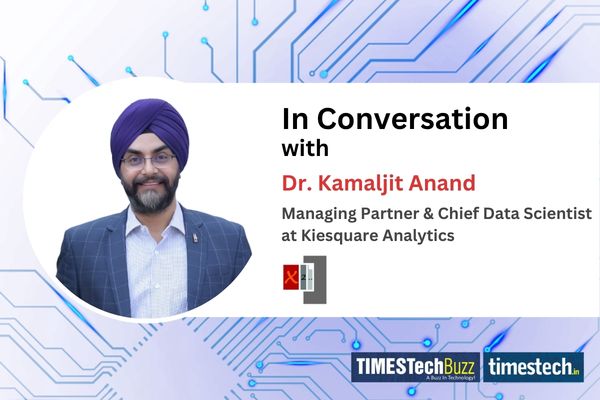
In an interview with Dr. Kamaljit Anand, Managing Partner & Chief Data Scientist at Kiesquare Analytics, TimesTech explores how AI, intelligent data lakes, and decision intelligence are transforming enterprise strategies globally. Dr. Anand highlights the shift toward faster, AI-driven business decisions, evolving industry data strategies, and India’s growing influence in the global analytics ecosystem amid rapid adoption of AI-powered technologies.
Read the full interview here:
TimesTech: KiE Square Analytics has delivered over 200 “data-to-decisions” programs globally, what have been the most significant shifts you’ve observed in how enterprises approach data-driven decision-making today compared to a decade ago?
Kamaljit: Over the past decade, enterprises have shifted from structured, internal data reliance to leveraging vast volumes of unstructured and external intelligence. The rise of intelligent data lakes and embedded AI/ML-driven solutions has enabled real-time, integrated decision-making, where analytics, data, and visualization systems work seamlessly to drive faster, more accurate business outcomes. For example,
A traditional Data Warehouse project would have taken 1 year for migration. Today the baseline can be achieved with far more complex Data Lakes within three months with 90%+ Quality need. Similarly, Data Science Models would take 60% less time with 95%+ result concurrence levels. BI & Visualization very encouragingly takes 80% less time but with 60% result concurrence only, leading to significant reworks. So overall, Data to Decisions journey has shortened by over 50% with 80%+ accuracy for most jobs which is a great news for enterprises and helps the early adopters of AI & intelligent data lakes strengthen Market share much more efficiently.

TimesTech: As organizations move from traditional analytics to decision intelligence, what are the key capabilities or mindset changes required to truly unlock business value from data?
Kamaljit: The shift from traditional analytics to decision intelligence is fundamentally a shift from hindsight to foresight and, more importantly, to action. It requires organizations to move beyond reporting and dashboards toward embedding intelligence directly into decision-making workflows.
The first capability is building a unified, high-quality data foundation, without which even the most advanced models fail to deliver value. Equally critical is adopting a strong integration capability that can scale across data sources, applications, AI, Visualization, Decision execution & Tracking Systems.
From a mindset perspective, leadership must embrace experimentation and trust AI-driven recommendations while maintaining governance and explainability. Finally, organizations need to align cross-functional teams, business, data, and technology, to ensure that insights are not just generated, but consistently translated into timely, high-impact decisions.
TimesTech: With AI adoption accelerating across industries, where do you see enterprises struggling the most in technology implementation, talent, or aligning AI with business outcomes?
Kamaljit: In my view, the biggest struggle for enterprises today is not technology or even talent in isolation, it is aligning AI with meaningful business outcomes. The sheer proliferation of AI tools and agentic frameworks is slowing executive decision-making, creating problem of riches.
Most organizations are flooded with tactical AI use cases, while truly strategic applications remain rare, perhaps one in a hundred. The absence of a structured AI think tank within enterprises often leads to misallocation of budgets, where strategic investments are spent on tactical initiatives and vice versa, resulting in both financial bleed and missed opportunities.
On the talent front, while advanced AI expertise remains scarce and commands a premium, there is an adequate supply of basic AI skills. The real need is not just talent, but the ability to channel it toward high-impact, outcome-driven AI initiatives.
TimesTech: KiE Square works across sectors like retail, BFSI, telecom, and the public sector, how do data strategies differ across these industries, and what common challenges persist?
Kamaljit: Data strategies vary significantly by sector. BFSI and telecom have historically been data-rich but operate under stringent statutory frameworks, limiting experimentation at the customer level, even as external intelligence reshapes decision-making. Retail, while data-enabled and less regulated, has leveraged aggressive CRM-led growth; however, margin pressures constrained tech investments, though quick commerce is rapidly altering this dynamic, especially post-DPDP. FMCG and pharma have traditionally lacked granular customer or transaction level data and underinvested in real time or embedded analytics. Today, with rising marketplace competition, barrage of new players, reduced product development time and lower entry barriers, they must pivot toward tech-driven strategies or face severe pressure in the next decade. Across sectors, key challenges remain: AI Technology familiarity, Lack of in-company AI Think-Tanks for Strategic AI use cases, Below par multi-application integration capabilities, low investment on Smart data lakes with Embedded BI & real time Decision engines, Slow migration to Newer & more efficient Tech stack.
TimesTech: You have extensively worked on marketing ROI, how is AI redefining marketing effectiveness, and what should enterprises prioritize to ensure measurable impact?
Kamaljit: AI is fundamentally redefining marketing effectiveness by shifting the focus from retrospective measurement to real-time, predictive decision-making through new age agentic AI frameworks. It enables granular attribution from Top funnel to bottom funnel to even hyperlocal, dynamic budget allocation, and hyper-personalized customer engagement at scale, moving beyond traditional ROI to a more continuous, outcome-driven performance model that can drive decision on a daily basis especially for downstream performance campaigns. The cost of achieving the same ROAS has fallen over time, but the rising competition and number of platforms competes for the total available budget to provide the counterbalance. Organizations still need to combine human strategic thinking with AI-led execution will achieve sustainable, measurable marketing impact.
TimesTech: Given your work with both global corporations and Indian institutions, how do you view India’s evolving role in the global data and analytics ecosystem, and what opportunities lie ahead?
Kamaljit: India’s position in the global data and analytics ecosystem is entering a defining phase. It is a mixed bag of opportunities, with strong momentum in AI-led backend infrastructure and the rapid expansion of Global Capability Centers (GCCs), offering long-term growth and infrastructure-led revenues. On the services front, AI Multimodal Learning Models, LLMs and Agentic AI frameworks are going to be the biggest workforce of the future that can potentially turnaround a full year’s data-oriented work that the entire world population does, in just a matter of weeks. Given that, India has to quickly change gears and adopt AI oriented work delivery models that are capable of 4x delivery compared to pre-AI times and also find gaps where AI is underwhelming. An AI and Non-AI Skill committee shall be set up swiftly to address the above needs. The Indian organizations would adopt AI much faster than global organizations and hence learnings from Indian AI PoCs can provide a fertile bed of innovations for Strategic global AI foray for the country.