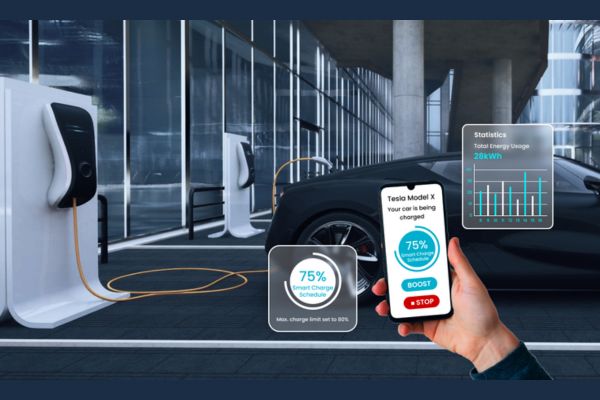
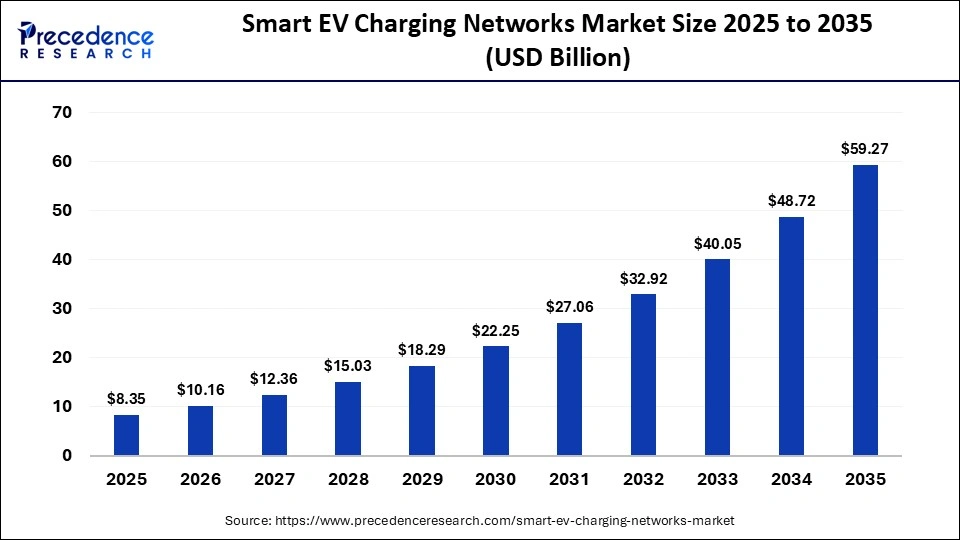
The global smart EV charging networks market size was valued at USD 8.35 billion in 2025 and is projected to grow from USD 10.16 billion in 2026 to nearly USD 59.27 billion by 2035, registering a CAGR of 21.65% during the forecast period from 2026 to 2035. The market growth is driven by the increasing adoption of electric vehicles, rising investments in connected charging infrastructure, growing demand for intelligent energy management solutions, and expanding collaborations between automakers and energy providers.
Key Takeaways
- Asia Pacific held the largest market share in 2025.
- Europe is projected to grow at the fastest CAGR during the foreseeable period.
- By charging level, the DC fast charging segment held the largest market share in 2025.
- By charging level, the level 2 charging segment is projected to grow at the fastest CAGR during the foreseeable period.
- By deployment, the commercial deployment segment held the largest market share in 2025.
- By deployment, the residential deployment segment is projected to grow at the fastest CAGR during the foreseeable period.
- By grid interaction capability, the unidirectional smart charging segment held the largest market share in 2025.
- By grid interaction capability, the bidirectional charging enabled networks segment is projected to grow at the fastest CAGR during the foreseeable period.
Market Overview
The smart EV charging networks market comprises cloud-based, connected charging infrastructure that intelligently manages electricity usage for charging electric vehicles while maintaining real-time grid stability through internet-enabled technologies. The market includes software-driven charging ecosystems that dynamically optimize energy consumption, regulate charging speeds, reduce operational costs, and prevent grid overload across public, commercial, and fleet charging applications. The market is primarily driven by the rising adoption of electric vehicles, stringent carbon emission regulations, and the growing need for efficient charging infrastructure capable of handling increasing electricity demand.
How is AI Impacting the Smart EV Charging Networks Market?
The integration of artificial intelligence is transforming the smart EV charging networks market from hardware-centric infrastructure into intelligent, software-defined ecosystems capable of predictive automation and optimized energy management. AI-powered algorithms enhance vehicle-to-grid (V2G) technology by efficiently regulating energy flow based on real-time demand patterns. Machine learning models continuously monitor charger performance, detect potential failures in advance, and help reduce infrastructure downtime and maintenance costs. In addition, AI-driven plug-and-charge capabilities eliminate the need for manual card authentication, enabling seamless, personalized, and rate-based charging solutions that minimize unnecessary grid loads and improve long-term grid efficiency.
Regional Outlook of the Smart EV Charging Networks Market
What Made Asia Pacific the Dominant Region in the Smart EV Charging Networks Market?
Asia Pacific dominated the market while holding the largest share in 2025, driven by aggressive government policies and subsidies for EV charging stations, substantial investments in smart EV charging infrastructure, a robust manufacturing base, rapid urbanization, and increasing EV adoption in leading countries. Technological advancements in EVs and charging points further fueled growth in the region. Additionally, the integration of EV charging stations with renewable energy sources such as solar power, along with developments like ultra-fast DC charging, is being increasingly adopted to meet the growing demand, supported by strong government policies and financial incentives.
How is Europe Rapidly Growing in the Smart EV Charging Networks Market?
Europe is projected to grow at the fastest CAGR during the foreseeable period due to the increasing EV adoption, regulatory mandate for fast charging, and its projection to reach 4 million public charging infrastructure with high-power charging expansion. The region is increasingly adopting AI-powered, software-based, and grid-balanced systems. According to data from March 2025, roads in Europe host 9.3 km of battery EVs and 5.2 m plug-in hybrid electric vehicles. By 2030, the combined EV fleet across countries in Europe is anticipated to reach 50m. Also, the original equipment manufacturers in Europe, like Kia and Shell, have covered 80% of public charging points in Europe, highlighting the rapid growth rate of the market in the region.
Smart EV Charging Networks Market Companies
ChargePoint Holdings, Inc.
is one of the leading players in the smart EV charging networks market, offering an extensive portfolio of charging hardware, cloud-based software, and subscription services for commercial, fleet, and residential customers. The company operates one of the world’s largest EV charging networks and focuses heavily on connected charging solutions, energy management, and scalable infrastructure to support growing EV adoption across North America and Europe.
Tesla, Inc.
has transformed the smart EV charging ecosystem through its global Supercharger network, which delivers ultra-fast, software-integrated charging for electric vehicles. Tesla’s charging network supports features such as real-time charger monitoring, route optimization, automated billing, and AI-driven queue management, while the company continues expanding access to non-Tesla EVs through the North American Charging Standard (NACS).
ABB Ltd.
is a major provider of smart EV charging infrastructure, specializing in high-power DC fast chargers and digital energy management systems. The company focuses on intelligent charging technologies integrated with cloud connectivity, renewable energy systems, and smart grid solutions, helping accelerate EV infrastructure deployment across public transport, commercial fleets, and highway charging corridors.
Siemens AG
plays a significant role in the smart EV charging networks market through its intelligent charging software, smart grid integration, and sustainable mobility solutions. The company develops advanced charging infrastructure for residential, commercial, and public applications, emphasizing IoT-enabled monitoring, energy optimization, and seamless integration with renewable power sources and urban mobility systems.
Schneider Electric
provides smart EV charging solutions focused on energy efficiency, grid reliability, and digital automation. Its EV charging platforms combine smart energy management software, building automation systems, and renewable energy integration, enabling businesses and cities to deploy scalable and sustainable EV charging networks while reducing operational energy costs.
EVgo Inc.
is a prominent operator of public fast-charging networks in the United States, offering convenient and software-enabled charging solutions for urban and highway EV users. The company focuses on fast DC charging, renewable-powered charging stations, and strategic partnerships with automakers and retail businesses to expand accessible smart charging infrastructure nationwide.
Segmental Insights of the Smart EV Charging Networks Market
Charging Level Insights
The DC fast charging segment led the market with the largest share in 2025 as it reduces charging time by up to 80-90% and allows vehicles to run for a longer period with fast charging, which supports long-distance travel. DC fast charging directly provides power to the battery and bypasses the limitations of on-board chargers. Faster turnover rates directly affect the maximum number of vehicles serving per day, which increases profitability for businesses. DC fast charging handles load balancing, dynamic pricing, and managing peak demand with utility grid management systems, which is highly crucial for densely populated regions.
Deployment Insights
The commercial deployment segment dominated the market with the largest share in 2025 due to the increased utilization and strong demand supported by government initiatives, advanced functional requirements, high revenue potential, and rapid expansion of public and fleet infrastructure, resulting in faster return on investment (ROI). Commercial charging sites require intelligent networked chargers equipped with advanced features such as dynamic pricing and energy load management to efficiently manage large public fleets, including buses, taxis, and logistics vehicles. Additionally, substantial financial backing and supportive regional government policies for charging infrastructure development continue to be key drivers fueling the growth of this segment.
Grid Interaction Capability Insights
The unidirectional smart charging segment led the market, holding the largest share in 2025. This is mainly due to its compatibility with most existing EV models, which allows controlled one-way power flow for load balancing. This charging is highly beneficial for residential and commercial applications. The unidirectional smart charging enables operators to modulate charging speed and time that minimizes load on the grids. Such grid interaction is highly supportive of leveraging renewable energy at its highest capability, supports environmental goals, and increases adoption rates across commercial, residential, and public infrastructure.
Connectivity Technology Insights
The cellular (4G/5G) segment held the largest share of the market in 2025, as it offers low latency that allows instant communication between vehicle and charger to start charging, dynamic pricing, and handling billing quickly. It further provides high-speed data capabilities, extensive coverage, secure payments, and remote diagnostics of sudden issues. Cellular IoT allows operators to handle station health remotely, perform remote firmware updates, and reduce the need for on-site visits for maintenance, ensuring higher uptime. LTE and NB-IoT offer widespread coverage and make them the first choice for highway charging and rural locations.