

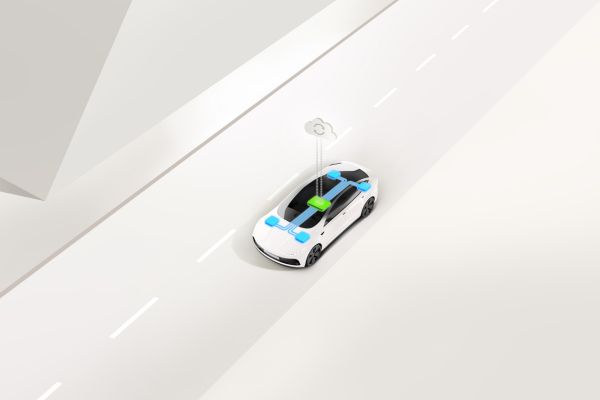
What’s new: As the automotive industry transitions to software defined vehicle (SDV) architectures, NXP Semiconductors is collaborating with Quanta—a leading global technology provider, large scale systems manufacturer, and Taiwanese technology powerhouse — to enable a deterministic zonal networking solution purpose-built for next generation vehicle architectures. The solution is built on NXP’s S32 automotive processing platform and the TrustMotion MotionWise middleware to enable predictable, real-time communication across zonal vehicle networks.
Built on NXP S32-based zonal controllers, the solution addresses a major OEM pain point: ensuring deterministic timing across hosts and network components, which reduces late-stage integration risk. Through a plug-and-play development flow that can accelerate development significantly, NXP is helping customers like Quanta dramatically speed the time required to deploy modern SDV designs.
The solution supports automated topology discovery, schedule generation, and deployment through a continuous integration workflow. By combining MotionWise deterministic scheduling and communication with a scalable hardware and software foundation, the solution provides automotive OEMs with a turnkey approach to developing and deploying zonal SDV architectures. Delivered as a single, validated platform integrating automotive-grade compute, networking, and system orchestration, NXP enables end-to-end determinism across both hosts and networks—rather than leaving OEMs to assemble and validate these capabilities themselves.
Why it matters: As automakers move from distributed, domain-based ECU architectures toward zonal and cross domain E/E systems, legacy designs are increasingly limiting their ability to deliver software defined functionality at scale. Ensuring deterministic timing across distributed compute and networking has become a critical challenge, directly affecting system performance, integration complexity, and time-to-market.
This collaborative solution addresses this challenge by delivering predictable, end-to-end latency and low jitter across ECUs and in-vehicle networks, helping ensure system level Quality of Service while reducing late stage integration risk. Its plug-and-play development approach enables automated configuration, scheduling, and deployment, which can accelerate SDV program timelines substantially. The platform also supports latency-sensitive use cases, including audio over Ethernet, HPC up-integration, real-time RCP control, and smart energy networking, enabling OEMs to scale a unified zonal architecture across multiple vehicle programs.
“Software defined vehicles require a fundamentally different approach to vehicle architecture—one that delivers deterministic timing across both compute and network at scale,” said Sebastien Clamagirand, SVP and GM, PL Automotive Systems and Platforms (AS&P), NXP Semiconductors. “By combining our S32 platform with MotionWise, we are helping OEMs overcome the limitations of legacy architectures, reduce integration risk, and accelerate development of scalable zonal systems.”
“Quanta’s Adaptive Zonal System is designed to deliver deterministic performance and system level scalability for next generation vehicle platforms,” said Terrisa Chung, Vice President and General Manager of Automotive Business Group at Quanta. “Working with NXP, we’re providing a ready to deploy foundation that helps our customers move faster while meeting strict timing, safety, and reliability requirements.”
More details: NXP’s solution integrates its scalable S32 processing platform, in vehicle networking, and system power management portfolio with MotionWise deterministic scheduling (MotionWise Schedule) and communication (MotionWise Communication). Key elements include S32 automotive processors for safe, secure, and OTA ready zonal compute; TSN enabled networking using SJA1110 switches; CAN and LIN connectivity; and scalable multi-PMIC power management.
The solution delivers a unified hardware/software architecture that supports automated configuration, CI/CD deployment, and continuous optimization based on runtime data. This approach enables OEMs to reduce integration barriers, move more efficiently from concept to production, and deploy a single, scalable zonal platform across vehicle classes and E/E architectures.
In addition, as part of their ongoing collaboration, NXP and Quanta are working now toward future alignment with the NXP CoreRide zonal reference system, building on the innovative foundation to support broader SDV system integration. Further updates are anticipated as this work progresses.