


According to Precedence Research, the global artificial intelligence (AI) market size was valued at USD 757.58 billion in 2025 and is projected to grow from USD 900.00 billion in 2026 to approximately USD 4,216.29 billion by 2035, expanding at a CAGR of 18.73% from 2026 to 2035.
The accelerating shift toward enterprise automation, cloud-based AI infrastructure, generative AI adoption, and intelligent workflow systems continues to reshape the global technology landscape. Artificial intelligence is increasingly moving from experimental deployment into mainstream enterprise operations, becoming a foundational technology across industries including healthcare, finance, manufacturing, retail, cybersecurity, and transportation.
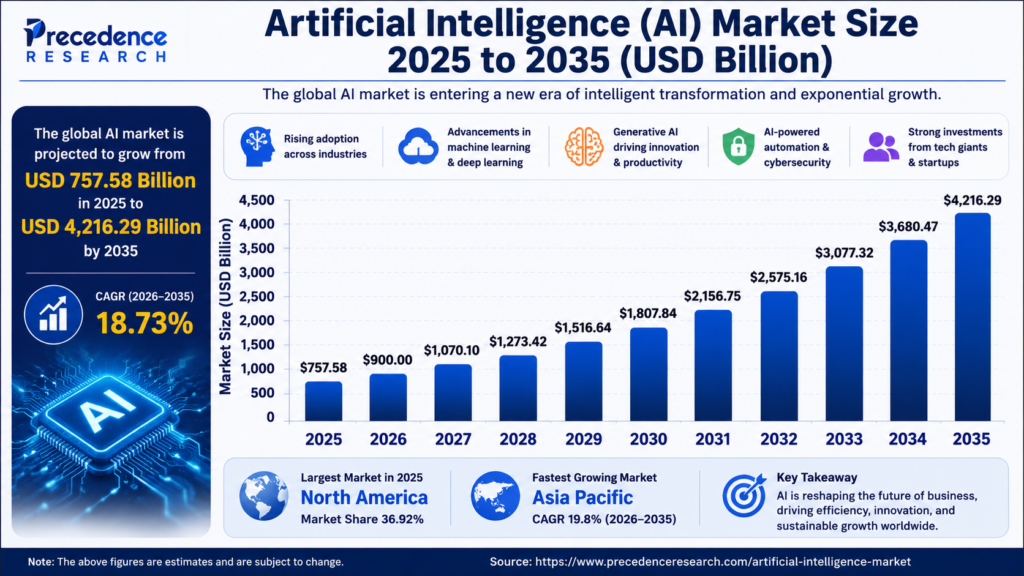
- North America accounted for the largest market share of 36.92% in 2025.
- Asia Pacific is expected to witness the fastest growth during the forecast period with a CAGR of 19.8%.
- By solution, the software segment dominated the market with a share of 51.40% in 2025.
- By technology, machine learning held the leading market share of 36.70% in 2025.
- Generative AI is expected to emerge as the fastest-growing technology segment over the forecast period.
- By function, operations represented the dominant segment in 2025.
- The cybersecurity segment is expected to grow significantly due to rising digital threats and enterprise security investment.
- BFSI remained the leading end-use industry in 2025.
- Healthcare is projected to experience notable growth due to increasing adoption of AI-assisted diagnostics and personalized medicine.
Key Takeaways
Why This Market Matters
Artificial intelligence is no longer operating as a standalone software capability. Enterprises are increasingly integrating AI into operational infrastructure, customer engagement systems, cybersecurity frameworks, supply chain optimization, and decision-making workflows.
The emergence of generative AI has accelerated this transition significantly. Businesses are moving beyond traditional predictive analytics and adopting AI systems capable of content generation, conversational interaction, automation, coding assistance, and research support.
This shift is creating a broader economic transformation across industries. AI investment is now influencing cloud infrastructure demand, semiconductor development, data-center expansion, enterprise software ecosystems, and digital productivity models globally.
Market Overview
Artificial intelligence refers to technologies that enable machines and software systems to simulate human intelligence functions including learning, reasoning, prediction, automation, and problem-solving.
The market is witnessing strong expansion due to several structural industry shifts:
- Growing enterprise digital transformation
- Rising adoption of automation technologies
- Expansion of generative AI applications
- Increasing cloud computing penetration
- Strong investment in AI infrastructure
- Rising use of AI in cybersecurity and fraud detection
- Growing demand for intelligent analytics and predictive systems
The market is also benefiting from large-scale investment by technology leaders including Microsoft, Google, NVIDIA, Amazon, IBM, and Baidu. These companies continue to strengthen AI ecosystems through infrastructure development, AI model training, cloud platform expansion, and strategic partnerships.
Governments globally are also increasing investment in AI innovation to strengthen digital competitiveness, industrial modernization, and national technology capabilities.
Impact of Generative AI on the Artificial Intelligence Market
Generative AI is becoming one of the most commercially disruptive areas within the broader AI ecosystem.
Unlike conventional machine learning systems focused primarily on prediction and classification, generative AI models can create text, images, videos, code, simulations, and conversational outputs. This is fundamentally changing enterprise productivity models and digital workflows.
The rapid adoption of large language models (LLMs), multimodal AI systems, and AI copilots is accelerating demand for:
- GPUs and AI accelerators
- Cloud AI infrastructure
- AI model training systems
- Enterprise productivity software
- Vector databases
- AI cybersecurity solutions
- Data-center capacity expansion
The impact extends far beyond software. Semiconductor companies, hyperscale cloud providers, cybersecurity firms, and infrastructure vendors are all benefiting from increasing enterprise AI deployment.
At the same time, concerns regarding hallucinations, misinformation, regulatory oversight, copyright risks, and AI governance continue influencing enterprise adoption strategies.
Key Industry Shifts
Enterprise AI spending is shifting from experimentation toward operational deployment.
Generative AI is reshaping enterprise software and productivity economics.
AI infrastructure demand is accelerating investment in GPUs and hyperscale data centers.
AI-powered cybersecurity systems are becoming strategically important for enterprises.
Governments are expanding AI governance frameworks and regulatory oversight.
AI adoption is increasing rapidly across healthcare diagnostics and scientific research workflows.
Semiconductor and cloud infrastructure providers are becoming central players in the AI ecosystem.
Market Dynamics
Driver: Rising AI Adoption Across Financial Services
The BFSI sector continues to represent one of the largest adopters of artificial intelligence technologies globally.
Financial institutions are increasingly using AI for:
- fraud detection,
- risk management,
- credit scoring,
- algorithmic trading,
- customer support automation,
- regulatory compliance,
- predictive analytics.
AI enables financial organizations to process large volumes of data significantly faster than traditional systems while improving operational efficiency and customer engagement.
The growing sophistication of digital fraud and cyber threats is also accelerating investment in AI-driven security infrastructure.
Organizations increasingly require explainable AI frameworks to ensure accountability, fairness, compliance, and consumer trust. Opportunity
AI Expansion Across Scientific Research
Restraint: Lack of Transparency in AI Decision-Making
One of the major concerns surrounding AI adoption involves transparency and explainability.
Many advanced AI models operate as “black box” systems where decision-making processes are difficult to interpret. This creates operational and regulatory concerns, particularly in highly sensitive industries such as healthcare, finance, and law.
Research institutions and scientific organizations are rapidly adopting AI to accelerate discovery processes and improve analytical capabilities.
AI is increasingly being used in:
- drug discovery,
- genomics,
- climate modeling,
- medical imaging,
- materials science,
- industrial simulation,
- predictive research.
Researchers are leveraging AI systems to process large datasets, identify hidden patterns, and optimize experiments more efficiently than traditional analytical methods.
Challenge: Shortage of Skilled AI Profession
Despite rapid market expansion, the shortage of qualified AI professionals remains a major industry challenge.
AI deployment requires expertise in:
- machine learning,
- data science,
- deep learning,
- software engineering,
- cloud infrastructure,
- AI model optimization.
The growing gap between talent demand and workforce availability is increasing operational costs and slowing enterprise AI implementation timelines.
Artificial Intelligence Market Segmentation Analysis
By Technology
Machine Learning Dominated the Market in 2025
Machine learning accounted for the largest market share in 2025 due to its broad applicability across predictive analytics, automation, recommendation systems, and enterprise intelligence platforms.
Organizations increasingly rely on machine learning algorithms to improve operational efficiency, automate repetitive tasks, and enhance business decision-making.
Generative AI is Emerging as the Fastest-Growing Segment
Generative AI is expected to witness substantial growth over the forecast period.
The technology is rapidly transforming:
- content creation,
- software development,
- enterprise productivity,
- customer interaction,
- research automation,
- media generation.
The growing adoption of AI copilots and large language models is significantly expanding enterprise investment in generative AI infrastructure.
By Solution
Software Segment Led the Market
The software segment held the dominant market share in 2025 due to rising deployment of AI-powered analytics, automation, and enterprise intelligence applications.
Businesses are increasingly integrating AI software into operations management, customer service, marketing automation, and workflow optimization systems.
Services Segment Continues Expanding
The services segment is expected to witness strong growth as enterprises seek support for:
- AI consulting,
- deployment,
- optimization,
- cloud migration,
- AI integration,
- managed AI services.
AI implementation often requires multidisciplinary expertise, increasing demand for specialized service providers.
By Function
Operations Segment Maintained Leadership
The operations segment dominated the market due to AI’s ability to improve process efficiency and automate repetitive enterprise workflows.
AI-powered systems are helping organizations optimize:
- supply chains,
- logistics,
- workforce management,
- predictive maintenance,
- operational analytics.
Cybersecurity Segment is Gaining Momentum
Cybersecurity is expected to become one of the fastest-growing functional application areas for AI.
Rising digital threats and increasingly sophisticated cyberattacks are accelerating enterprise demand for AI-powered:
- threat detection,
- anomaly monitoring,
- fraud prevention,
- automated incident response,
- predictive security systems.
By End-Use
BFSI Remained the Largest End-Use Industry
The BFSI sector accounted for the leading market share due to growing AI adoption in fraud detection, customer engagement, compliance monitoring, and algorithmic trading systems.
Financial institutions are increasingly investing in AI to improve efficiency, reduce operational risk, and strengthen digital competitiveness.
Healthcare is Witnessing Accelerated AI Adoption
Healthcare is expected to experience notable growth during the forecast period due to rising adoption of AI in:
- diagnostics,
- medical imaging,
- personalized medicine,
- hospital workflow automation,
- drug discovery,
- clinical decision support systems.
AI is increasingly becoming a strategic technology for improving healthcare efficiency and patient outcomes.
Regional Analysis
North America
North America dominated the global AI market in 2025 due to advanced digital infrastructure, strong enterprise technology adoption, and concentration of leading AI developers.
The United States remains the center of global AI innovation, supported by:
- large-scale R&D investment,
- strong venture capital activity,
- advanced cloud infrastructure,
- semiconductor leadership,
- favorable government initiatives.
Major technology companies including Microsoft, Google, Amazon, NVIDIA, IBM, and Meta continue investing aggressively in AI infrastructure and foundation model development.
Asia Pacific
Asia Pacific is expected to witness the fastest market growth during the forecast period.
Countries including China, India, Japan, and South Korea are significantly increasing investment in:
- AI infrastructure,
- robotics,
- smart manufacturing,
- healthcare AI,
- cloud computing,
- digital public systems.
China continues strengthening its domestic AI ecosystem through aggressive policy support and rising investment in local AI companies.
Europe
Europe is increasingly focusing on responsible AI deployment, governance frameworks, and industrial AI integration.
The region is witnessing rising AI adoption across:
- automotive,
- transportation,
- manufacturing,
- healthcare,
- research sectors.
European governments are simultaneously promoting innovation while strengthening AI-related regulations focused on transparency, ethics, and data privacy.
The artificial intelligence market remains highly competitive and innovation-driven.
Technology companies are competing across:
- generative AI models,
- enterprise AI ecosystems,
- cloud AI infrastructure,
- semiconductor development,
- AI copilots,
- cybersecurity AI,
- automation platforms,
- autonomous systems.
Competitive positioning increasingly depends on:
- compute infrastructure scale,
- proprietary AI models,
- enterprise integration capabilities,
- semiconductor capacity,
- cloud ecosystem strength,
- AI governance frameworks.
Strategic partnerships, AI startup acquisitions, and infrastructure expansion continue shaping the competitive landscape globally.
Key Companies
- Intel Corporation
- Microsoft
- IBM
- Amazon Web Services
- NVIDIA Corporation
- Baidu, Inc.
- H2O.ai
- Lifegraph
- Sensely, Inc.
- Enlitic, Inc.
- AiCure
- HyperVerge, Inc.
- Arm Limited
- Clarifai, Inc.
Recent Developments
- In February 2025, OpenAI introduced Deep Research, an AI-powered multi-step internet research tool designed for complex analytical tasks.
- In December 2024, Google launched Gemini 2.0, focusing on multimodal AI capabilities and enterprise automation support.
- In September 2024, Bharti Airtel introduced an AI-powered spam detection platform integrated into telecom network infrastructure.
- The European Union also expanded AI infrastructure initiatives to strengthen regional AI competitiveness and industrial deployment.
Future Outlook
The artificial intelligence market is expected to remain one of the most strategically important technology sectors over the next decade.
Future market leadership will increasingly depend on:
- AI compute infrastructure,
- semiconductor scalability,
- foundation model ecosystems,
- enterprise integration,
- energy-efficient AI computing,
- AI governance capabilities,
- multimodal AI deployment.
Generative AI, enterprise automation, AI-driven cybersecurity, scientific AI, and autonomous systems are expected to become major long-term growth pillars globally.
At the same time, regulatory oversight, transparency requirements, infrastructure costs, cybersecurity risks, and talent shortages will continue shaping market evolution.
Frequently Asked Questions (FAQs)
What is the current size of the artificial intelligence market?
The global artificial intelligence market size was valued at USD 757.58 billion in 2025 and is projected to reach approximately USD 4,216.29 billion by 2035.
What is the expected CAGR of the AI market?
The artificial intelligence market is expected to expand at a CAGR of 18.73% from 2026 to 2035.
Which technology segment dominates the AI market?
Machine learning currently dominates the market due to its widespread use in predictive analytics, automation, and enterprise intelligence systems.
Why is generative AI growing rapidly?
Generative AI is expanding rapidly because it can generate text, code, images, and conversational outputs that improve enterprise productivity and automation.
Which region dominates the global AI market?
North America currently dominates the global AI market due to strong infrastructure, high R&D investment, and the presence of major technology companies.
What are the major challenges facing the AI market?
Major challenges include lack of transparency in AI decision-making, shortage of skilled professionals, regulatory complexity, cybersecurity concerns, and infrastructure costs.