
The global Palletizing Robot Market is experiencing substantial growth as industries increasingly adopt automation technologies to improve operational efficiency, reduce labor costs, and optimize supply chain operations. From manufacturing facilities to e-commerce warehouses, palletizing robots are transforming material handling processes worldwide.
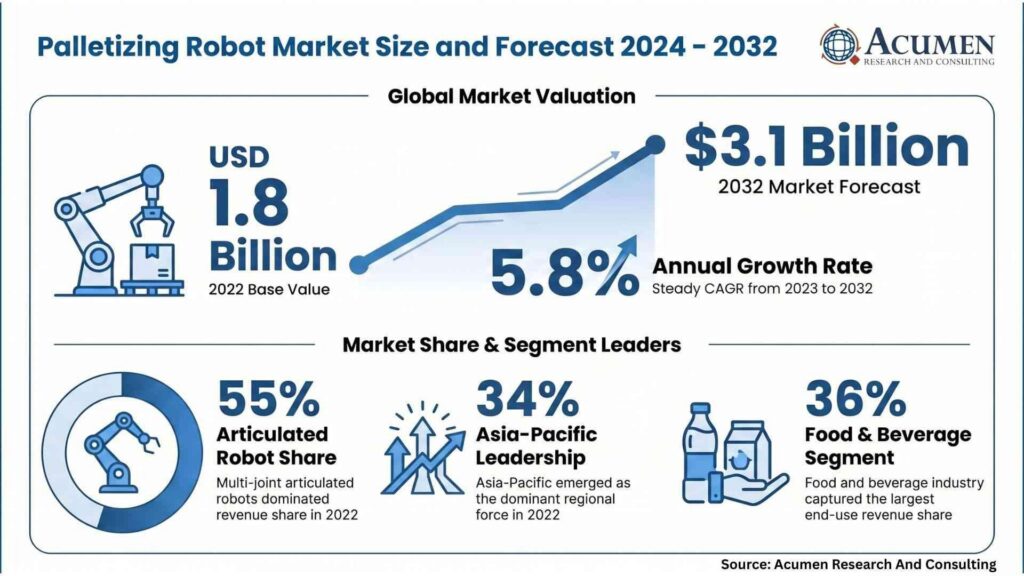
According to Acumen Research and Consulting, the Global Palletizing Robot Market was valued at USD 1.8 Billion in 2022 and is projected to reach USD 3.1 Billion by 2032, growing at a CAGR of 5.8% from 2023 to 2032.
Why the Palletizing Robot Market is Growing Rapidly
The rapid expansion of warehouse automation, e-commerce logistics, and smart manufacturing is driving strong demand for palletizing robots globally.
Palletizing robots automate repetitive material handling tasks such as:
- Stacking products onto pallets
- Packaging operations
- Warehouse sorting
- Product handling
- Logistics automation
- Distribution center operations
Industries are increasingly adopting robotic palletizing systems to enhance speed, precision, and workplace safety while reducing dependency on manual labor.
The growing labor shortage across warehousing and manufacturing sectors is also encouraging businesses to invest in robotic automation technologies.
Palletizing Robot Market Size & Forecast
The market outlook remains highly optimistic as automation becomes a strategic priority across industries worldwide.
Key Market Statistics
- Palletizing Robot Market Size in 2022: USD 1.8 Billion
- Palletizing Robot Market Forecast by 2032: USD 3.1 Billion
- Palletizing Robot Market CAGR (2023–2032): 5.8%
- Asia-Pacific Market Share (2022): Over 34%
- Europe Expected CAGR (2023–2032): Above 6.3%
- Articulated Robot Segment Share (2022): Over 55%
- Food & Beverage Segment Share (2022): More than 36%
The increasing demand for automation in logistics, manufacturing, pharmaceuticals, and food processing is expected to continue driving long-term market expansion.
Warehouse Automation Boom Fueling Palletizing Robot Market Demand
One of the primary growth drivers of the Palletizing Robot Market is the rapid rise of warehouse automation.
The explosive growth of e-commerce and omnichannel retailing has created massive pressure on logistics operators to improve order fulfillment speed and reduce operational inefficiencies.
Palletizing robots help warehouses achieve:
- Faster order processing
- Improved stacking accuracy
- Reduced product damage
- Enhanced inventory management
- Lower labor dependency
- 24/7 operational capability
As global online shopping volumes continue increasing, warehouse operators are investing heavily in robotic palletizing solutions to manage growing shipment volumes efficiently.
Articulated Robots Dominate the Market
Among robot types, articulated robots currently account for the largest share of the Palletizing Robot Market.
According to Acumen Research insights, the articulated robot segment captured over 55% of market revenue in 2022.
These robots are widely preferred because of their:
- High flexibility
- Wide range of motion
- Heavy payload capacity
- Precision handling
- Adaptability across industries
Articulated palletizing robots are commonly deployed in:
- Food & beverage manufacturing
- Automotive facilities
- Consumer goods packaging
- Pharmaceutical production
- Logistics centers
Their ability to handle complex palletizing operations makes them highly suitable for dynamic industrial environments.
Food & Beverage Industry Holds Major Market Share
The food and beverage sector accounted for more than 36% of the market share in 2022.
Food manufacturers increasingly rely on palletizing robots to improve:
- Hygiene standards
- Packaging efficiency
- Product handling accuracy
- Operational consistency
- Workplace safety
Automated palletizing systems are particularly important for food companies due to strict safety and sanitation requirements.
The growing global demand for packaged food, beverages, and ready-to-eat products is further strengthening the adoption of robotic palletizing technologies across the industry.
Asia-Pacific Leads the Global Palletizing Robot Market
Asia-Pacific currently dominates the global Palletizing Robot Market with more than 34% market share.
Countries driving regional growth include:
- China
- Japan
- South Korea
- India
- Taiwan
China remains one of the largest manufacturing and warehouse automation hubs globally, while Japan and South Korea continue leading industrial robotics innovation.
India is also witnessing growing adoption of palletizing robots due to:
- Expansion of manufacturing activities
- Increasing warehouse automation
- Growth of e-commerce logistics
- Rising labor costs
- Government manufacturing initiatives
The region’s expanding industrial ecosystem is expected to continue supporting market growth over the coming decade.
Europe Emerging as the Fastest Growing Region
Europe is projected to witness the fastest growth, recording a CAGR of over 6.3% during the forecast period.
Several factors are contributing to regional market expansion:
- Strong Industry 4.0 adoption
- Advanced manufacturing infrastructure
- Rising labor costs
- Focus on workplace safety
- Smart factory investments
European manufacturers are aggressively investing in automation technologies to maintain global competitiveness and improve operational efficiency.
The growing emphasis on sustainable and intelligent manufacturing is also accelerating robotic palletizing adoption across the region.
Technological Advancements Reshaping the Market
The Palletizing Robot Market is undergoing rapid technological transformation driven by AI, machine learning, and advanced robotics innovations.
Modern palletizing robots now feature:
- AI-powered vision systems
- Machine learning algorithms
- Smart sensors
- Collaborative robotics capabilities
- Real-time monitoring
- Predictive maintenance systems
These advancements enable robots to:
- Identify products accurately
- Adapt to changing workflows
- Handle mixed pallet configurations
- Operate safely alongside humans
- Improve packaging precision
The integration of intelligent automation technologies is significantly improving robotic efficiency and flexibility across industries.
Growing Focus on Workplace Safety Driving Adoption
Workplace safety is becoming a major priority for manufacturers and warehouse operators globally.
Manual palletizing tasks often involve:
- Heavy lifting
- Repetitive movements
- Workplace injuries
- Physical strain
- Human error risks
Palletizing robots help reduce occupational injuries while improving operational consistency and productivity.
The growing emphasis on worker safety regulations and ergonomic workplace standards is accelerating robotic automation investments across multiple industries.
Key Companies Operating in the Palletizing Robot Market
Several global robotics manufacturers are actively competing in the Palletizing Robot Market through technological innovation, strategic partnerships, and product expansion.
Major market players include:
- FANUC Corporation
- Kawasaki Robotics
- KUKA Robotics
- Yaskawa America Inc.
- Mitsubishi Heavy Industries
- Fuji Robotics Americas
- Krones AG
- Schneider Packaging Equipment Co. Inc.
- Concetti S.P.A.
These companies are focusing heavily on:
- AI-enabled robotics
- Collaborative palletizing systems
- Smart warehouse integration
- Energy-efficient robotics
- High-speed automation solutions
Recent Developments and Investments in the Industry
Rise of Collaborative Robots (Cobots)
Manufacturers are increasingly adopting collaborative robots capable of safely operating alongside human workers in warehouse and packaging environments.
AI-Powered Vision Systems
Advanced computer vision technologies are enabling robots to identify and handle diverse products with improved precision.
Expansion of Smart Warehouses
E-commerce and logistics companies are investing heavily in intelligent warehouse automation systems incorporating robotic palletizing technologies.
Increased R&D Investments
Robotics companies are significantly increasing investments in machine learning, AI, and sensor technologies to enhance robotic capabilities.
Future Trends Shaping the Palletizing Robot Market
Several emerging trends are expected to reshape the industry over the next decade.
Growth of E-Commerce Logistics
The expansion of global e-commerce will continue driving demand for automated warehouse solutions.
Adoption of Autonomous Warehouses
Fully automated warehouses utilizing robotics and AI are expected to become increasingly common.
AI-Integrated Robotics
Artificial intelligence will improve robotic decision-making, flexibility, and operational optimization.
Sustainability-Focused Automation
Energy-efficient robotic systems and optimized packaging operations will become key market priorities.
Expansion of Cobots
Collaborative palletizing robots are expected to witness strong adoption among small and medium-sized enterprises.
Challenges Impacting Market Growth
Despite strong growth potential, the industry faces several challenges:
- High initial investment costs
- Integration complexities
- Skilled workforce shortages
- Maintenance requirements
- Cybersecurity concerns
- Compatibility issues with legacy systems
However, declining robotic costs and continuous technological advancements are expected to mitigate these challenges over time.
Why Businesses Are Investing in the Palletizing Robot Market
The Palletizing Robot Market presents attractive long-term investment opportunities due to:
- Growing warehouse automation
- Rising labor shortages
- Increasing e-commerce demand
- Expansion of smart factories
- Improved operational efficiency
- Enhanced workplace safety
As industries increasingly prioritize automation and supply chain optimization, demand for robotic palletizing solutions is expected to rise significantly.
Businesses seeking detailed competitive intelligence and future market forecasts can request full sample pages of report here.
Frequently Asked Questions About the Palletizing Robot Market
What is the size of the Palletizing Robot Market?
The global Palletizing Robot Market was valued at USD 1.8 Billion in 2022 and is projected to reach USD 3.1 Billion by 2032, growing at a CAGR of 5.8% from 2023 to 2032.
What factors are driving the Palletizing Robot Market growth?
Major growth drivers include warehouse automation, rising e-commerce demand, labor shortages, workplace safety improvements, and increasing adoption of smart manufacturing technologies.
Which region dominates the Palletizing Robot Market?
Asia-Pacific currently dominates the market with more than 34% market share due to strong manufacturing and warehouse automation activities.
Which robot type holds the largest market share?
Articulated robots dominate the market, accounting for over 55% of revenue share in 2022.
Which end-use industry leads the market?
The food and beverage industry accounted for more than 36% of market revenue in 2022 due to rising automation and hygiene requirements.
Who are the leading companies in the Palletizing Robot Market?
Major players include FANUC Corporation, Kawasaki Robotics, KUKA Robotics, Yaskawa America Inc., and Krones AG.
What are the future trends in the Palletizing Robot Market?
Future trends include AI-powered robotics, collaborative robots, autonomous warehouses, smart manufacturing integration, and sustainable automation technologies.