
Printed Electronics Market Enters a New Era of Innovation, Flexibility, and Sustainable Manufacturing
According to Ameco Research, the Global Printed Electronics Market Size was valued at USD 11.2 Billion in 2022 and is projected to surpass USD 54.7 Billion by 2032, expanding at a robust CAGR of 17.6% between 2023 and 2032.
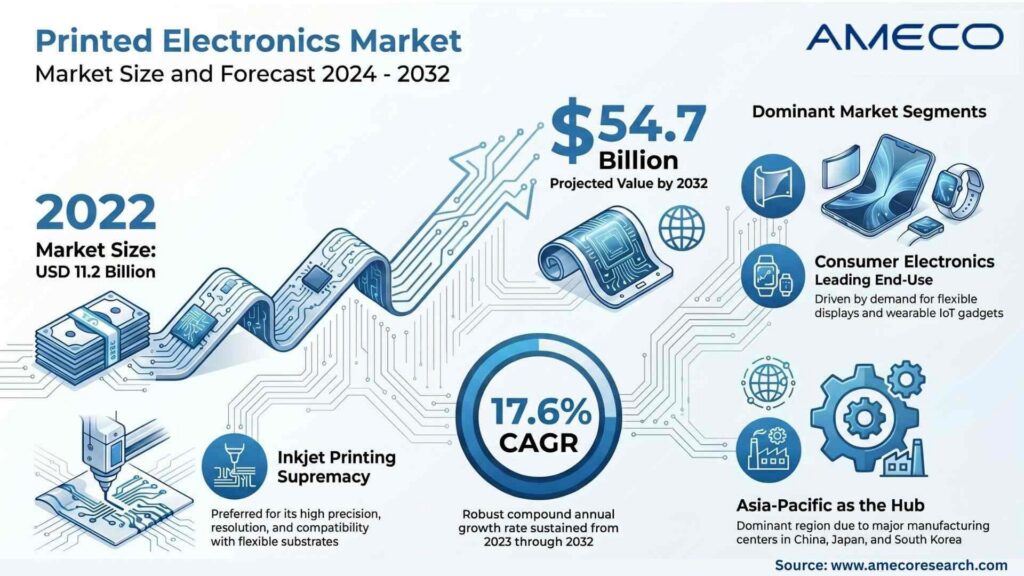
The accelerating adoption of Internet of Things (IoT) devices, flexible displays, advanced sensors, and eco-friendly manufacturing solutions is expected to fuel long-term Printed Electronics Market Growth globally.
The global Printed Electronics Market is rapidly emerging as one of the most transformative sectors within the electronics and semiconductor industry. As businesses accelerate toward flexible technologies, smart devices, connected ecosystems, and sustainable manufacturing, printed electronics are becoming the foundation for next-generation innovation.
From foldable smartphones and wearable health monitors to smart packaging and automotive sensors, printed electronics are reshaping how electronic devices are designed, manufactured, and integrated into daily life.
Why the Printed Electronics Market Is Gaining Global Momentum
Traditional electronics manufacturing methods often involve expensive, rigid, and resource-intensive production processes. Printed electronics, however, provide a more scalable and cost-efficient alternative by using additive printing technologies to create electronic circuits and components on flexible substrates such as plastic, paper, glass, and textiles.
This technological shift is unlocking new opportunities across industries.
Today’s consumers increasingly demand:
- Lightweight devices
- Flexible displays
- Smart wearable products
- Energy-efficient electronics
- Compact connected systems
Printed electronics meet these demands while reducing manufacturing complexity and material waste.
The technology also enables manufacturers to produce ultra-thin and bendable electronic devices that were previously impossible using conventional semiconductor fabrication methods.
As a result, the Printed Electronics Market is witnessing strong adoption across healthcare, automotive, aerospace, retail packaging, industrial automation, and consumer electronics sectors.
Rising IoT Ecosystem Accelerating Printed Electronics Market Growth
One of the strongest growth catalysts for the Printed Electronics Market is the rapid global expansion of IoT-enabled devices.
Smart sensors, RFID tags, NFC labels, flexible batteries, and printed antennas are becoming essential components in connected ecosystems. As industries digitize operations and embrace automation, demand for low-cost and scalable electronic components continues to rise.
Printed electronics technologies are increasingly used in:
- Smart homes
- Industrial IoT systems
- Logistics tracking
- Smart retail shelves
- Connected healthcare devices
- Intelligent transportation systems
The growing need for real-time data monitoring and wireless connectivity is creating massive opportunities for manufacturers operating in the Printed Electronics Market.
Ameco Research experts also believe that the transition toward 5G-enabled devices and edge computing infrastructure will further accelerate market expansion over the next decade.
Consumer Electronics Dominating Printed Electronics Market Share
Among all end-use sectors, consumer electronics currently account for the largest Printed Electronics Market Share.
The rising popularity of foldable smartphones, smartwatches, fitness bands, e-paper displays, and wearable electronics is driving strong demand for printed sensors, conductive inks, OLED displays, and flexible circuits.
Modern consumers prioritize portability, aesthetics, durability, and energy efficiency. Printed electronics provide manufacturers with greater design flexibility while reducing overall production costs.
Flexible display technologies are becoming especially important in premium smartphones and next-generation entertainment devices.
Leading technology companies are investing heavily in:
- Printed OLED displays
- Smart touch sensors
- Flexible printed batteries
- Printed photovoltaic systems
- Interactive packaging technologies
As innovation cycles shorten in the electronics industry, printed electronics are becoming critical for rapid prototyping and scalable production.
Case Study: Samsung’s Investment in Flexible Display Innovation
One of the strongest examples of Printed Electronics Market Trends influencing the global technology sector is Samsung’s aggressive investment in foldable and flexible display technologies.
Samsung Electronics has significantly expanded its research and commercialization efforts around OLED-based flexible displays used in foldable smartphones and wearable electronics.
The company’s Galaxy Fold and Galaxy Z series devices demonstrate how printed and flexible electronic technologies are transforming consumer electronics design.
Samsung’s innovations have helped accelerate broader industry adoption of:
- Printed conductive materials
- Flexible display substrates
- Bendable electronic circuits
- Lightweight electronic components
This development has encouraged multiple electronics manufacturers to increase investment in flexible electronic manufacturing ecosystems.
The success of flexible consumer devices is expected to remain a major contributor to overall Printed Electronics Market Growth during the forecast period.
Healthcare Industry Emerging as a High-Potential Revenue Generator
The healthcare sector is rapidly becoming one of the most promising application areas within the Printed Electronics Market.
Printed biosensors and wearable healthcare devices are revolutionizing patient monitoring, diagnostics, and personalized medicine.
Medical companies are increasingly adopting printed electronics for:
- Glucose monitoring patches
- Smart skin sensors
- Disposable diagnostics
- Remote patient monitoring systems
- Smart drug delivery devices
Flexible and skin-compatible electronic sensors allow real-time health monitoring without causing patient discomfort.
The growing adoption of telemedicine and remote healthcare services has further accelerated demand for wearable medical technologies.
Printed electronics also support cost-effective healthcare manufacturing, making advanced diagnostics more accessible in emerging economies.
As healthcare systems globally move toward preventive and personalized care, Printed Electronics Market Analysis suggests the healthcare segment will witness substantial growth throughout the next decade.
Sustainability Driving the Future of Printed Electronics
Environmental sustainability is becoming a critical factor influencing the future of the electronics industry.
Conventional electronics manufacturing generates significant material waste and consumes large amounts of energy. In contrast, printed electronics use additive manufacturing techniques that reduce waste while improving production efficiency.
This sustainability advantage is becoming a major differentiator in the Printed Electronics Market.
Printed electronics offer several environmental benefits:
- Lower energy consumption
- Reduced raw material usage
- Lightweight product manufacturing
- Recyclable substrate compatibility
- Lower carbon footprint
As governments and corporations strengthen ESG commitments, industries are increasingly adopting greener manufacturing technologies.
Smart packaging is another area benefiting from printed electronics innovation. Companies are integrating printed RFID and NFC technologies into packaging systems to improve supply chain visibility, reduce waste, and enhance customer engagement.
The increasing focus on sustainable manufacturing is expected to create long-term opportunities across the Printed Electronics Market.
Case Study: DuPont Advancing Conductive Ink Technologies
DuPont has emerged as a key innovator in the Printed Electronics Market through its advanced conductive ink technologies and flexible electronic materials.
The company has focused heavily on developing high-performance silver inks and printed conductive solutions for applications across automotive, healthcare, solar energy, and consumer electronics sectors.
DuPont’s conductive materials are widely used in:
- Flexible printed circuits
- Automotive touch sensors
- Medical diagnostic devices
- Smart wearable electronics
- Printed antennas
The company’s investments in advanced material science are helping improve conductivity, durability, and production scalability within printed electronic manufacturing.
Industry analysts believe such innovations are accelerating commercialization opportunities for flexible and printed electronic devices worldwide.
Asia-Pacific Leading Global Printed Electronics Market Expansion
Regionally, Asia-Pacific dominates the global Printed Electronics Market and is expected to maintain its leadership position throughout the forecast period.
Countries including China, Japan, South Korea, and India are emerging as major hubs for electronics manufacturing and flexible display innovation.
Several factors are driving regional growth:
- Strong semiconductor manufacturing infrastructure
- Rising demand for consumer electronics
- Government support for electronics production
- Expanding IoT ecosystem
- Increasing investments in R&D
China continues to lead in large-scale electronics production, while Japan and South Korea remain innovation leaders in flexible displays and advanced printing technologies.
India is also gaining traction due to increasing investments in electronics manufacturing and government initiatives promoting domestic semiconductor and electronics production.
Meanwhile, North America and Europe are witnessing increasing demand for printed electronics in healthcare, aerospace, and automotive applications.
Emerging Printed Electronics Market Trends Shaping the Future
The Printed Electronics Market is evolving rapidly with the emergence of several breakthrough technologies.
Flexible Hybrid Electronics (FHE)
Flexible hybrid electronics combine printed circuits with traditional semiconductor components, enabling thinner and smarter devices with enhanced functionality.
Printed Energy Storage Systems
Manufacturers are increasingly developing printed batteries and supercapacitors for wearable electronics and IoT devices.
Smart Packaging Solutions
Retailers and logistics companies are adopting printed RFID and NFC-enabled packaging systems for inventory tracking and consumer engagement.
Printed Photovoltaics
Flexible solar cells and lightweight photovoltaic materials are opening new opportunities in renewable energy applications.
Stretchable Electronics
Stretchable sensors and electronic skin technologies are gaining popularity in healthcare, robotics, and sports performance monitoring.
These advancements are expected to significantly influence future Printed Electronics Market Trends and investment strategies.
Competitive Landscape Becoming Increasingly Innovation-Driven
The global Printed Electronics Market is highly competitive, with companies focusing aggressively on innovation, partnerships, and product commercialization.
Key companies profiled in the Printed Electronics Market Report include:
- Samsung
- LG
- BASF
- DuPont
- Agfa-Gevaert
- Molex
- E Ink Holdings
- Novacentrix
- Nissha USA
- Ynvisible Interactive
Strategic collaborations between material providers, semiconductor companies, and electronics manufacturers are accelerating product development and market expansion.
Companies are also investing heavily in:
- Conductive inks
- Flexible displays
- Printed sensors
- Smart labels
- Advanced substrates
- Printed batteries
As commercialization scales globally, competition is expected to intensify across multiple application segments.
Future Outlook of the Printed Electronics Market
The future of the Printed Electronics Market appears exceptionally promising as industries continue embracing digital transformation, flexible electronics, and sustainable manufacturing technologies.
With strong momentum across healthcare, automotive, consumer electronics, and industrial automation sectors, printed electronics are expected to become an integral component of next-generation connected ecosystems.
According to the latest Printed Electronics Market Report published by Ameco Research, technological innovation, expanding IoT adoption, and rising demand for lightweight electronic solutions will continue driving long-term market expansion.
As global manufacturers race to develop smarter, thinner, and more energy-efficient products, printed electronics are poised to redefine the future of electronics manufacturing worldwide.